
vip@mingyuforklift.com
+86-0535-2090977

Introduction
Securing a load on an industrial forklift is not merely a matter of convenience—it is a fundamental safety imperative governed by federal regulations, engineering principles, and operational best practices. Improperly secured loads are a leading cause of forklift-related incidents, including tip-overs, struck-by injuries, and property damage. According to OSHA, approximately 85 deaths and 34,900 serious injuries occur annually in the United States due to forklift accidents, many of which are directly attributable to load handling failures.
This article provides a comprehensive technical examination of the requirements for securing loads on industrial forklifts, covering regulatory mandates, the physics of load stability, pre-operational verification procedures, physical securing techniques, and transport protocols. Understanding these requirements is essential not only for compliance but for the prevention of catastrophic workplace incidents.
Regulatory Framework
OSHA Standard 29 CFR 1910.178
The primary regulatory authority governing forklift load security in the United States is OSHA's 29 CFR 1910.178, the Powered Industrial Trucks standard. While the regulation does not prescribe a single universal method for securing every load, it establishes foundational requirements that operators and employers must follow:
Capacity Compliance: Operators must never exceed the forklift's rated capacity as displayed on the data plate.
Load Backrest: The standard mandates that "where necessary to protect the operator, forklift trucks shall be fitted with a vertical load backrest extension to prevent the load from hitting the mast when the mast is positioned at maximum backward tilt."
Overhead Guard: High-lift rider trucks must be equipped with an overhead guard manufactured in accordance with ANSI B56.1 to protect against falling objects.
Pre-Operational Inspection: Forklifts must be examined before being placed in service, and shall not be operated if any condition adversely affects safety.
ANSI/ITSDF B56.1 Compliance
All forklift data plates must include a designation of compliance with ANSI/ITSDF B56.1, the "Safety Standard for Low and High Lift Trucks." This standard provides the engineering basis for load capacity calculations, stability testing, and structural requirements for safety features like overhead guards and load backrests.
Understanding the Physics of Load Stability
The Stability Triangle
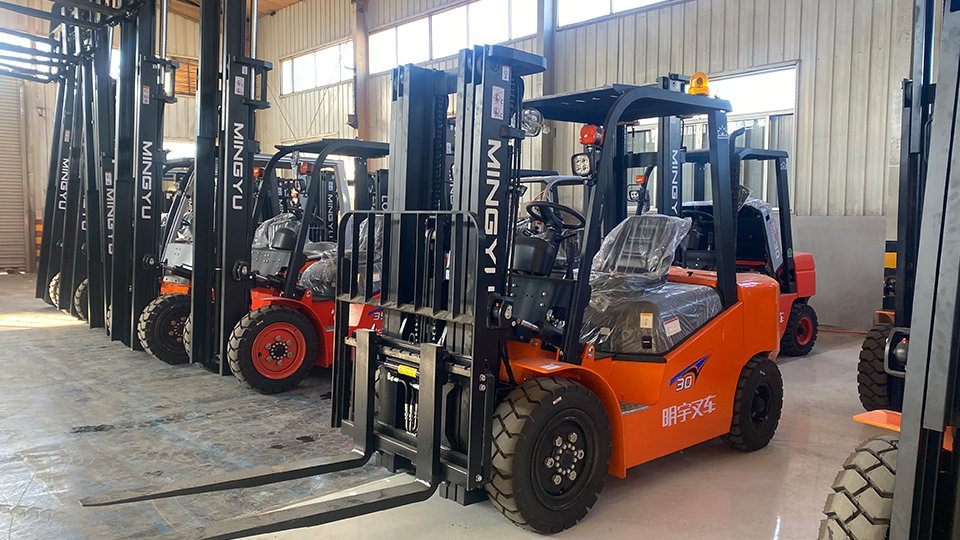
The foundation of load security lies in understanding the stability triangle—the triangular area formed by the two front wheel contact points and the pivot point at the center of the rear axle. For a forklift to remain stable, the combined center of gravity of the truck and load must remain within this triangle.
When a load is lifted, the combined center of gravity shifts forward. If it moves beyond the front edge of the stability triangle, the forklift will tip forward. Several factors influence this shift:
Load height: Higher elevations raise the center of gravity, reducing stability
Load center distance: The horizontal distance from the front face of the forks to the load's center of gravity
Mast tilt angle: Forward tilt moves the center of gravity forward; backward tilt moves it rearward
Travel speed and turning: Centrifugal force during turns shifts the center of gravity laterally
Load Center and Rated Capacity
The load center is defined as the distance from the vertical face of the forks to the center of gravity of the load. Most forklifts are rated with a standard 24-inch load center. The rated capacity decreases as the load center increases—a critical relationship that operators must understand.
For example, a forklift rated for 5,000 lbs at a 24-inch load center may only safely lift 3,500 lbs if the load center extends to 36 inches. This derating is not optional; it is an engineering necessity encoded in the capacity chart on the data plate.
Pre-Operational Load Verification
Data Plate Verification
Before handling any load, operators must verify the forklift's capabilities against the data plate (also called a nameplate or capacity plate). OSHA requires that this plate be present, legible, and accurate. Key information includes:
表格
Data Plate Element Purpose
Model & Serial Number Identifies the specific truck for parts and service
Truck Weight Needed for floor loading calculations and transport
Load Capacity Maximum weight at specified load center and lift height
Load Center Standard distance (typically 24") for rated capacity
Maximum Lift Height Highest safe elevation for rated capacity
Attachments Any installed attachments and their capacity deratings
Tilt Angles Maximum forward and backward tilt specifications
Mast Type Determines lift height and capacity characteristics
Operating a forklift with a damaged or missing data plate is a violation of 29 CFR 1910.178(a)(3) and creates significant liability exposure.
Load Assessment
Before lifting, operators must conduct a thorough assessment of the load itself:
Weight Verification: Confirm the load weight does not exceed the rated capacity at the actual load center. When in doubt, use a scale.
Center of Gravity Determination: Identify the load's center of gravity based on its shape, weight distribution, and packaging. Irregular or asymmetrical loads require extra caution.
Packaging Integrity: Inspect for damaged pallets, broken shrink wrap, or compromised strapping. Damaged packaging must be repaired or replaced before lifting.
Load Dimensions: Measure the load to ensure it can be safely maneuvered within aisle widths, door clearances, and rack configurations.
Physical Load Securing Requirements
Fork Positioning and Engagement
Proper fork positioning is the first line of defense in load security:
Width Adjustment: Adjust fork spacing to match the pallet width, ensuring symmetric distribution on both sides of the load's center of gravity.
Full Insertion: Insert forks fully into the pallet slots or under the load's stable support points. Partial insertion creates an unstable lifting platform and risks pallet failure.
Level Entry: Approach the load at a right angle with forks level. Angled entry can cause uneven lifting and load shift.
Even Distribution: Ensure both forks bear equal weight. Uneven distribution shifts the center of gravity laterally, increasing side-tip risk.
Mast Tilt Control
Mast tilt is a critical control for load security during both lifting and transport:
Lifting Phase: Tilt the mast slightly backward after the load clears the ground to shift the center of gravity rearward, closer to the forklift body. This prevents forward tip and keeps the load stable.
Transport Phase: Maintain backward tilt throughout travel to keep the load against the carriage. However, avoid excessive tilt that could compromise balance or visibility.
Placement Phase: Use forward tilt only when positioning the load at its destination, and only when the forklift is stationary and stable.
OSHA explicitly recommends tilting the mast back when carrying a load to ensure the load is positioned over the front wheels for optimal stability.
Load Backrest Utilization
The load backrest extension is a vertical device extending from the fork carriage frame that prevents raised loads from falling backward toward the operator. OSHA mandates this feature "where necessary to protect the operator."
Key requirements for load backrests include:
Structural Integrity: The backrest must be secure, unbent, and uncracked. Any damage requires immediate repair or replacement.
Height Adequacy: The backrest must extend sufficiently above the top of the load to prevent rearward displacement during backward tilt or sudden stops.
No Modifications: Never remove or modify the load backrest, as this compromises operator protection and violates OSHA standards.
Securing Methods for Unstable or Irregular Loads
Standard palletized loads with intact shrink wrap generally remain stable when properly forked and tilted back. However, certain loads require additional securing measures:
Stretch Wrap and Banding
Loads should be unitized with stretch film or banding before forklift handling
Ensure wrap tension is adequate and film is not torn or compromised
For heavy or irregular items, use reinforced strapping with adequate Working Load Limit (WLL)
Load Securing Straps
Select straps with a WLL matching the cargo weight
Total WLL of all straps should be at least 50% of cargo weight
Use edge protectors to prevent strap cutting into cargo
Never overtighten with power tools; use manual force only
Specialized Attachments
Fork extensions: For oversized loads, but must be rated and accounted for in capacity calculations
Bale clamps, carton clamps, or push-pull attachments: For unit loads without pallets
Drum handlers, carpet poles, or boom attachments: For specific cargo types
All attachments require manufacturer approval and updated data plate information
Overhead Guard Considerations
While the overhead guard protects against falling objects, operators must understand its limitations:
Not a Load Restraint: The overhead guard is not designed to withstand the impact of a full-capacity load falling from height. It protects against small packages, boxes, and bagged material—not massive load drops.
Structural Inspection: Daily inspections must verify the overhead guard has no broken welds, missing bolts, or other damage.
Removal Restrictions: An overhead guard may only be removed when it would prevent the truck from entering a workspace, and only if the operator is not exposed to low overhead obstructions.
Transport Protocols for Secured Loads
Height Requirements
One of the most critical—and frequently violated—requirements is maintaining proper load height during transport:
Keep Loads Low: During transport, the cargo should always be kept at a low height—typically 4 to 6 inches off the ground. This lowers the center of gravity and maximizes stability.
Never Travel with Elevated Loads: Driving with a raised load shifts the center of gravity upward and forward, dramatically increasing tip-over risk, especially during turns or on uneven surfaces.
Temporary Elevation: Loads may be raised temporarily to clear obstacles, but must be lowered immediately afterward.
Speed and Maneuvering
Reduced Speed: Travel at safe speeds, with significant reduction when turning or traversing uneven surfaces. Centrifugal force during turns can shift the combined center of gravity outside the stability triangle.
Wide Turns: Increase turning radius to minimize lateral force on the load.
Horn Signals: Sound the horn at intersections, blind corners, and when approaching pedestrians.
Three-Foot Rule: Maintain at least a 3-foot safe distance from people, equipment, and racking.
Ramp and Incline Procedures
Operating on ramps introduces unique stability challenges:
Loaded Ascent: Drive forward up ramps with the load in front to keep the heavy end uphill.
Loaded Descent: Drive in reverse down ramps with the load behind to prevent forward tip.
No Turning on Inclines: Never turn on a ramp or incline, as this combines gravitational and centrifugal forces in ways that easily destabilize the forklift.
Visibility Management
When loads obstruct forward visibility:
Reverse Driving: Travel in reverse to maintain visibility of the travel path.
Spotter Assignment: Use a trained spotter to guide movements when visibility is limited or when navigating tight spaces.
Mirror Use: Ensure all mirrors are clean, properly adjusted, and used consistently.
Special Load Securing Scenarios
High or Unstable Loads
When a load is too high or inherently unstable:
Stop immediately and assess the situation
Tilt the mast backward to maintain stability
Lower the cargo to a safe height
Reinforce securing with additional straps or wrap
Split the load into smaller, more manageable units if necessary
Irregularly Shaped Loads
Loads that are not uniformly shaped or packaged require special attention:
Use appropriate attachments designed for the specific cargo type
Ensure the center of gravity is identified and aligned with the forklift's centerline
Consider using slings or chains with proper rigging techniques
Never attempt to lift loads that cannot be adequately stabilized
Double-Stacked or Mixed Loads
When handling multiple items or stacked pallets:
Place heavier items on the bottom
Distribute weight evenly from side to side
Ensure the combined center of gravity remains within the stability triangle
Do not exceed the rated capacity for the actual load center of the combined unit
Documentation and Compliance Verification
Daily Pre-Shift Inspections
OSHA requires daily inspections before placing a forklift in service. The inspection must verify:
Forks and Carriage: No cracks, bends, or excessive wear at the heel; retaining pins secure
Mast and Hydraulics: Chains properly lubricated and tensioned; no leaking hoses
Overhead Guard and Backrest: Structural integrity confirmed; no broken welds or missing bolts
Data Plate: Legible and present; matches current configuration
Tires: Proper inflation (pneumatic) or no chunking/flat spots (solid)
Operational Tests: Lift, lower, tilt, brakes, steering, horn, and lights all functional
Any forklift found to have defects affecting safety must be immediately removed from service and tagged out until repairs are completed.
Recordkeeping
While OSHA does not technically mandate retention of daily inspection records, industry best practice—and legal defensibility—requires maintaining documentation for at least three years. Digital inspection systems that tie checks to operator IDs, store photo evidence, and can lock out unsafe equipment provide superior compliance assurance.
Conclusion
Securing a load on an industrial forklift is a multi-faceted discipline that integrates regulatory compliance, engineering physics, equipment integrity, and operator skill. The requirements are not arbitrary rules but rather derived from the fundamental need to keep the combined center of gravity within the stability triangle while protecting both the operator and surrounding personnel.
Key requirements include: verifying capacity against the data plate before every lift; positioning forks fully and evenly under the load; utilizing mast tilt to stabilize the center of gravity; maintaining load backrest integrity; keeping loads low during transport; and conducting thorough pre-shift inspections. For irregular, oversized, or unstable loads, additional securing measures such as strapping, specialized attachments, or load splitting may be necessary.
Organizations that treat load securing as a checkbox exercise rather than a core safety discipline expose themselves to regulatory penalties, equipment damage, and—most critically—preventable injuries and fatalities. Under the 2026 OSHA penalty schedule, serious violations cost $15,625 per instance, while willful or repeated failures reach $156,259. These financial consequences, however, pale in comparison to the human cost of a load-related forklift accident. Comprehensive training, rigorous inspection protocols, and unwavering adherence to load securing requirements are not merely compliance obligations—they are essential components of a mature safety culture.
Name: selena
Mobile:+86-13176910558
Tel:+86-0535-2090977
Whatsapp:8613181602336
Email:vip@mingyuforklift.com
Add:Xiaqiu Town, Laizhou, Yantai City, Shandong Province, China
