
vip@mingyuforklift.com
+86-0535-2090977

I. Introduction
Hook: Why "burn rate" is the metric that separates profitable fleets from bleeding ones
Direct answer: 2.5–6.5 liters per engine hour for most applications, with heavy-duty units exceeding 8 L/h
Define "burn rate" precisely: fuel volume consumed per engine running hour (not clock hour)
Preview: how to measure it, what skews it, and how to benchmark your own fleet
II. What "Hourly Burn Rate" Actually Means
Engine hour meter vs. clock time: why they diverge
The difference between "operating burn rate" and "average burn rate including idle"
Why manufacturers quote "weighted average" figures that confuse buyers
Key formula: Burn Rate (L/h) = Total Fuel Dispensed (L) ÷ Engine Hours Elapsed
III. Manufacturer Burn Rate Specifications Decoded
Standardized test cycles (VDI 2198, ISO 2330) and their limitations
How OEMs derive their "typical consumption" figures
Why spec-sheet numbers are usually 20–30% optimistic
Burn rate ranges by forklift class:
Light-duty (1.5–2.5t): 2.0–3.0 L/h
Medium-duty (2.5–5.0t): 3.0–4.5 L/h
Heavy-duty (5.0–10.0t): 4.5–7.0 L/h
Rough-terrain / container handlers: 7.0–12.0 L/h
IV. The Six Levers That Move Your Actual Burn Rate
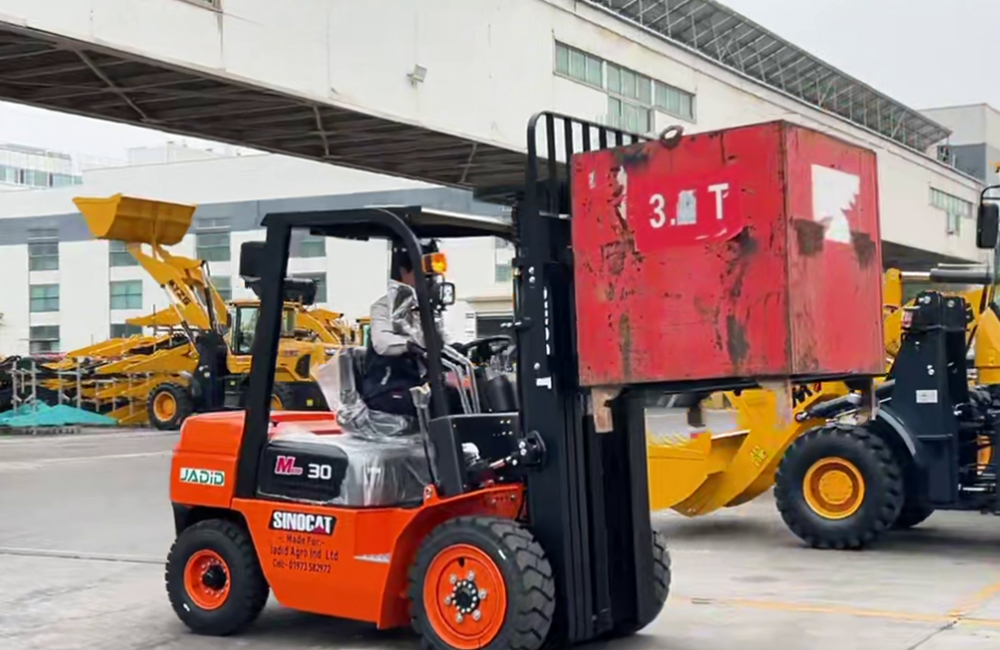
A. Load Factor
Empty travel vs. rated-load hydraulics: up to 40% difference
High-cycle operations (cross-docking) vs. long-transport yards
B. Idle Time
Idle burn rate: 0.8–1.5 L/h with zero productivity
The compound effect: a 30% idle fleet operates at 130% fuel cost per productive hour
C. Terrain & Environment
Grades: 5% slope = +15% burn; 10% slope = +35%
Cold-start fuel enrichment and extended warm-up
Dusty environments choking air intake
D. Hydraulic Demand
Mast lift speed settings
Attachment duty cycles (paper clamps, push-pulls, rotators)
Load-sensing vs. constant-flow pump efficiency
E. Engine & Emissions Tier
Tier III mechanical injection vs. Tier IV common-rail efficiency
DPF active regeneration: hidden fuel penalty of 2–5%
Engine de-rating in high-altitude operations
F. Operator Technique
Throttle aggression mapping
Pre-shift warm-up habits
Use of inching pedals vs. brake-and-throttle overlap
V. How to Measure Burn Rate Accurately in Your Operation
A. The Manual Tank-Top Method
Procedure, frequency, and common measurement errors
Converting partial-fill data to reliable L/h
B. Onboard Fuel Flow Metering
Positive-displacement flow meters vs. ultrasonic sensors
CAN-bus integration and telematics dashboards
Real-time vs. logged data granularity
C. The "Normalized Burn Rate" Approach
Adjusting for temperature, load factor, and duty cycle
Creating an operational baseline for your specific fleet
Spotting anomalies: when burn rate spikes signal mechanical problems
VI. Burn Rate Economics: From Liters to Ledger
A. Calculating Hourly Fuel Cost
Regional diesel price volatility
The "fuel cost per pallet moved" metric
B. The Hidden Burn
Engine oil consumption as a secondary fuel-adjacent cost
DPF ash accumulation and service intervals tied to fuel throughput
Cooling system load and seasonal variance
C. Burn Rate as a Fleet Replacement Trigger
When rising burn rate indicates end-of-engine-life
Comparing rehab cost vs. replacement based on fuel efficiency degradation
VII. Reducing Burn Rate: Engineering and Operational Tactics
A. Low-Hanging Fruit
Anti-idling policies and auto-shutoff timers (target: <10% idle time)
Proper tire inflation and alignment
Air filter monitoring and scheduled replacement
B. Technology Interventions
Engine auto-stop/start systems
Variable-displacement hydraulic pumps
Telematics-driven operator scorecards
C. Fleet Right-Sizing
Matching forklift capacity to actual load (oversized = over-fueled)
When electric or LPG alternatives beat diesel on burn-rate economics
VIII. Real-World Burn Rate Profiles
A. Indoor Warehouse, Single-Shift
2.5t counterbalance, light duty: 2.4 L/h
B. Outdoor Lumber Yard, Multi-Shift
5.0t rough-terrain, severe duty: 5.8 L/h
C. Cold-Storage Distribution
3.0t with heated cab: 3.6 L/h (vs. 2.9 L/h ambient)
D. Port Container Handling
16t heavy-duty forklift: 9.5 L/h
IX. Conclusion
Recap: Burn rate is not a fixed property of the forklift—it is a function of your operation
The 20% rule: most fleets can reduce burn rate by 15–20% through measurement and behavior change alone
Final thought: In an era of fuel price volatility and emissions scrutiny, knowing your exact burn rate is no longer optional fleet hygiene—it is competitive intelligence
Name: selena
Mobile:+86-13176910558
Tel:+86-0535-2090977
Whatsapp:8613181602336
Email:vip@mingyuforklift.com
Add:Xiaqiu Town, Laizhou, Yantai City, Shandong Province, China
