
vip@mingyuforklift.com
+86-0535-2090977

The CPC40 diesel forklift can support demanding outdoor and industrial handling, yet safe productivity depends on how the site separates people from moving equipment. This 2026 guide turns pedestrian protection into a practical yard traffic-plan process centered on physical layout and controlled crossings.
Current industry guidance continues to place pedestrian and vehicle separation at the center of forklift risk control. A CPC40 can work effectively in yards and factories, but signs and alarms alone cannot compensate for a route that repeatedly mixes people with moving equipment. The strongest plan begins with layout, access and physical boundaries, then adds procedures, visibility and supervision.
For every CPC40 traffic-plan review, ZGFORKLIFT and MYZG recommend following the equipment manual, site risk assessment, applicable law and competent safety advice. Physical separation should lead, while procedures and technology reinforce verified controls.
Observe truck arrivals, CPC40 travel, pedestrian journeys, contractors, visitors and shift changes. Mark pickup points, parking, refueling, doors, time clocks, offices and amenities. Include temporary shortcuts and queue locations rather than drawing only the intended route. A useful map describes how the site actually behaves during normal, peak and abnormal conditions.
For every CPC40 traffic-plan review, ZGFORKLIFT and MYZG recommend following the equipment manual, site risk assessment, applicable law and competent safety advice. Physical separation should lead, while procedures and technology reinforce verified controls.
Provide distinct pedestrian and vehicle paths with fixed barriers where site conditions allow. Separate entrances can prevent people from stepping directly into a truck lane. Barriers must be suitable for the assessed risk, correctly installed and maintained. Painted lines support a system, but they do not offer the same protection as a well-designed physical boundary.
For every CPC40 traffic-plan review, ZGFORKLIFT and MYZG recommend following the equipment manual, site risk assessment, applicable law and competent safety advice. Physical separation should lead, while procedures and technology reinforce verified controls.
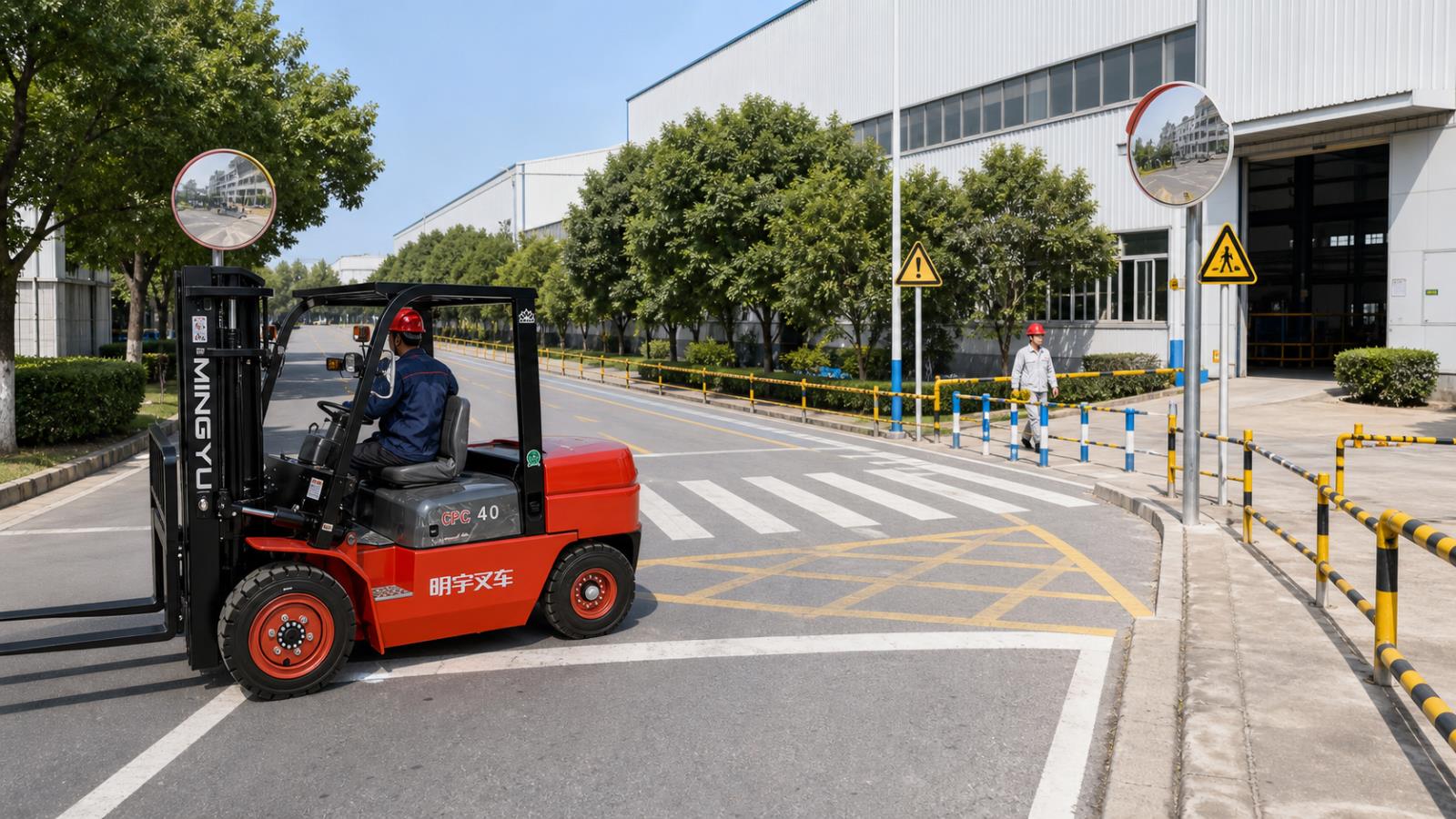
Related product: CPC40 Diesel Forklift - view specifications and request application support.
Where a crossing cannot be eliminated, keep the number of crossings low and place them where visibility is strong. Use gates, stop positions, lighting and clear priority rules suited to local requirements. Avoid putting a crossing immediately beside a blind doorway or loading point. The route should guide people naturally rather than depend on everyone resisting a convenient shortcut.
For every CPC40 traffic-plan review, ZGFORKLIFT and MYZG recommend following the equipment manual, site risk assessment, applicable law and competent safety advice. Physical separation should lead, while procedures and technology reinforce verified controls.
Mirrors, warning devices and horns can assist awareness, but they should not be the only controls. Remove visual obstructions, improve lighting, slow the approach and relocate stored material. Establish a safe stop-and-check process where required. A CPC40 operator must retain a clear view of travel or use an approved alternative such as a trained spotter under site rules.
For every CPC40 traffic-plan review, ZGFORKLIFT and MYZG recommend following the equipment manual, site risk assessment, applicable law and competent safety advice. Physical separation should lead, while procedures and technology reinforce verified controls.
Truck drivers, loaders and pedestrians often converge around docks. Create a protected driver waiting area and define who may enter the operating zone. Secure vehicles according to site procedure and coordinate communication before the CPC40 approaches. People should never stand where a load, trailer movement or rear swing could reach them.
For every CPC40 traffic-plan review, ZGFORKLIFT and MYZG recommend following the equipment manual, site risk assessment, applicable law and competent safety advice. Physical separation should lead, while procedures and technology reinforce verified controls.
A counterbalance forklift turns around its front axle and the rear can sweep outward. Marking only the fork path misses this hazard. Route widths, barriers and waiting positions should consider the complete machine envelope, load and attachment. Travel speed must allow controlled stopping for the surface, visibility, load and pedestrian conditions; a forklift is not expected to stop like a person.
For every CPC40 traffic-plan review, ZGFORKLIFT and MYZG recommend following the equipment manual, site risk assessment, applicable law and competent safety advice. Physical separation should lead, while procedures and technology reinforce verified controls.
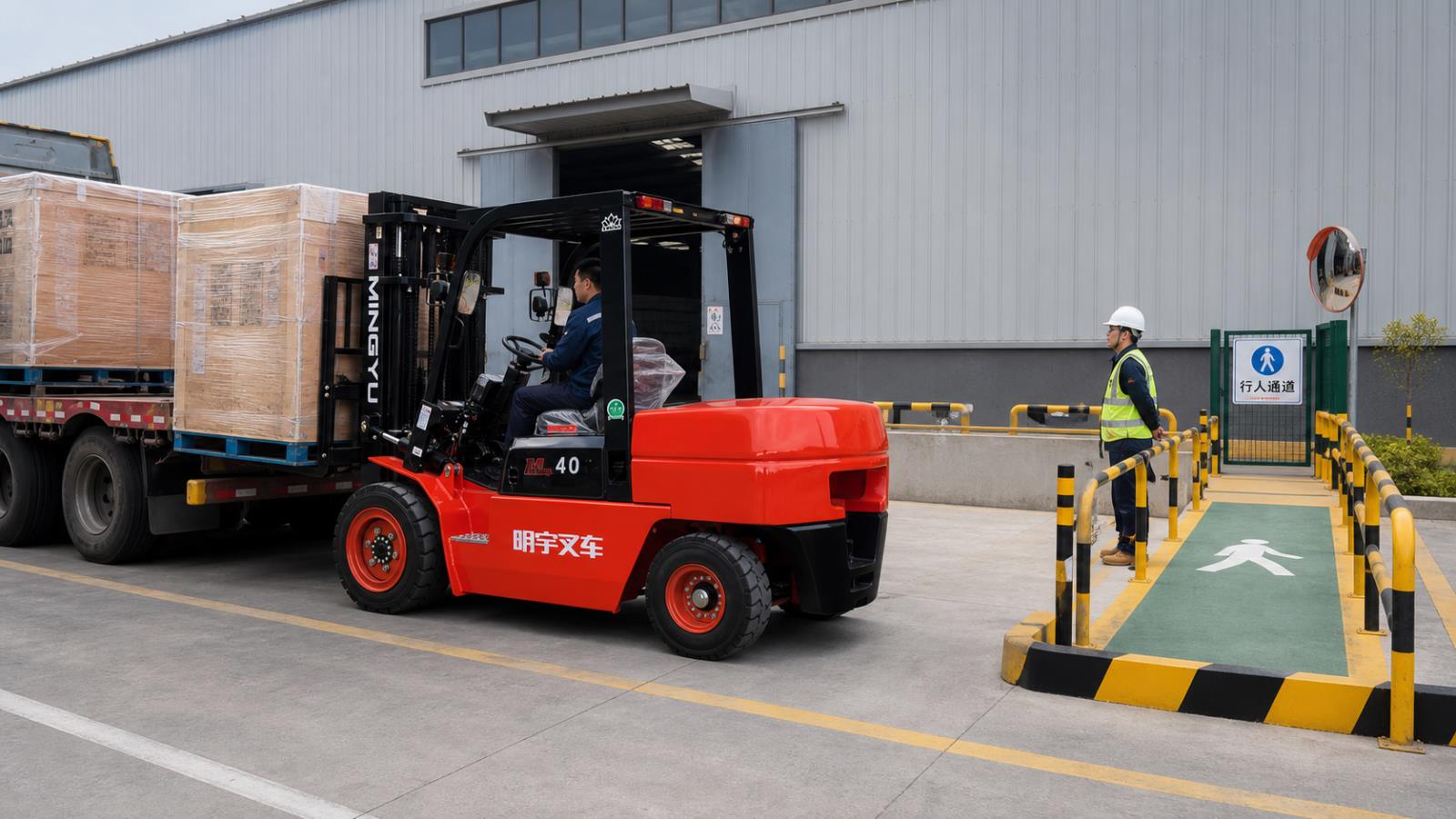
Related product: CPC15 Diesel Forklift - view specifications and request application support.
Pedestrian density increases at entrances, break rooms, offices, parking and clock-in areas. Keep vehicle routes away from these points where practicable. Use protected walkways, offset gates and barriers so a person cannot step directly into the CPC40 path. Review arrangements at shift change, when routine traffic volume may differ sharply from mid-shift conditions.
For every CPC40 traffic-plan review, ZGFORKLIFT and MYZG recommend following the equipment manual, site risk assessment, applicable law and competent safety advice. Physical separation should lead, while procedures and technology reinforce verified controls.
Cameras, projected lights, proximity alerts and location systems may strengthen awareness after the fundamental traffic plan is established. Validate detection zones, nuisance alarms, coverage and operator response in the real environment. Technology must not encourage pedestrians to enter a vehicle lane or create confidence beyond its tested capability. Follow manufacturer instructions and local requirements.
For every CPC40 traffic-plan review, ZGFORKLIFT and MYZG recommend following the equipment manual, site risk assessment, applicable law and competent safety advice. Physical separation should lead, while procedures and technology reinforce verified controls.
A spotter can assist when visibility is restricted, but the task needs a defined safe position, signals, communication and stop rule. The operator should stop if visual or agreed communication is lost. A spotter must never stand between the forklift, load, trailer, wall or other fixed object. Spotting should not become a permanent substitute for correcting a poor layout.
For every CPC40 traffic-plan review, ZGFORKLIFT and MYZG recommend following the equipment manual, site risk assessment, applicable law and competent safety advice. Physical separation should lead, while procedures and technology reinforce verified controls.
People unfamiliar with the yard may not recognize rear swing, load hazards or route priority. Control access, provide relevant induction and escort where required. Delivery drivers need a safe waiting location and clear instruction before leaving the cab. Signage should be understandable, but supervision and physical route design remain important when language, noise or unfamiliarity affects communication.
For every CPC40 traffic-plan review, ZGFORKLIFT and MYZG recommend following the equipment manual, site risk assessment, applicable law and competent safety advice. Physical separation should lead, while procedures and technology reinforce verified controls.
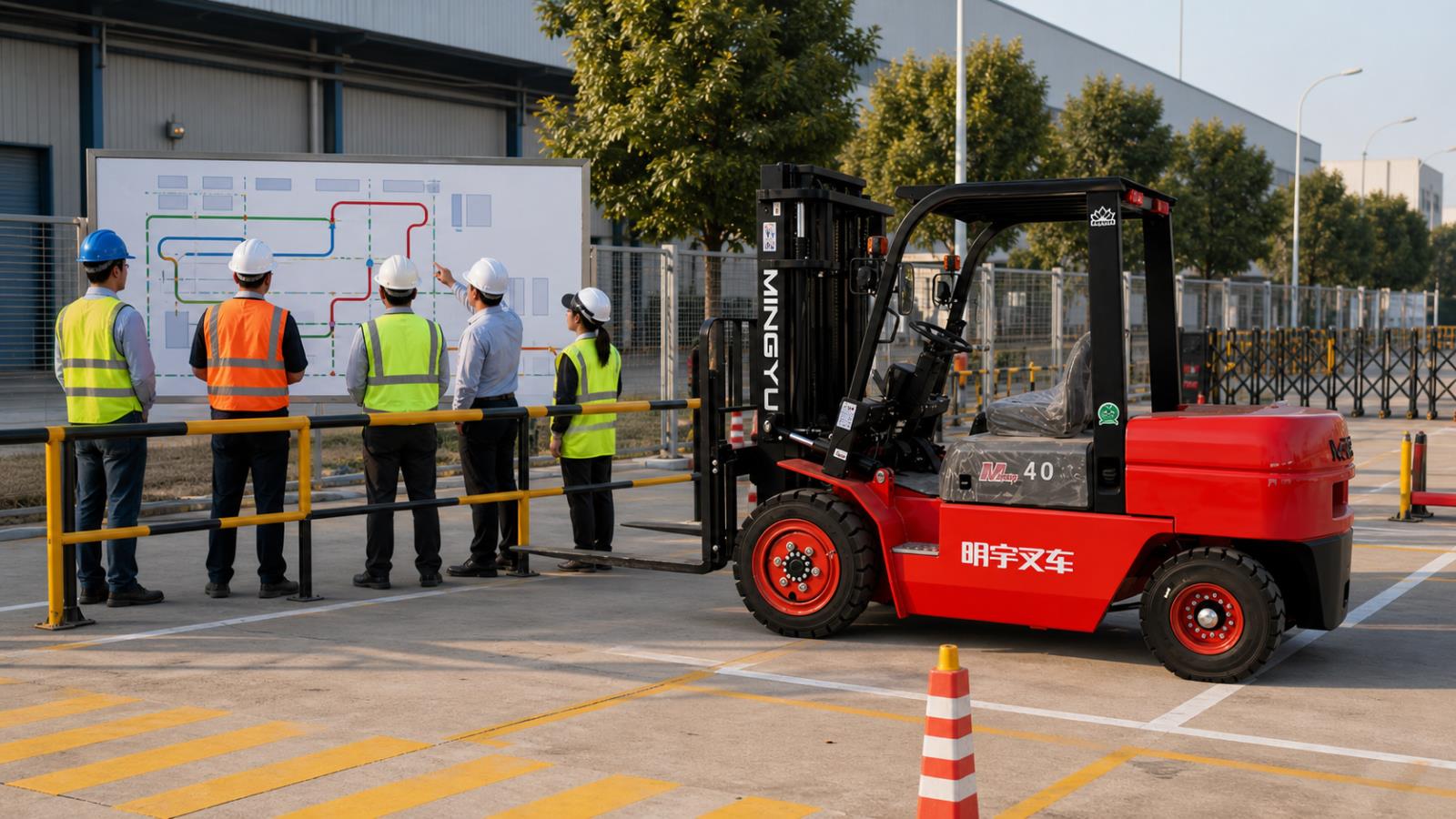
Related product: CPC20 Diesel Forklift - view specifications and request application support.
Check barriers, gates, mirrors, markings, lights, signs and surface condition on a defined schedule. Repair damage and remove stored goods that narrow routes or block sightlines. Review parked vehicles and vegetation as possible visual obstructions. A plan shown on a wall is not effective if daily conditions quietly remove its protective features.
For every CPC40 traffic-plan review, ZGFORKLIFT and MYZG recommend following the equipment manual, site risk assessment, applicable law and competent safety advice. Physical separation should lead, while procedures and technology reinforce verified controls.
Reassess the plan when layouts, products, shifts, attachments, staffing or vehicle types change. Investigate near misses and reports for system lessons instead of waiting for injury. Consult affected workers as required and test revised routes before full operation. Preserve evidence and confirm that a new control does not transfer risk to another crossing or work group.
For every CPC40 traffic-plan review, ZGFORKLIFT and MYZG recommend following the equipment manual, site risk assessment, applicable law and competent safety advice. Physical separation should lead, while procedures and technology reinforce verified controls.
Assign ownership for mapping, inspection, corrective action, training and approval. Shandong Zhuogong Machinery equipment Co.,Ltd supports ZGFORKLIFT and MYZG users with CPC40 application discussions, while site owners remain responsible for traffic management, operator authorization, maintenance and legal compliance. A cycle of observe, separate, control, inspect and review keeps the plan aligned with real operations.
For every CPC40 traffic-plan review, ZGFORKLIFT and MYZG recommend following the equipment manual, site risk assessment, applicable law and competent safety advice. Physical separation should lead, while procedures and technology reinforce verified controls.
Shandong Zhuogong Machinery equipment Co.,Ltd
Website: https://www.vavforklift.com/
Email: vip@mingyuforklift.com
Tel: +86-0535-2090977
WhatsApp: +86 131 8160 2336
Address: Xiaqiu Town, Laizhou, Yantai City, Shandong Province, China.
Name: selena
Mobile:+86-13176910558
Tel:+86-0535-2090977
Whatsapp:8613181602336
Email:vip@mingyuforklift.com
Add:Xiaqiu Town, Laizhou, Yantai City, Shandong Province, China
