
vip@mingyuforklift.com
+86-0535-2090977

Forklift safety is moving from reactive incident reports to predictive, connected decision-making in 2026. One of the most useful developments is the near-miss heatmap: a visual record showing where vehicle alerts, harsh braking, impacts, pedestrian conflicts or repeated route deviations occur. Instead of waiting for an injury or damaged rack to expose a weak point, a warehouse can use event patterns to redesign the layout and operating method.
For facilities using a 3T LPG forklift, the topic is especially relevant. A three-ton counterbalance truck may serve receiving, manufacturing supply, finished-goods staging and indoor-to-outdoor transfer. Its size, load and operating energy mean that route design, stopping distance, visibility and pedestrian separation need evidence-based control. This ZGFORKLIFT / MYZG guide explains how Shandong Zhuogong Machinery equipment Co.,Ltd customers can combine a correctly selected truck, disciplined operating rules and carefully governed event data.
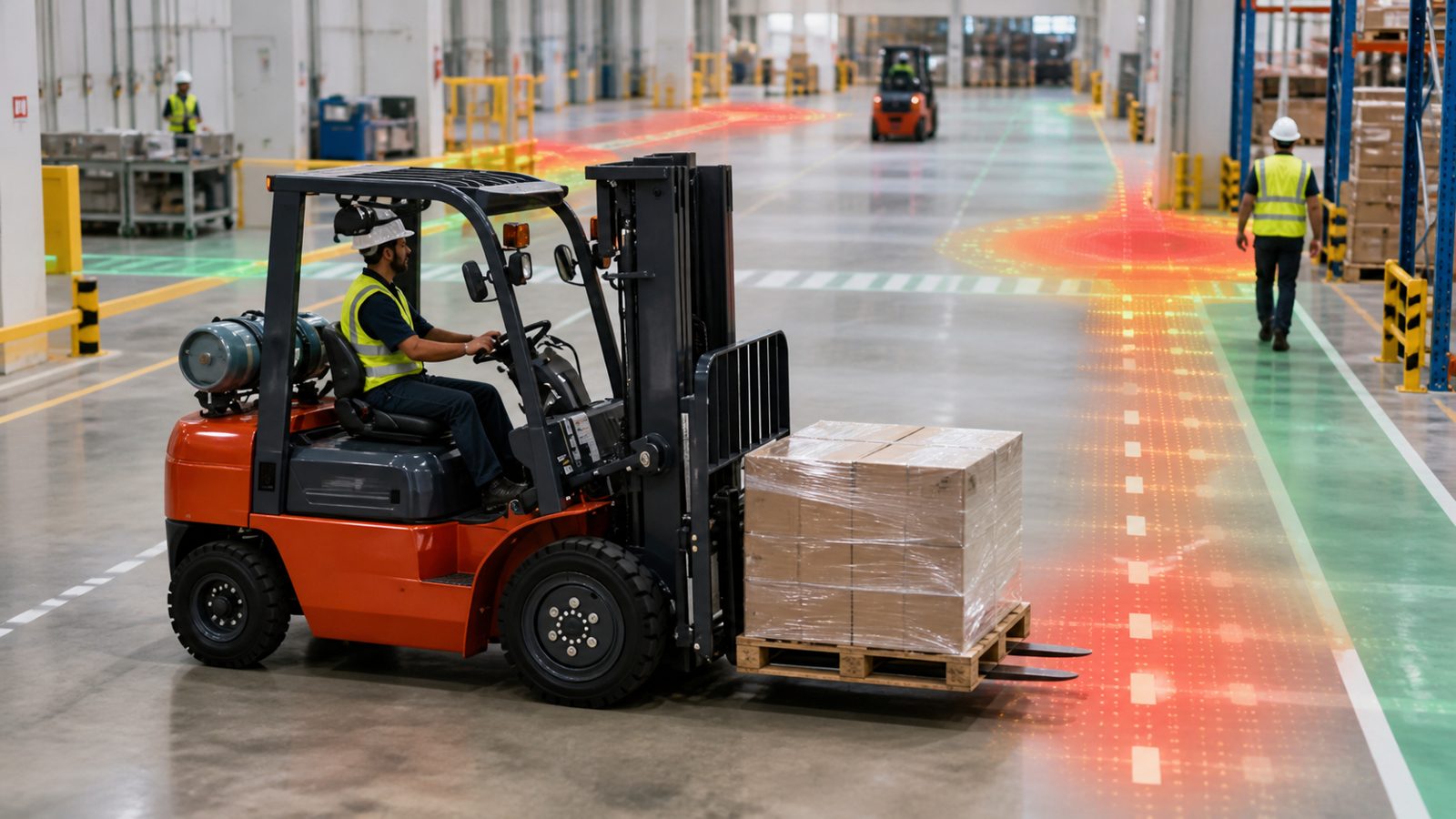
Modern warehouses are denser, faster and more connected. Forklifts share space with pedestrians, pallet trucks, automated mobile robots, dock equipment and temporary workers. Traditional incident counts describe only events that were reported. Near misses often disappear because no injury or damage occurred. Connected cameras, proximity sensors, impact monitors, telematics and real-time location systems can reveal recurring conflict points before a serious event.
A heatmap is not proof that an operator caused a problem. A cluster of alerts near one doorway may indicate blocked sightlines, poor lighting, unrealistic throughput targets, a missing barrier, unsuitable rack-end staging or an incorrectly tuned sensor. The value comes from combining data with on-site observation, operator feedback and a competent risk assessment. Technology should help the team find system weaknesses rather than create an automatic blame list.
Safety analytics cannot correct an unsuitable machine. Record the maximum load weight, pallet dimensions, load centre, lift height, attachment, travel distance, gradients and surface condition. A nominal three-ton capacity applies only under defined conditions. Long, offset or unstable loads, high masts and attachments can reduce residual capacity. Request a capacity assessment for the exact mast, forks and options, and ensure the final data plate matches the delivered configuration.
Measure the narrowest aisle, lowest doorway, trailer opening, turning point and ramp. Confirm tyre type, braking expectation, visibility and outdoor exposure. The CPY30 Gasoline/LPG Forklift Truck product page provides a relevant starting reference for buyers planning a three-ton LPG application. Final parameters and destination requirements must be confirmed in writing for the ordered machine.
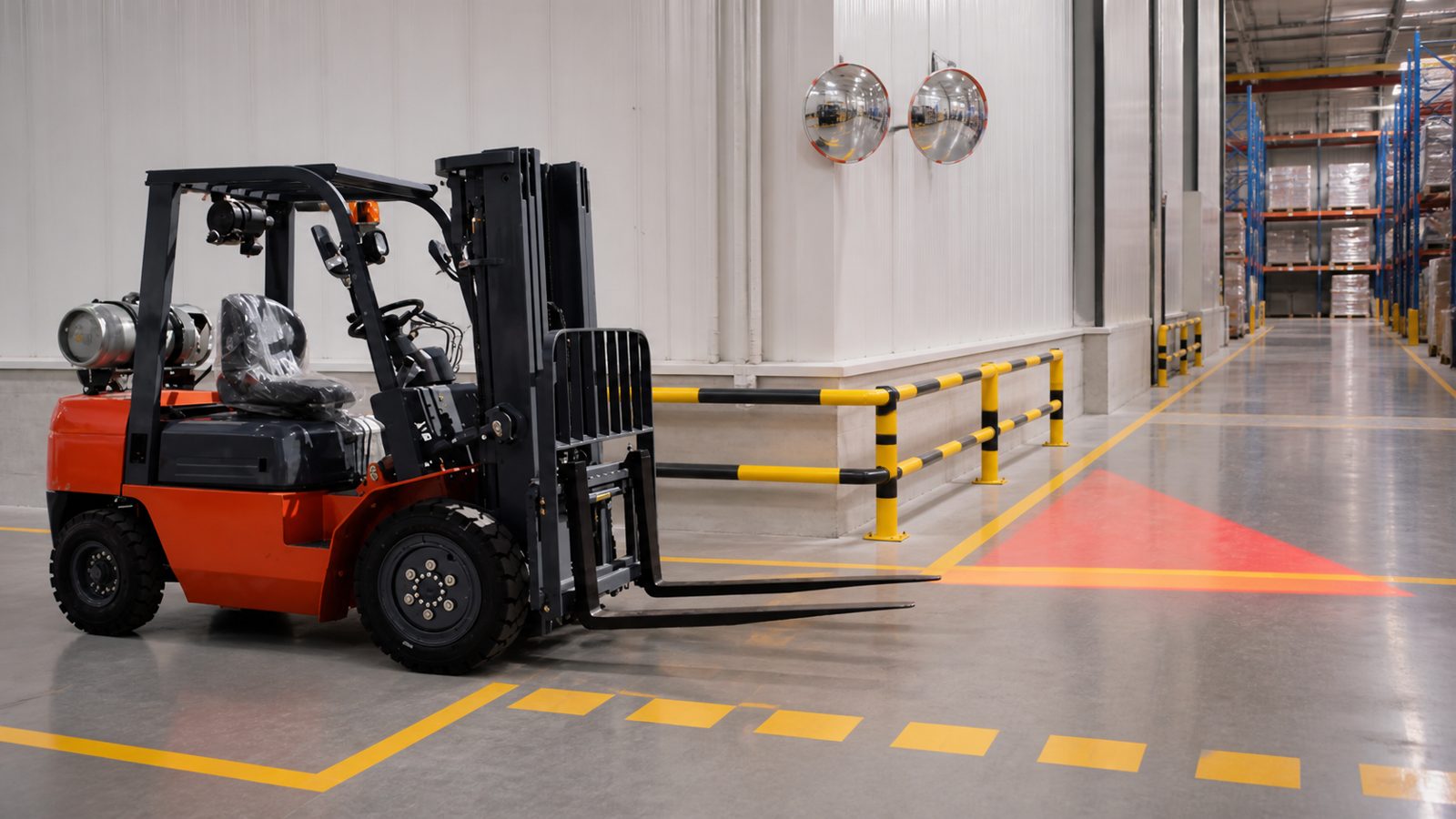
Map vehicle lanes, walkways, crossings, doors, dock edges, battery or fuel areas, parking points, racks, production cells and emergency access. Observe each shift, because traffic changes with staffing, carrier schedules and production demand. Record where loads block forward visibility, where pedestrians take shortcuts and where temporary pallets narrow the intended route.
Measure normal travel speeds, stopping behaviour, reversing, horn use, congestion delays and near-miss reporting. Review lighting, mirrors, barriers, gates, signs and floor markings. A digital system is more useful after the site understands its existing route. Without a baseline, the team may collect thousands of alerts without knowing whether risk is improving.
Choose a limited set of event types that support decisions. Examples include pedestrian detection inside a configured zone, vehicle-to-vehicle proximity, hard braking, excessive cornering speed, rack or obstacle impact, unauthorised operation, repeated reversing at a blind point and entry into a restricted area. Each event needs a clear definition, time stamp, location and review owner.
Avoid tuning the system so sensitively that normal work produces constant alarms. Alarm fatigue teaches operators and pedestrians to ignore warnings. Pilot the detection zones with representative loads, speeds, lighting and traffic. Use a wider awareness zone and a smaller critical zone only where the system supports it and where the response is understood. Any automatic intervention must be evaluated for compatibility with the truck and site.
When a heatmap shows a repeated hot spot, inspect the location during the relevant shift. Determine whether the conflict involves sight distance, route geometry, staging, traffic priority, speed, lighting or behaviour. Correct the strongest physical and process causes first. A barrier, one-way route, relocated staging area or controlled pedestrian gate can be more reliable than adding another warning sound.
Use the hierarchy of controls. Eliminate unnecessary interaction where possible, create physical separation, apply engineering controls such as gates or speed zones, then reinforce the system with procedures, training and personal protective equipment. Buyers whose loads are lighter may compare a smaller machine using the CPY25 Gasoline/LPG Forklift Truck product page. Right-sizing can improve manoeuvrability, but the selected truck must still meet residual-capacity and route requirements.
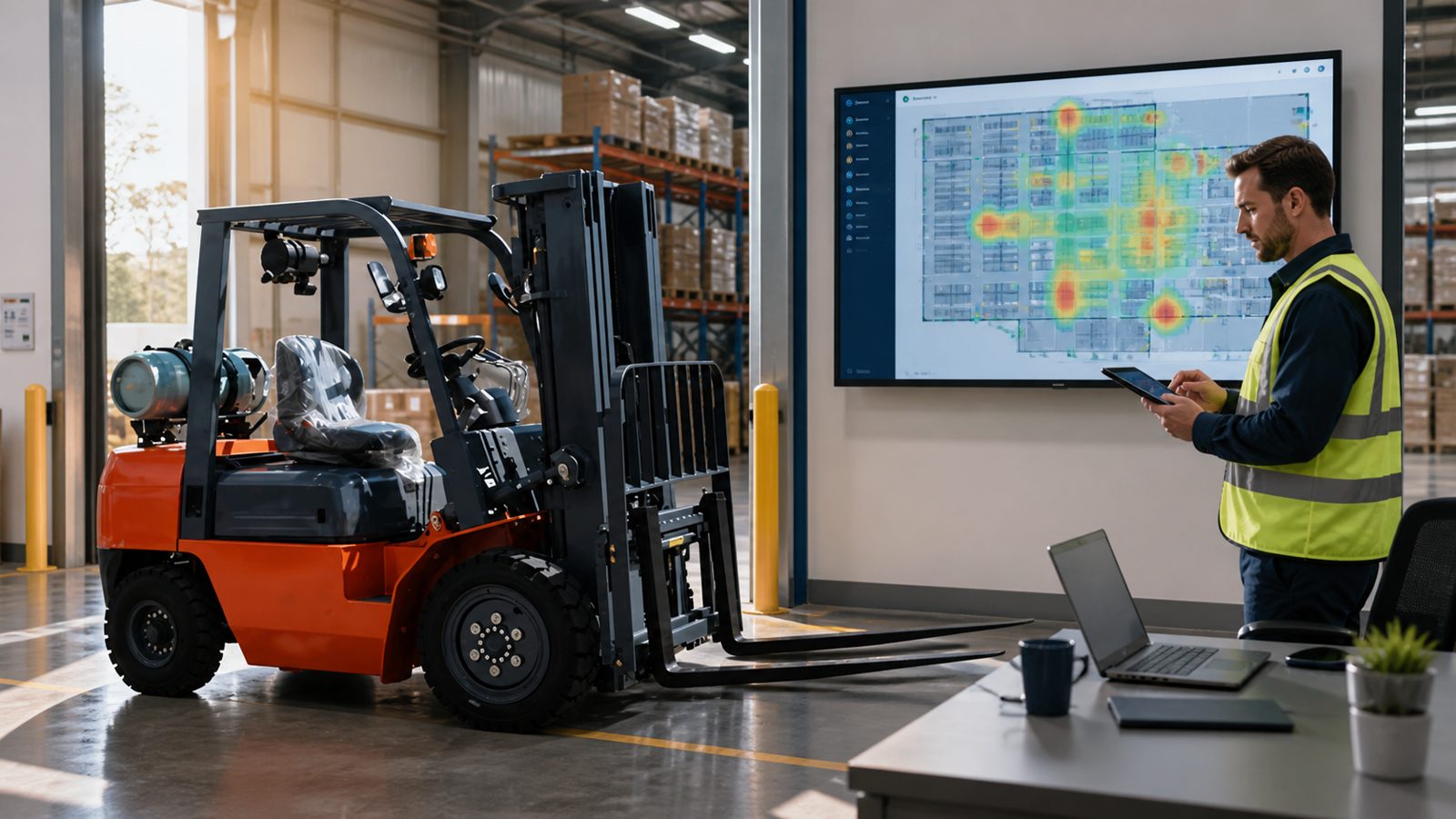
Operators often know why a risk event occurred. Include them in reviews and ask what they could see, what load they carried, whether the lane was blocked and what production pressure existed. A pattern of harsh braking may reveal a blind crossing or unstable schedule rather than intentional aggressive driving. Coaching should focus on the verified behaviour and the conditions that encouraged it.
Define who can access individual-level data, how long records are retained and how errors are corrected. Follow applicable privacy, employment and cybersecurity requirements. Secure administrator accounts, updates and data exports. A safety platform that is not governed can create mistrust or expose sensitive operational information.
The safe speed depends on truck mass, load, floor condition, tyre grip, visibility, gradient, traffic and stopping distance. One facility-wide limit may be too fast for a blind intersection and unnecessarily slow for an isolated open lane. Create zone rules from a competent risk assessment and verify them under controlled conditions.
At pedestrian crossings, dock approaches, cold-room doors and rack ends, the plan may require slower travel, a full stop, an audible warning or controlled right-of-way. Geofencing or proximity-based speed assistance can support the rule, but it does not replace operator responsibility or physical separation. Confirm that any retrofit is compatible with the truck's control system and does not introduce unexpected braking or stability risk.
Near-miss analytics does not replace LPG discipline. Cylinders must be approved, correctly oriented, securely mounted and within required inspection periods. Store and exchange them in designated, well-ventilated areas away from ignition sources and traffic hazards. Only trained, authorised personnel should perform cylinder exchange according to the manual and local requirements.
Before handling the cylinder, park on level ground, lower the forks, apply the parking brake and shut down correctly. Inspect the valve, hose, connector and mounting. Isolate leaking, damaged, corroded or non-compliant cylinders. Never force incompatible fittings, use an open flame for leak testing or modify pressure components without approved instructions.
LPG forklifts produce combustion exhaust, including carbon monoxide and other pollutants. Indoor use requires suitable ventilation, maintenance, monitoring and compliance with applicable exposure rules. A cleaner-burning fuel description does not mean zero emissions. Evaluate building volume, operating hours, number of trucks, ventilation performance and sensitive products.
Track excessive idling as both an air-quality and operating-cost event. Determine why it occurs before setting a target. Congestion, queuing, comfort needs or process delays may be responsible. Maintain the engine, ignition, fuel regulation and emission-control equipment so that alert systems are not protecting a warehouse while poor combustion creates another hazard.
Impact events and harsh operation can accelerate wear in tyres, wheels, brakes, steering, mast components and attachments. A high-energy event should trigger the site's approved inspection and release process. Do not return the truck to service simply because it still moves. Qualified personnel must assess relevant structures and systems.
Daily inspection should cover forks, locking pins, carriage, mast, chains, rollers, hydraulic hoses, tyres, wheels, brakes, steering, lights, horn, restraint, overhead guard, fluid leaks and LPG components. Scheduled service should follow the manual and consider actual duty intensity. Accurate hour, fault, parts and inspection records help connect safety data with physical equipment condition.
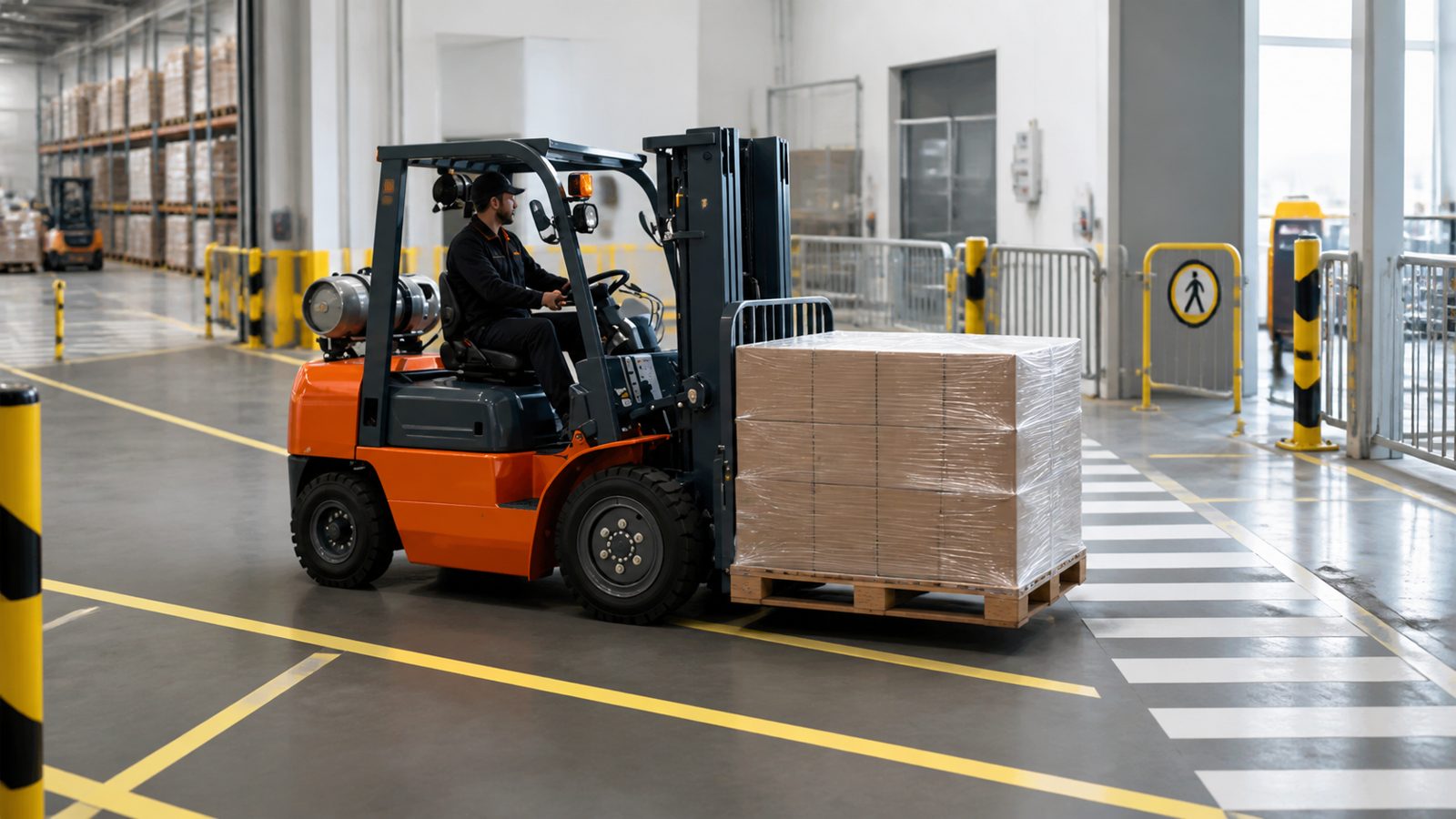
A standard three-ton counterbalance LPG forklift can support smooth-floor warehouses, paved yards and dock transfer when the exact configuration is suitable. It should not be treated as a rough-terrain forklift on mud, deep gravel or undeveloped ground. Surface strength, drainage and weather affect traction, braking and stability.
Operations with demanding outdoor routes should evaluate purpose-built equipment rather than relying on electronic safety assistance to overcome unsuitable terrain. The 5T Off-Road Forklift product page illustrates a different chassis, capacity and terrain class. Fleet planning should assign each machine to the environment for which it was selected.
After changing a route or control, hold the configuration stable long enough to compare results. Review near misses, alarm frequency, impacts, operator feedback, pedestrian compliance, travel time, pallets moved, congestion and maintenance events together. A reduction in alerts is positive only if it reflects lower risk, not a disabled sensor or discouraged reporting.
Document the before-and-after layout, settings, training and observations. Revalidate controls when racks, shifts, loads, attachments, software, tyres or traffic patterns change. Expand the method only after recurring exceptions are closed and responsibilities are clear.
Send the maximum load weight and dimensions, load centre, lift height, pallet type, fork length, mast requirement, attachments, aisle width, lowest doorway, turning points, gradients, floor and yard condition, indoor and outdoor ratio, daily hours, shifts, traffic density, tyre preference, fuel and cylinder standard, destination country, compliance expectations, quantity and delivery schedule. Site photographs and a marked route plan are valuable.
Ask the supplier to confirm the exact model, rated and residual capacity, mast, dimensions, turning radius, tyres, engine, LPG system, cylinder interface, emission configuration, safety options, warranty, service intervals, spare parts, packing and destination documentation. Safety technology should be quoted separately with its functions, limits, compatibility and commissioning requirements clearly stated.
Shandong Zhuogong Machinery equipment Co.,Ltd supports buyers, distributors and fleet operators with application communication, equipment selection, production coordination, export planning, parts identification and lifecycle support. ZGFORKLIFT / MYZG can discuss LPG, diesel, electric, warehouse and rough-terrain alternatives around the customer's actual load, route and shift.
For a three-ton LPG forklift proposal, provide real application evidence instead of only a nominal capacity. Final specification, options, compliance documents, lead time and commercial terms must be confirmed for the exact ordered machine.
Shandong Zhuogong Machinery equipment Co.,Ltd
Website: https://www.vavforklift.com/
Email: vip@mingyuforklift.com
Tel: +86-0535-2090977
WhatsApp: +86 131 8160 2336
Address: Xiaqiu Town, Laizhou, Yantai City, Shandong Province, China
Name: selena
Mobile:+86-13176910558
Tel:+86-0535-2090977
Whatsapp:8613181602336
Email:vip@mingyuforklift.com
Add:Xiaqiu Town, Laizhou, Yantai City, Shandong Province, China