
vip@mingyuforklift.com
+86-0535-2090977

A Technical Deep Dive into Efficiency, Environmental Impact, and the Path Forward
Introduction
Diesel forklifts have long been the backbone of heavy material handling operations worldwide. From lumber yards and steel mills to ports and construction sites, these machines deliver the raw torque, durability, and rapid refueling capabilities that electric alternatives struggle to match in demanding environments. Yet the diesel forklift sits at a crossroads: rising fuel costs, increasingly stringent emissions regulations, and the accelerating electrification of industrial fleets have placed its performance under unprecedented scrutiny.
This article provides a rigorous technical analysis of how diesel forklifts perform across two critical dimensions—fuel consumption and emissions. We examine the engineering principles that govern diesel efficiency, the evolution of emissions control technologies from Tier 1 to Tier 4 Final, the real-world cost implications for fleet operators, and the comparative landscape as electric and alternative-fuel technologies mature. For fleet managers, procurement officers, and operations engineers, understanding these factors is essential to making informed decisions in an era of energy transition.
The Fundamentals of Diesel Forklift Fuel Consumption
Engine Architecture and Efficiency Characteristics
Diesel forklifts are powered by industrial diesel engines ranging from compact 1.5-liter naturally aspirated units in small-capacity machines to turbocharged 4.5-liter engines in heavy-duty models exceeding 15 tonnes. The fundamental advantage of diesel combustion lies in its thermodynamic efficiency. Diesel engines operate at compression ratios typically between 15:1 and 23:1, significantly higher than gasoline engines (8:1 to 12:1). This high compression ratio enables diesel engines to extract more mechanical energy from each unit of fuel, yielding thermal efficiencies of 35–45% compared to 25–30% for spark-ignition engines.
In forklift applications, this translates to superior fuel economy under load. A diesel engine maintains consistent torque output across a broad RPM range, making it ideal for the stop-start, high-torque demands of lifting and transporting heavy materials. Unlike gasoline engines, which experience significant efficiency degradation under partial load, diesel engines retain relatively stable fuel consumption rates across varying duty cycles—a critical advantage in material handling where load weights fluctuate continuously.
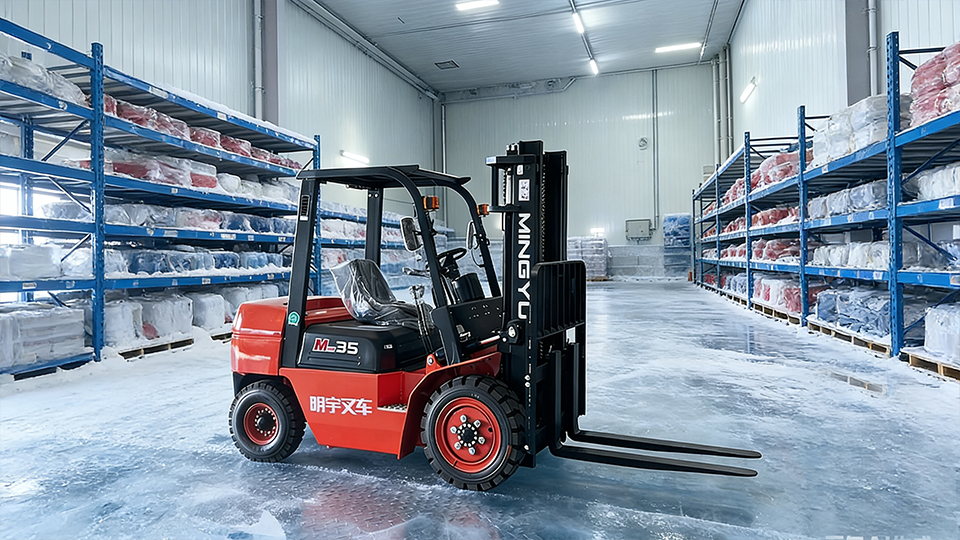
Standardized Consumption Benchmarks: VDI 2198
The industry relies on the VDI 2198 test cycle to quantify forklift fuel consumption under controlled conditions. Developed by the Association of German Engineers, this protocol subjects a forklift to 60 standardized duty cycles within a 60-minute period. Each cycle involves driving to a designated point, lifting a rated load to 2 meters, reversing, traveling 30 meters to a second point, lifting again, and returning to the start position. The resulting "VDI 60" figure represents fuel consumption under intensive, continuous operation.
For a typical 3-tonne diesel forklift, VDI 60 consumption ranges from 2.5 to 3.5 liters per hour. For 5-tonne models, figures cluster around 3.2 to 4.5 liters per hour. Heavy-duty 8-tonne machines can exceed 5.5 liters per hour under the same test conditions. However, these figures represent laboratory benchmarks rather than real-world averages. In practice, effective operating time within an 8-hour shift typically constitutes 50–70% of total hours, with the remainder consumed by idle time, loading queues, and operator breaks. Applying a 60–70% intensity correction to VDI 60 figures yields more realistic operational estimates.
Real-World Consumption Variables
Multiple technical variables influence actual fuel consumption beyond the standardized test cycle. Load weight is the most significant factor: operating at rated maximum capacity can increase fuel usage by 20–40% compared to handling average loads. The engine must generate additional hydraulic pressure and torque, increasing both fuel injection volume and duration. Lifting height compounds this effect—sustained high-pressure hydraulic flow to raise loads to maximum mast extension places sustained demand on the engine.
Terrain conditions dramatically alter consumption profiles. Smooth, level concrete floors minimize rolling resistance and allow steady engine operation. Conversely, rough terrain, gravel surfaces, and inclines increase consumption by 30–50% as the engine overcomes increased resistance and maintains traction. Outdoor yards with unpaved surfaces represent some of the highest-consumption environments for diesel forklifts.
Ambient temperature introduces further variability. Cold-start enrichment requires richer fuel mixtures until the engine reaches operating temperature, typically 10–15 minutes in moderate climates and significantly longer in sub-zero conditions. Winter-grade diesel formulations have slightly lower energy density than summer blends, and extreme cold necessitates engine block heaters and fuel filter heaters that add parasitic electrical load.
Operator behavior represents the most variable and least predictable factor. Aggressive acceleration, hard braking, rapid direction changes, and excessive idling can increase consumption by 10–20% compared to smooth, trained operation. Telematics systems that monitor and provide feedback on operator behavior have demonstrated fuel savings of 10–15% in managed fleets.
The Emissions Landscape: From Unregulated to Tier 4 Final
Historical Evolution of Emissions Standards
The emissions performance of diesel forklifts has undergone radical transformation over the past three decades. Prior to 1996, industrial diesel engines were essentially unregulated, emitting nitrogen oxides (NOx), particulate matter (PM), hydrocarbons (HC), and carbon monoxide (CO) without aftertreatment. The U.S. Environmental Protection Agency's Tier 1 standards, implemented in 1996, marked the first regulatory intervention, requiring modest reductions in NOx and PM through engine calibration changes and rudimentary exhaust gas recirculation (EGR).
Subsequent tiers—Tier 2 (2001), Tier 3 (2006), and Interim Tier 4 (2008–2012)—progressively tightened limits, driving manufacturers to adopt turbocharging, intercooling, high-pressure common-rail fuel injection, and advanced EGR systems. The culmination of this regulatory trajectory is Tier 4 Final, fully implemented in 2015, which mandates near-zero emissions for NOx and PM.
Tier 4 Final: Engineering Solutions for Near-Zero Emissions
Tier 4 Final represents a technological inflection point. To meet the stringent limits—0.4 g/kWh for NOx and 0.02 g/kWh for PM—manufacturers employ a multi-component aftertreatment system that fundamentally redefines diesel forklift architecture.
Diesel Oxidation Catalyst (DOC): Positioned immediately downstream of the exhaust manifold, the DOC oxidizes carbon monoxide and hydrocarbons into carbon dioxide and water using a platinum-group metal catalyst. It also generates the heat necessary for downstream DPF regeneration by oxidizing additional fuel injected during active regeneration cycles.
Diesel Particulate Filter (DPF): The DPF captures particulate matter on a ceramic honeycomb substrate with alternating plugged channels. As soot accumulates, exhaust backpressure increases, triggering regeneration. Passive regeneration occurs continuously when exhaust temperatures exceed 350°C, oxidizing soot using NO2 generated by the DOC. Active regeneration, required when passive regeneration is insufficient, injects additional fuel into the exhaust stream to raise temperatures to 550–650°C, burning accumulated soot. This process consumes additional fuel—typically 1–3% of total consumption—and requires the forklift to operate under sufficient load to maintain regeneration temperatures.
Selective Catalytic Reduction (SCR): For engines above 75 horsepower, Tier 4 Final mandates SCR systems to address NOx emissions. An aqueous urea solution—diesel exhaust fluid (DEF)—is injected into the exhaust stream, where it decomposes into ammonia. The ammonia reacts with NOx over a vanadium or zeolite catalyst, converting it to nitrogen and water. DEF consumption typically ranges from 2–5% of diesel fuel consumption, adding a secondary fluid management requirement to fleet operations.
Exhaust Gas Recirculation (EGR): Cooled EGR systems recirculate a portion of exhaust gas back into the intake manifold, reducing combustion temperatures and thereby limiting NOx formation at the source. However, EGR increases particulate matter generation, creating a trade-off that requires careful calibration between EGR rate, injection timing, and aftertreatment loading.
The Fuel Penalty of Emissions Compliance
The transition to Tier 4 Final has not been without cost. The aftertreatment systems introduce multiple fuel penalties. DPF active regeneration consumes additional diesel fuel. SCR systems require DEF, which—while not diesel—represents an operational fluid cost and logistical complexity. EGR reduces combustion efficiency, increasing fuel consumption per unit of work. The combined effect is a 5–10% increase in fuel consumption compared to pre-Tier 4 engines under equivalent operating conditions.
Moreover, Tier 4 engines impose operational constraints. DPF regeneration requires sustained exhaust temperatures that may not be achieved in light-duty, intermittent applications—precisely the environments where diesel forklifts were traditionally deployed. Frequent short-run cycles with insufficient load can lead to incomplete regenerations, DPF clogging, and costly downtime. This operational limitation has accelerated the migration of indoor, light-duty applications to electric forklifts, leaving diesel increasingly concentrated in heavy-duty, continuous-operation niches where exhaust temperatures naturally support aftertreatment function.
Comparative Analysis: Diesel, Electric, and Alternative Fuels
Diesel vs. Electric: The Total Cost of Ownership Equation
The 2026 operating cost landscape places diesel at a significant disadvantage in many applications. A mid-range diesel forklift consuming 3.0 liters per hour at current diesel prices generates approximately $18–25 in daily fuel cost for an 8-hour shift. An equivalent electric forklift consuming 2.0–2.5 kWh per hour costs approximately $3–5 per day to recharge at average industrial electricity rates. Over 2,000 annual operating hours, this differential accumulates to $6,000–12,000 in fuel costs for diesel versus $800–2,000 for electricity.
When maintenance is included, the gap widens further. Diesel engines require oil changes (typically every 500 hours), filter replacements, DPF service, SCR system maintenance, and periodic injector cleaning. Electric forklifts eliminate these requirements, reducing maintenance costs by 40–60%. A comprehensive 2026 analysis of a 30-forklift fleet transition projected annual savings of approximately $735,000, driven primarily by fuel and maintenance cost differentials.
However, diesel retains specific advantages that preserve its relevance. In outdoor rough-terrain operations, electric forklifts face challenges with battery sealing, traction, and ground clearance. For loads exceeding 10 tonnes, battery weight and cost become prohibitive. In remote sites without reliable grid infrastructure, diesel's energy density and rapid refueling (3 minutes versus 1–2 hours for full battery charging) remain decisive. And in extreme climates, diesel engines operate reliably where battery performance degrades significantly.
Diesel vs. LPG and CNG
Liquid petroleum gas (LPG) and compressed natural gas (CNG) represent intermediate alternatives. LPG forklifts offer lower upfront cost than diesel, reduced emissions (particularly PM), and indoor operational capability with proper ventilation. However, LPG fuel costs typically exceed diesel by 15–25%, and LPG engines exhibit 10–15% higher fuel consumption per unit of work due to lower energy density.
CNG forklifts provide the lowest carbon emissions among fossil-fuel options and benefit from historically stable pricing in regions with abundant natural gas supply. Infrastructure requirements—high-pressure compressors and storage—limit deployment flexibility, and CNG energy density (even at 3,600 psi) requires larger fuel tanks or more frequent refueling compared to diesel.
Maintenance Discipline: The Efficiency Multiplier
A poorly maintained diesel forklift can consume 15–25% more fuel and emit proportionally higher pollutants than a well-maintained equivalent. Critical maintenance factors include:
Air Filtration: A clogged air filter increases fuel consumption by 8–12% by restricting airflow and forcing richer combustion. In dusty environments, filter restriction indicators should be checked weekly, with filters changed at 200-hour intervals rather than the standard 500-hour interval.
Engine Lubrication: Used or contaminated oil increases internal friction, requiring more fuel to maintain power output. API CK-4 or CJ-4 rated oils should be used, with viscosity selected for ambient temperature. Extending oil changes beyond 500 hours in heavy-duty cycle degrades both fuel economy and engine longevity.
Fuel Quality: Ultra-low sulfur diesel (ULSD) with maximum 15 ppm sulfur is mandatory for Tier 4 engines. Biodiesel blends above B20 reduce fuel injector life by 50% and increase oil change frequency by 40% due to polymerization. B100 (pure biodiesel) voids DPF and SCR warranties and should never be used in modern diesel forklifts.
Aftertreatment Maintenance: DPF ash accumulation from lubricant additives and incomplete regeneration requires periodic cleaning or replacement, typically every 3,000–6,000 hours depending on duty cycle. SCR catalysts degrade over time and may require replacement after 8,000–12,000 hours. DEF quality is critical—contaminated DEF can poison the SCR catalyst, resulting in replacement costs exceeding $5,000.
The Path Forward: Hybridization and Hydrogen
As the material handling industry confronts decarbonization imperatives, diesel forklifts face existential pressure. Two emerging technologies offer potential pathways for diesel's evolution rather than extinction.
Hybrid Diesel-Electric Systems: Combining a downsized diesel engine with an electric motor and battery pack enables the diesel engine to operate at its optimal efficiency point while the electric motor handles transient loads. This architecture can reduce fuel consumption by 20–30% and emissions by 40–50% compared to conventional diesel. However, the added complexity and cost have limited commercial deployment in forklifts to date.
Hydrogen Internal Combustion: Hydrogen-fueled internal combustion engines retain the mechanical simplicity and rapid refueling of diesel while eliminating CO2 and PM emissions. NOx emissions are reduced by 90–95% compared to diesel. The primary barriers are hydrogen infrastructure, storage costs, and the energy intensity of hydrogen production. Pilot programs in European ports and logistics hubs are evaluating hydrogen forklifts as zero-emission alternatives for heavy-duty applications where battery electric solutions are impractical.
Conclusion
Diesel forklifts deliver robust fuel consumption performance in heavy-duty, continuous-operation environments where their high thermal efficiency, torque characteristics, and rapid refueling capabilities remain unmatched. Under standardized VDI 2198 testing, mid-range models consume 2.5–4.5 liters per hour, with real-world operational consumption varying dramatically based on duty cycle, terrain, load, and maintenance discipline. The transition to Tier 4 Final emissions standards has reduced NOx and PM emissions by over 90% compared to unregulated predecessors, but at the cost of increased fuel consumption, operational complexity, and maintenance requirements.
The comparative landscape has shifted decisively. For indoor, light-to-moderate duty applications, electric forklifts now offer compelling total cost of ownership advantages with zero direct emissions. For heavy-duty outdoor operations, diesel retains technical relevance but faces growing pressure from electrification, hydrogen, and regulatory constraints on fossil fuel use.
For fleet managers, the critical insight is that diesel forklift performance—in both fuel consumption and emissions—is not a fixed characteristic but a function of application fit, operational discipline, and maintenance rigor. In appropriate applications with proper management, diesel forklifts remain viable, efficient tools. In applications better served by alternatives, clinging to diesel represents both an economic and environmental liability. The technology is not obsolete, but its domain is narrowing—and the window for optimization is closing as the industry accelerates toward decarbonization.
Name: selena
Mobile:+86-13176910558
Tel:+86-0535-2090977
Whatsapp:8613181602336
Email:vip@mingyuforklift.com
Add:Xiaqiu Town, Laizhou, Yantai City, Shandong Province, China
