
vip@mingyuforklift.com
+86-0535-2090977

A Systematic Technical Analysis of the Variables Governing Diesel Consumption in Material Handling Equipment
Introduction
Fuel consumption in diesel forklifts is not a fixed value inscribed on a specification sheet—it is a dynamic output shaped by the interaction of dozens of engineering, operational, and environmental variables. For fleet managers seeking to optimize costs, for procurement officers comparing equipment options, and for operations engineers troubleshooting excessive consumption, understanding the complete causal chain of fuel burn is essential.
This article provides a systematic, hierarchical analysis of the factors that determine how much fuel a diesel forklift burns. Moving from the fundamental mechanical architecture through duty cycle characteristics, environmental conditions, and human factors, we construct a comprehensive framework for predicting, measuring, and controlling fuel consumption in industrial material handling operations.
Tier 1: Engine Architecture and Mechanical Design
The foundation of fuel consumption lies in the engine's fundamental design parameters. These are fixed at manufacture and establish the theoretical efficiency envelope within which all other variables operate.
Compression Ratio and Combustion Chamber Geometry
Diesel engines achieve superior thermal efficiency compared to spark-ignition engines primarily through higher compression ratios, typically ranging from 15:1 to 23:1 in industrial forklift applications. This high compression enables the air-fuel mixture to reach auto-ignition temperatures without external spark ignition, extracting more mechanical energy per unit of fuel. Within the diesel engine category, however, compression ratio variations of 2–3 points can alter fuel efficiency by 3–5%. Modern common-rail direct injection systems, operating at pressures exceeding 2,000 bar, enable precise control over injection timing, duration, and rate-shaping, optimizing combustion phasing for maximum efficiency across the load spectrum.
Combustion chamber geometry—whether direct injection with a piston bowl or indirect injection with a pre-chamber—affects flame propagation, heat transfer losses, and emissions formation. Direct injection designs dominate modern forklift engines due to their superior efficiency (5–8% better than indirect injection) and simpler mechanical construction.
Displacement and Power Rating
Engine displacement establishes the maximum fuel throughput capacity. A 1.5-liter engine in a compact 2-tonne forklift cannot physically consume fuel at the rate of a 4.5-liter engine in a 15-tonne heavy-duty machine, regardless of operating conditions. However, specific fuel consumption—grams of fuel per kilowatt-hour—is often more favorable in larger, slower-turning engines that operate closer to their optimal efficiency island on the brake specific fuel consumption (BSFC) map.
The relationship between rated power and actual load is critical. An engine chronically under-loaded—operating at 30% of rated power—suffers efficiency penalties because fixed friction losses (piston rings, bearings, oil pump) consume a disproportionate share of output. Conversely, an engine consistently overloaded beyond 90% of rated power enters a regime of enriched combustion and elevated temperatures that increase fuel consumption and accelerate wear. The optimal operating window for diesel efficiency typically spans 50–80% of rated power.
Aspiration and Charging
Naturally aspirated engines draw intake air through atmospheric pressure alone, limiting power density and efficiency at altitude. Turbocharged engines force additional air into the cylinders, enabling more complete fuel combustion and higher specific output. Intercooling—cooling the compressed air before it enters the cylinder—increases air density further, improving combustion efficiency by 3–5% compared to turbocharging alone.
Variable geometry turbochargers (VGT), increasingly common in Tier 4 Final forklift engines, adjust vane angles to optimize boost pressure across the RPM range, reducing turbo lag and improving transient response. This technology enables smaller displacement engines to replace larger naturally aspirated units while maintaining performance, yielding fuel savings of 8–12% in variable-load applications typical of forklift operation.
Transmission Architecture
The transmission mediates between engine output and drivetrain demand, and its design significantly influences fuel consumption. Two primary architectures dominate forklift applications:
Hydrostatic transmissions use variable-displacement hydraulic pumps and motors to provide stepless speed variation. They excel in applications requiring frequent direction changes, precise inching control, and smooth acceleration—dock work, truck loading, and narrow-aisle operations. However, hydraulic systems exhibit efficiency losses of 15–25% due to fluid friction, internal leakage, and heat generation. In steady-state travel, hydrostatic systems consume 15–20% more fuel than mechanical alternatives.
Powershift transmissions use multi-plate clutches and planetary gear sets to provide discrete speed ratios with minimal parasitic loss. They achieve 90–95% mechanical efficiency and are preferred for yard operations with long travel distances. The trade-off is less refined inching control and higher operator fatigue in stop-start applications.
The transmission selection should match the duty cycle. Misalignment—using a hydrostatic transmission in a long-distance yard application, for example—can increase fuel consumption by 20% while providing no operational benefit.
Tier 2: Hydraulic System Design and Load Characteristics
Forklifts consume fuel not only to propel the vehicle but also to power the hydraulic system that enables lifting, tilting, and attachment operation. The hydraulic load often equals or exceeds the propulsion load in typical material handling cycles.
Hydraulic Pump Configuration
The hydraulic pump converts mechanical energy from the engine into fluid pressure. Three configurations are common:
Gear pumps provide fixed displacement, delivering flow proportional to engine speed regardless of demand. When the operator is not actuating a hydraulic function, excess flow bypasses through a relief valve, generating heat and consuming fuel without productive output. Gear pump systems are simple and inexpensive but inefficient in variable-demand applications.
Variable displacement piston pumps adjust output to match demand, reducing bypass losses. When no hydraulic function is active, the pump destrokes to minimum displacement, minimizing fuel consumption. This technology improves hydraulic efficiency by 15–25% compared to fixed-displacement systems.
Load-sensing systems add pressure and flow feedback to the variable displacement pump, delivering precisely the flow required at the pressure demanded by the load. These systems achieve the highest hydraulic efficiency, reducing fuel consumption by 20–30% in applications with highly variable hydraulic demand.
Load Weight and Center of Gravity
The rated load capacity of a forklift—2 tonnes, 5 tonnes, 10 tonnes—represents the maximum safe lifting limit, not the typical operational load. Fuel consumption scales non-linearly with load because:
Hydraulic demand increases: Lifting heavier loads requires higher system pressure. A 5-tonne load may require 180 bar hydraulic pressure versus 120 bar for a 2-tonne load, increasing pump power draw by 50%.
Engine load increases: The engine must generate additional torque to drive the hydraulic pump at elevated pressure, increasing fuel injection quantity.
Rolling resistance increases: Heavier loads increase tire deformation and ground contact pressure, raising resistance during travel.
Stability compensation: Heavier loads require reduced travel speeds and more cautious maneuvering, often resulting in suboptimal engine operating points.
Operating at 80% of rated capacity can increase fuel consumption by 25–35% compared to handling 40% of rated capacity. Conversely, chronic under-loading—handling 20% of rated capacity with a 10-tonne machine—results in poor engine efficiency and excessive fuel burn per unit of material moved.
Lifting Height and Mast Configuration
The height to which a load must be raised directly influences fuel consumption. Higher lifts require:
Extended hydraulic cylinder stroke, increasing fluid volume pumped
Sustained high-pressure operation for longer duration
Potential need for multiple mast stages, adding weight and mechanical complexity
A forklift operating with loads routinely raised to 6 meters consumes 10–15% more fuel than the same machine handling loads at 2 meters, assuming equivalent cycle frequency. Full free-lift masts, which raise the load without extending the outer mast, reduce the mass that must be lifted but do not eliminate the hydraulic energy requirement.
Tier 3: Duty Cycle and Operational Parameters
Beyond mechanical design, the operational pattern—the duty cycle—determines how the engine and hydraulic system are loaded over time. Duty cycle analysis is the most powerful tool for predicting real-world fuel consumption.
Cycle Intensity and Frequency
The VDI 2198 test cycle provides a standardized benchmark: 60 cycles per hour, each comprising travel, lift, lower, and return phases. Real-world operations deviate significantly:
Light-duty cycles (20–30 cycles per hour) feature extended idle periods, long travel distances between picks, and intermittent operation. Effective engine load factor may be only 30–40%, with significant time spent at idle or low-load cruise. Fuel consumption per productive unit of work is high due to fixed losses during non-productive periods.
Moderate-duty cycles (40–50 cycles per hour) represent typical warehouse and distribution center operations. The engine operates across a broader load range, with periodic high-load events for lifting and acceleration interspersed with moderate-load travel. This is often the most efficient operational regime, as the engine avoids chronic under-loading while not being stressed to maximum output.
Heavy-duty cycles (60+ cycles per hour) approach or exceed the VDI 2198 intensity. Continuous lifting, short travel distances, and minimal idle time keep the engine near its optimal efficiency point but at sustained high output. Fuel consumption per hour is maximized, though fuel per unit of work may be favorable due to high productivity.
Travel Distance and Speed Profile
The proportion of operating time spent traveling versus lifting significantly impacts consumption. Long travel distances at maximum speed place sustained load on the engine, but at relatively efficient operating points. Short, interrupted travel with frequent acceleration and deceleration is less efficient because:
Acceleration events require enriched fuel mixtures and higher injection rates
Deceleration dissipates kinetic energy as heat through brakes rather than recovering it
Frequent direction changes require transmission shifting or hydrostatic reversals, incurring transient losses
An operation with 60% travel time and 40% lift time will exhibit different consumption characteristics than one with 30% travel and 70% lift, even if total cycle time is identical.
Idle Time and Engine Shutdown Policy
Engine idle represents pure fuel consumption without productive output. A diesel forklift at idle consumes 0.8–1.5 liters per hour depending on engine size and ambient temperature. In an 8-hour shift with 3 hours of idle time, 2.4–4.5 liters of fuel are consumed with zero material handling benefit.
Automatic idle shutdown systems, which stop the engine after 5–10 minutes of stationary operation, can reduce annual fuel consumption by 15–20% in operations with significant queue or waiting time. However, frequent start-stop cycles increase starter motor and battery wear, and cold starts produce higher emissions during the warm-up period. The optimal shutdown threshold balances fuel savings against wear and emissions trade-offs.
Tier 4: Environmental and Ambient Conditions
The environment in which a forklift operates modifies the baseline fuel consumption established by mechanical design and duty cycle.
Temperature Effects
Ambient temperature affects diesel consumption through multiple pathways:
Cold-start enrichment: Below 10°C, engines require richer fuel mixtures to achieve reliable ignition and stable idle. Fuel injection timing is advanced, and injection quantity increased, until coolant temperature reaches the normal operating range (80–95°C). In sub-zero conditions, enrichment can increase fuel consumption by 20–30% during the first 15–20 minutes of operation.
Warm-up duration: Extended warm-up periods in cold climates add non-productive fuel burn. Engine block heaters, which pre-warm the coolant using grid electricity, can reduce warm-up fuel consumption by 50% but require infrastructure investment.
Fuel properties: Winter-grade diesel contains additives to prevent gelling at low temperatures, slightly reducing energy density (2–3%) compared to summer formulations. Biodiesel blends exhibit even greater cold-flow challenges, with B20 gelling at approximately -6°C versus -18°C for petroleum diesel.
Air density: Cold air is denser, providing more oxygen per unit volume and enabling more complete combustion. Paradoxically, this can improve efficiency slightly once the engine is warm, partially offsetting cold-start penalties.
Altitude Effects
At elevations above 1,000 meters, atmospheric pressure and oxygen partial pressure decrease. Naturally aspirated engines suffer power deration of approximately 3% per 300 meters of altitude gain, requiring higher throttle openings and increased fuel consumption to maintain performance. Turbocharged engines compensate by increasing boost pressure, but turbo efficiency decreases at altitude, and intercooling effectiveness is reduced due to lower air density. Above 2,500 meters, even turbocharged engines exhibit measurable efficiency degradation.
Surface Conditions and Terrain
The rolling surface fundamentally affects propulsion energy requirements:
Smooth, level concrete: Coefficient of rolling resistance approximately 0.010–0.015. Minimal energy lost to surface deformation, optimal for fuel efficiency.
Asphalt: Slightly higher resistance (0.015–0.020) due to surface texture and temperature-dependent viscosity.
Compacted gravel or dirt: Resistance increases to 0.020–0.040. Irregular surfaces require constant steering correction and speed variation, preventing steady-state efficient operation.
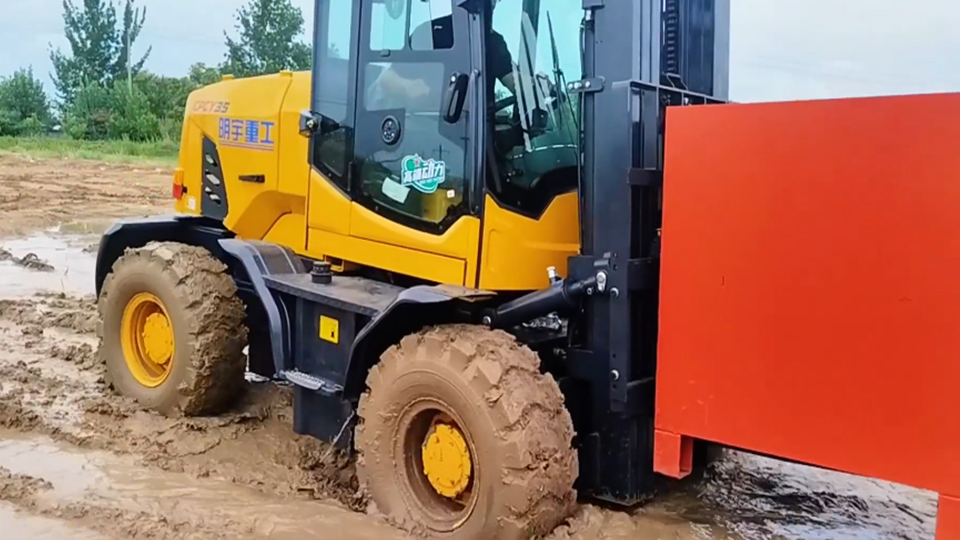
Soft ground, mud, or sand: Resistance can exceed 0.100. The engine operates at high load with minimal forward progress, creating the worst fuel efficiency conditions.
Grades: Operating on inclines adds a gravitational load component. A 5% grade increases fuel consumption by 15–20% during ascent. Descent typically does not recover equivalent energy due to braking losses unless the transmission provides downhill speed control.
Tier 5: Maintenance State and Fuel Quality
The condition of the forklift and the quality of fuel consumed act as efficiency multipliers—either preserving design efficiency or degrading it.
Air Intake System
A clean air filter presents minimal restriction to intake airflow. As dust accumulates, pressure drop across the filter increases, reducing the mass of air entering the cylinders. The engine control unit responds by enriching the fuel mixture to maintain power output, increasing specific fuel consumption by 5–8% at moderate restriction and 10–15% at severe restriction. In dusty environments—cement plants, grain handling, mining operations—filters may require replacement at 100–200 hour intervals rather than the standard 500 hours.
Turbocharger condition also affects intake efficiency. Worn bearings increase clearance and reduce boost pressure. Fouled compressor wheels reduce airflow capacity. These degradations are gradual and often unnoticed until fuel consumption has increased 8–12%.
Fuel Injection System
Common-rail injectors operate with tolerances of micrometers. Injector nozzle wear, carbon deposits, and internal leakage alter spray pattern, droplet size, and injection timing. Worn injectors produce poor atomization, resulting in incomplete combustion, increased particulate matter, and elevated fuel consumption (typically 5–10% increase). Injector replacement or refurbishment at 4,000–6,000 hours restores efficiency.
Fuel pump wear reduces rail pressure stability, forcing the engine to operate with compromised injection parameters. High-pressure pump replacement is a major maintenance event but necessary when pressure deviation exceeds 5% of specification.
Engine Mechanical Condition
Piston ring wear increases blow-by—combustion gases escaping past the rings into the crankcase—reducing effective compression pressure and combustion efficiency. Cylinder bore wear creates out-of-round conditions that degrade piston seal. Valve seat recession or burning reduces compression ratio and alters valve timing. These mechanical degradations accumulate gradually, with fuel consumption increasing 2–3% per 1,000 hours of operation in the absence of major overhaul.
Lubrication System
Engine oil viscosity directly affects friction losses. Oil that has degraded through oxidation, shear, or contamination exhibits higher viscosity at operating temperature, increasing pumping losses and bearing friction. Used oil also contains acidic byproducts and particulate matter that accelerate wear. Adherence to 500-hour oil change intervals with API CK-4 or CJ-4 rated lubricants maintains friction losses at design levels.
Fuel Quality
Ultra-low sulfur diesel (ULSD, maximum 15 ppm sulfur) is mandatory for Tier 4 Final engines. Higher sulfur content poisons DOC and SCR catalysts, degrading aftertreatment performance and potentially triggering derated engine operation. Water contamination in fuel causes injector corrosion, microbial growth, and filter plugging. Particulate contamination accelerates pump and injector wear. Fuel stored in bulk tanks should be filtered to ISO 4406 18/16/13 cleanliness level and monitored for water content below 200 ppm.
Biodiesel blends above B20 are not recommended for modern diesel forklifts. Biodiesel's higher viscosity and lower energy density (8–10% less than petroleum diesel) increase fuel consumption. Its hygroscopic nature promotes water accumulation. And its tendency to polymerize and form deposits increases filter plugging frequency and injector fouling.
Tier 6: Human Factors and Operational Management
The final determinant of fuel consumption is the human operator and the management systems that govern their behavior.
Operator Technique
Trained operators can reduce fuel consumption by 10–15% compared to untrained operators through:
Smooth, gradual acceleration rather than aggressive throttle application
Anticipatory driving that minimizes hard braking
Efficient route planning that reduces travel distance
Minimizing idle time by shutting down during extended waits
Proper load positioning that maintains stability and reduces corrective maneuvering
Conversely, aggressive operation—rapid acceleration, high-speed cornering, abrupt braking—increases fuel consumption, accelerates tire and brake wear, and elevates safety risk.
Fleet Management and Telematics
Modern telematics systems provide real-time monitoring of fuel consumption, engine parameters, operator behavior, and maintenance status. Data-driven fleet management enables:
Identification of high-consumption units requiring maintenance attention
Operator coaching based on objective performance metrics
Route optimization through warehouse layout analysis
Predictive maintenance scheduling based on actual operating conditions rather than fixed intervals
Fleets implementing comprehensive telematics and management programs have demonstrated sustained fuel consumption reductions of 10–20%.
Conclusion
The fuel consumption of a diesel forklift is determined by the interaction of six hierarchical tiers of variables: engine architecture establishes the theoretical efficiency envelope; hydraulic system design and load characteristics define the instantaneous power demand; duty cycle and operational parameters determine how that demand varies over time; environmental conditions modify the baseline requirements; maintenance state and fuel quality act as efficiency multipliers; and human factors ultimately determine how the machine is utilized in practice.
No single factor dominates. A well-designed engine operated poorly in adverse conditions with deferred maintenance will consume fuel at rates far exceeding its specification. Conversely, a modest engine operated with discipline in favorable conditions with rigorous maintenance can approach optimal efficiency.
For fleet managers, the implication is clear: fuel optimization requires a systems approach. Specification must match application. Maintenance must be proactive rather than reactive. Operators must be trained and monitored. And environmental factors must be accounted for in budgeting and scheduling. In an era of volatile energy costs and environmental accountability, mastering these determinants is not merely a cost-control exercise—it is a competitive necessity.
Name: selena
Mobile:+86-13176910558
Tel:+86-0535-2090977
Whatsapp:8613181602336
Email:vip@mingyuforklift.com
Add:Xiaqiu Town, Laizhou, Yantai City, Shandong Province, China