
vip@mingyuforklift.com
+86-0535-2090977

A Comprehensive Technical Analysis for Fleet Managers and Operations Engineers
Introduction
For any operation relying on internal combustion forklifts, diesel fuel consumption represents one of the largest variable operating costs in the fleet budget. Yet the question "How much diesel does a forklift use in an 8-hour shift?" is deceptively simple. The answer depends on a web of interrelated technical variables—engine specifications, duty cycle intensity, load profiles, terrain conditions, operator behavior, and maintenance discipline—that can swing consumption by 200% or more between two seemingly identical machines performing different tasks.
This article provides a rigorous, data-driven framework for estimating diesel consumption during a standard 8-hour shift. Drawing on manufacturer specifications, standardized test protocols, and real-world operational data, we break down the factors that govern fuel usage and provide practical methodologies for fleet managers to calculate, benchmark, and optimize consumption in their specific environments.
Understanding the Baseline: Manufacturer Specifications and Standardized Testing
Before examining real-world variables, it is essential to understand how forklift manufacturers quantify fuel consumption. The industry-standard measurement is the VDI 2198 test cycle, developed by the Association of German Engineers (Verband Deutscher Ingenieure). In this protocol, a forklift completes a standardized duty cycle 60 times within a 60-minute period. The cycle involves driving to a designated point, lifting a rated load to 2 meters, reversing, traveling 30 meters to a second point, lifting again, and returning to the start position.
The resulting figure—typically labeled "VDI 60" on specification sheets—represents fuel consumption under intensive, continuous operation. However, this is a laboratory benchmark, not a real-world average. In practice, most forklifts do not operate at this intensity for the full duration of a shift. Idle time, loading queues, operator breaks, and task variability all reduce the effective duty cycle. Industry guidance suggests that a reasonable real-world estimate can be derived by applying the VDI 60 figure to approximately 60% of shift time—roughly 4.8 hours of active operation within an 8-hour shift.
This distinction is critical. A fleet manager who budgets fuel costs based purely on VDI 60 figures multiplied by eight hours will significantly overestimate consumption. Conversely, ignoring the intensity correction entirely will lead to underestimation in high-throughput environments.
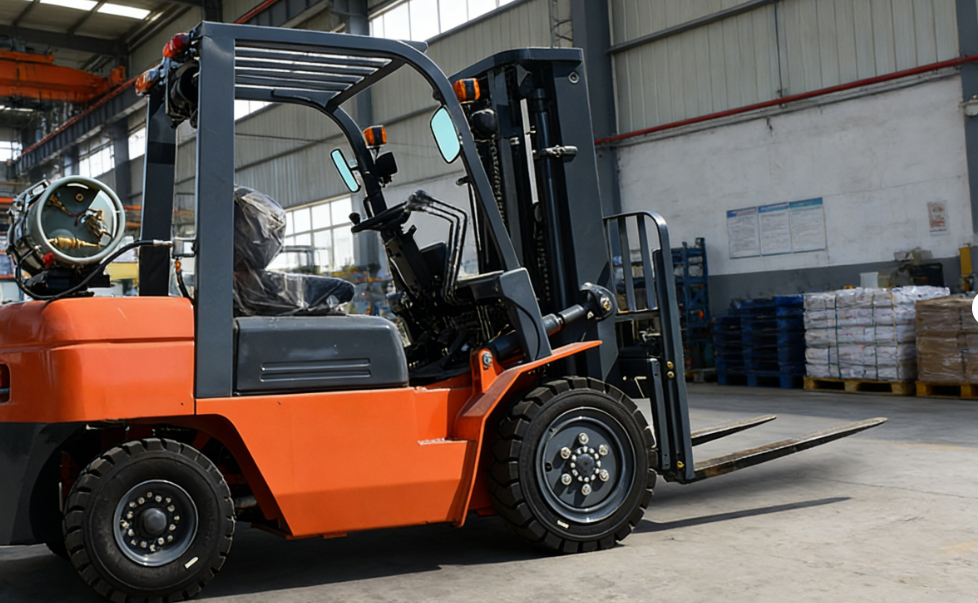
Fuel Consumption by Forklift Category
Diesel forklifts span a wide capacity range, and fuel consumption scales almost linearly with engine displacement and lifting capacity. Based on 2025–2026 manufacturer data and industry analyses, the following categories provide a useful framework for estimation:
Compact Diesel Forklifts (2,000–3,500 lbs / 1–1.6 tonnes)
These units, common in light warehouse and retail applications, typically consume 0.8 to 1.5 gallons per hour (3.0–5.7 liters per hour) under normal operating conditions. A 3-tonne capacity forklift, a widely deployed mid-compact model, averages approximately 2.5 to 3.5 liters per hour.
Mid-Range Diesel Forklifts (4,000–6,000 lbs / 2–3 tonnes)
Representing the majority of commercial deployments, these forklifts balance capacity with efficiency. Typical consumption falls between 1.5 and 2.5 gallons per hour (5.7–9.5 liters per hour). For a standard 3-tonne model under moderate duty, 3.2 liters per hour is a commonly cited operational average.
Heavy-Duty Diesel Forklifts (8,000+ lbs / 3.5+ tonnes)
Designed for ports, lumber yards, steel fabrication, and construction, these machines prioritize torque and durability over fuel economy. Consumption ranges from 2.5 to 4+ gallons per hour (9.5–15+ liters per hour). An 8,000-pound capacity unit in heavy-duty cycle—characterized by continuous lifting and travel—can burn 1.2 to 1.5 gallons per hour, while the same machine in moderate cycle drops to 0.8 to 1.0 gallons per hour.
Industry Averages
Across all categories, a broad industry estimate places typical diesel forklift consumption at 2 to 5 liters per hour under normal conditions, with many mid-range units clustering around 2.5 to 3.0 gallons per hour when averaged across loaded and unloaded operation.
Calculating 8-Hour Shift Consumption: A Multi-Scenario Analysis
With the hourly baselines established, we can model consumption across an 8-hour shift under different operational scenarios. The critical variable is the effective operating hours—the time the engine is under load versus idling.
Scenario 1: Light-Duty Warehouse Operation
Forklift: 3-tonne compact diesel
Conditions: Smooth concrete floors, intermittent pallet movement, significant idle time
Hourly consumption (light duty): ~2.5 liters/hour
Effective operating time: 4 hours (50% of shift)
Idle consumption: ~0.35 liters/hour (engine at idle)
Idle time: 4 hours
Calculation:
Active fuel: 4 hours × 2.5 L/h = 10.0 liters
Idle fuel: 4 hours × 0.35 L/h = 1.4 liters
Total 8-hour shift: ~11.4 liters (3.0 gallons)
Scenario 2: Moderate-Duty Distribution Center
Forklift: 5-tonne mid-range diesel
Conditions: Mixed loading/unloading, moderate travel distances, minimal idle time
Hourly consumption (moderate duty): ~3.2 liters/hour
Effective operating time: 5.5 hours (~70% of shift)
Idle time: 2.5 hours
Calculation:
Active fuel: 5.5 hours × 3.2 L/h = 17.6 liters
Idle fuel: 2.5 hours × 0.35 L/h = 0.9 liters
Total 8-hour shift: ~18.5 liters (4.9 gallons)
Scenario 3: Heavy-Duty Outdoor Yard
Forklift: 8,000 lb heavy-duty diesel
Conditions: Rough terrain, continuous lifting, long travel distances, minimal idle time
Hourly consumption (heavy duty): ~5.5 liters/hour (1.45 gallons/hour)
Effective operating time: 7 hours (~85% of shift)
Idle time: 1 hour
Calculation:
Active fuel: 7 hours × 5.5 L/h = 38.5 liters
Idle fuel: 1 hour × 0.35 L/h = 0.35 liters
Total 8-hour shift: ~38.9 liters (10.3 gallons)
These scenarios illustrate the dramatic range in shift consumption—from approximately 11 liters in light-duty indoor environments to nearly 39 liters in heavy-duty outdoor applications—even when the nominal shift length remains constant at 8 hours.
The Primary Variables: What Drives Consumption?
Understanding why consumption varies requires examining the technical factors that govern fuel burn rates.
Engine Architecture and Emissions Tier
Modern diesel forklifts are governed by EPA Tier 4 Final emissions standards, which mandate diesel particulate filters (DPF) and selective catalytic reduction (SCR) systems. While these systems reduce NOx and particulate emissions, they introduce fuel penalties. DPF regeneration cycles consume additional fuel, and SCR systems require diesel exhaust fluid (DEF). Tier 4 engines typically exhibit 5–10% higher fuel consumption than pre-emission counterparts under equivalent load, though advances in common-rail fuel injection and electronic engine management partially offset this penalty.
Transmission Type: Hydrostatic vs. Powershift
Transmission architecture significantly impacts fuel economy. Hydrostatic transmissions—using variable-displacement hydraulic pumps and motors—offer superior inching control and reduce operator fatigue in applications requiring frequent direction changes. However, hydraulic efficiency losses cause hydrostatic systems to consume 15–20% more fuel than powershift transmissions during steady-state travel. For yard operations with long travel distances, powershift is the more economical choice. For dock work or truck loading with constant stop-start cycles, hydrostatic efficiency losses may be offset by productivity gains.
Load Weight and Lifting Height
Fuel consumption is not linear with load. Operating at rated maximum capacity can increase fuel usage by 20–40% compared to handling average loads. The engine must generate additional hydraulic pressure and torque to lift and transport heavier materials. Similarly, lifting to maximum height requires sustained high-pressure hydraulic flow, increasing engine load. Operations that routinely handle near-capacity loads at full mast extension will see consumption at the upper end of their category range.
Terrain and Surface Conditions
Operating on smooth, level concrete minimizes rolling resistance and allows steady engine operation. Conversely, rough terrain, gravel, inclines, and soft ground can increase consumption by 30–50%. The engine must overcome increased rolling resistance, maintain traction, and often operate at higher RPMs to navigate uneven surfaces. Outdoor yards with unpaved surfaces represent one of the highest-consumption environments for diesel forklifts.
Ambient Temperature
Cold weather increases fuel consumption through multiple mechanisms. Cold-start enrichment requires richer fuel mixtures until the engine reaches operating temperature. Extended warm-up periods—particularly in climates below -10°C—add non-productive fuel burn. Additionally, winter-grade diesel and anti-gel additives have slightly lower energy density than summer formulations. In extreme cold (below -20°C), engine block heaters and fuel filter heaters become necessary, adding electrical load but preventing catastrophic no-start conditions that would otherwise halt operations entirely.
Operator Behavior
Perhaps the most variable and least predictable factor is the human operator. Aggressive acceleration, hard braking, rapid direction changes, and excessive idling can increase fuel consumption by 10–20% compared to smooth, trained operation. Conversely, well-trained operators who minimize idle time, plan efficient travel routes, and use gradual control inputs can approach the lower bounds of manufacturer consumption figures. Telematics systems that monitor and feedback operator behavior have demonstrated fuel savings of 10–15% in managed fleets.
The Hidden Cost: Idle Fuel Consumption
A frequently overlooked component of shift consumption is idle time. A diesel forklift engine at idle consumes approximately 0.3 to 0.4 gallons per hour (1.1–1.5 liters per hour). While this seems modest compared to active operation, it accumulates rapidly. In an 8-hour shift with 3 hours of idle time, the forklift burns an additional 3.3–4.5 liters of fuel while accomplishing zero productive work.
For a fleet of 20 forklifts, each idling 3 hours daily, this translates to approximately 66–90 liters of wasted fuel per day—or roughly 17,000–23,000 liters annually. Automatic idle shutdown systems, which kill the engine after 5–10 minutes of stationary operation, can reduce annual fuel consumption by 15–20% in operations with significant queue or waiting time.
Maintenance Discipline: The Efficiency Multiplier
A poorly maintained forklift can consume 15–25% more fuel than a well-maintained equivalent. The critical maintenance factors include:
Air Filtration
A clogged air filter increases fuel consumption by 8–12% by restricting airflow and forcing the engine to run richer. In dusty environments—grain handling, cement plants, construction yards—filter restriction indicators should be checked weekly, and filters changed at 200-hour intervals or when the indicator enters the red zone, rather than the standard 500-hour interval.
Engine Lubrication
Used or contaminated engine oil increases internal friction, requiring more fuel to maintain power output. Extending oil changes beyond 500 hours in heavy-duty cycle increases engine wear rates by 300% and degrades fuel economy. API CK-4 or CJ-4 rated oils should be used, with viscosity selected for ambient temperature.
Hydraulic System Integrity
Leaking hydraulic cylinders, worn pumps, and contaminated hydraulic fluid force the engine to work harder during lifting operations. Well-maintained hydraulics reduce engine load and, consequently, fuel consumption during the lift/lower cycle.
Tire Pressure and Condition
Under-inflated tires increase rolling resistance, directly increasing fuel burn during travel. Properly inflated pneumatic or cushion tires reduce resistance and improve stability. Worn tires with degraded tread patterns also reduce traction efficiency, particularly on wet or loose surfaces.
Fuel Quality
The use of high-quality ultra-low sulfur diesel (ULSD) with maximum 15 ppm sulfur is mandatory for Tier 4 engines. Biodiesel blends above B20 (20% biodiesel) reduce fuel injector life by 50% and increase oil change frequency by 40% due to polymerization and deposit formation. B100 (pure biodiesel) voids DPF and SCR warranties and should never be used in modern diesel forklifts.
Practical Fuel Budgeting: A Formula for Fleet Managers
To establish a reliable fuel budget for an 8-hour shift, fleet managers should use the following methodology:
Identify the forklift category and obtain the manufacturer's VDI 60 fuel consumption figure (liters or gallons per hour).
Assess the duty cycle intensity for the specific application:
Light duty (intermittent operation, significant idle time): apply 50–60% of VDI 60
Moderate duty (steady operation, moderate idle): apply 70–80% of VDI 60
Heavy duty (continuous operation, minimal idle): apply 90–100% of VDI 60
Estimate effective operating hours within the 8-hour shift based on historical data or time-motion studies.
Add idle consumption by estimating total idle hours and multiplying by 0.35 L/h (or 0.09 gal/h).
Apply an environmental correction factor:
Indoor smooth concrete: 1.0
Outdoor paved yard: 1.1–1.2
Outdoor rough terrain: 1.3–1.5
Cold climate (below -10°C): 1.1–1.15
Apply a maintenance factor: 1.0 for well-maintained fleets, 1.1–1.2 for fleets with deferred maintenance.
Example Calculation:
A 5-tonne diesel forklift with a VDI 60 rating of 4.0 L/h operates in a moderate-duty outdoor paved yard for 8 hours, with 2 hours of idle time. Maintenance is current.
Active consumption: 6 hours × (4.0 L/h × 0.75) × 1.15 (outdoor correction) = 20.7 liters
Idle consumption: 2 hours × 0.35 L/h = 0.7 liters
Total estimated shift consumption: ~21.4 liters (5.7 gallons)
Comparative Context: Diesel vs. Alternatives
Understanding diesel consumption in isolation is insufficient for modern procurement decisions. The 2026 operating cost landscape places diesel at a significant disadvantage versus electric alternatives in many applications. A mid-range diesel forklift burning 2.5–3.5 liters per hour at $4.20/gallon generates $18–25 in daily fuel cost for an 8-hour shift. An equivalent electric forklift consuming 2.0–2.5 kWh/hour costs approximately $3–5 per day to recharge at average industrial electricity rates.
Over 2,000 annual operating hours, this differential accumulates to $6,000–12,000 in fuel costs for diesel versus $800–2,000 for electricity. When maintenance (diesel engines require oil changes, filter replacements, DPF service, and SCR system maintenance) is included, the total cost gap widens further. A 2026 analysis of a 30-forklift fleet transition from diesel to electric projected annual savings of approximately $735,000, driven primarily by fuel cost differentials.
However, diesel retains advantages in specific niches: outdoor rough-terrain operations, loads exceeding 10 tonnes, remote sites without grid infrastructure, and environments where refueling time (3 minutes) is critical versus charging time (1–2 hours for full charge).
Conclusion
The answer to "How much diesel fuel does a forklift use during an 8-hour shift?" is not a single number but a distribution. For a typical mid-range diesel forklift in moderate-duty indoor operation, 15 to 25 liters (4.0–6.6 gallons) represents a reasonable estimate. For heavy-duty outdoor applications, 30 to 40 liters (8.0–10.5 gallons) is realistic. For light-duty indoor work with significant idle time, 10 to 15 liters (2.6–4.0 gallons) may suffice.
The precision of any estimate depends on the fleet manager's ability to characterize their specific duty cycle, environmental conditions, and maintenance discipline. By applying the VDI 60 benchmark with appropriate real-world corrections, monitoring idle time, enforcing maintenance schedules, and investing in operator training, organizations can move from rough estimation to accurate fuel budgeting—and potentially reduce consumption by 15–25% without capital investment.
In an era of rising energy costs and increasing environmental scrutiny, understanding and optimizing diesel forklift fuel consumption is not merely an accounting exercise. It is a operational imperative that directly impacts competitiveness, sustainability metrics, and bottom-line profitability.
Name: selena
Mobile:+86-13176910558
Tel:+86-0535-2090977
Whatsapp:8613181602336
Email:vip@mingyuforklift.com
Add:Xiaqiu Town, Laizhou, Yantai City, Shandong Province, China
