
vip@mingyuforklift.com
+86-0535-2090977

In the fast-paced environment of logistics and manufacturing, forklifts are the workhorses that move the global economy. However, they are also heavy-duty industrial machines governed by unforgiving laws of physics. One of the most critical safety concerns for any facility manager or operator is understanding the stopping distance of these vehicles. Unlike a passenger car, which is designed for high-speed deceleration and passenger comfort, a forklift is a dense, rear-heavy machine designed for load stability.
When we analyze why a forklift requires significantly more room to stop than other vehicles, we must look at the interplay between Gross Vehicle Weight (GVW), Momentum, and the mechanical limitations of industrial braking systems.
1. Defining the Core Concepts: Weight and Mass
To understand braking, we first have to understand what we are trying to stop. A standard 5,000-lb capacity forklift does not weigh 5,000 lbs—that is merely its lifting capacity.
Gross Vehicle Weight (GVW)
The GVW of a forklift includes the chassis, the massive cast-iron counterweight at the rear, the mast assembly, and the load being carried.
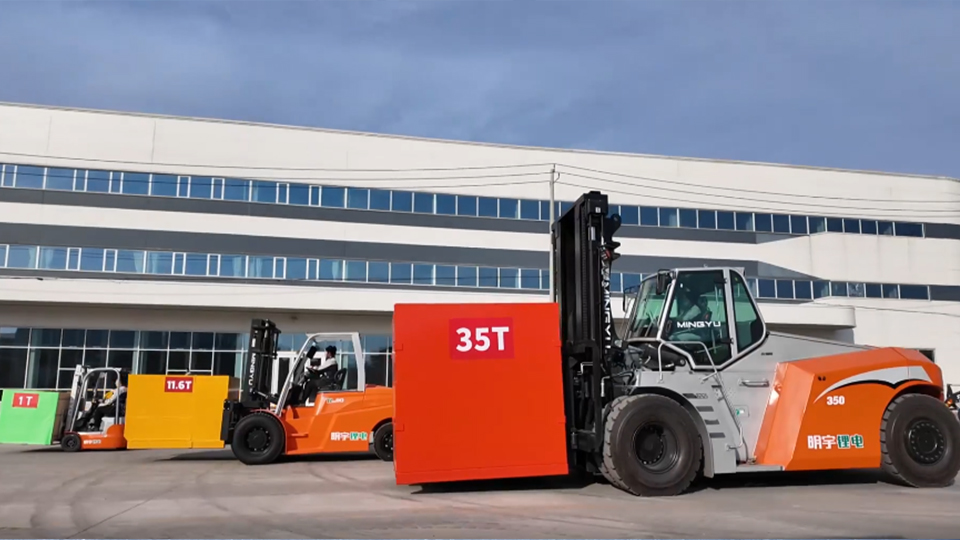
A "Small" Forklift: A typical 5,000-lb capacity forklift often has an empty weight (service weight) of approximately 9,000 lbs.
A Loaded Forklift: When carrying its maximum rated load, the total mass moving across the warehouse floor can exceed 14,000 lbs (7 tons).
By comparison, the average mid-size sedan weighs about 3,500 lbs. This means a loaded forklift carries the mass of four passenger cars concentrated into a footprint roughly the size of a loveseat.
2. The Momentum Equation: Why Speed is Deceptive
In physics, momentum ($p$) is the product of an object's mass ($m$) and its velocity ($v$):
$$p = m \times v$$
Because the mass ($m$) of a forklift is so high, even at low speeds, the momentum is immense.
The "Slow Speed" Fallacy
Many operators feel safe traveling at 8 or 10 mph because it "feels" slow. However, because momentum is linear to mass, a 14,000-lb forklift moving at 5 mph has more momentum than a 3,500-lb car moving at 15 mph.
When it comes to stopping, we must convert that momentum into Kinetic Energy ($E_k$), which follows the formula:
$$E_k = \frac{1}{2} m v^2$$
Note that velocity is squared. If an operator doubles their speed from 3 mph to 6 mph, they haven't just doubled the energy the brakes must dissipate—they have quadrupled it.
3. The Mechanics of the Forklift Braking System
Forklift brakes are not designed like automotive brakes. Most forklifts utilize Drum Brakes or Enclosed Wet Disc Brakes. While these are highly durable and offer high torque for holding positions on ramps, they are not designed for high-speed heat dissipation.
The Braking Force ($F$)
To stop the vehicle, the brakes must apply a force ($F$) over a distance ($d$) to do enough "work" to reduce the kinetic energy to zero. This is expressed as:
$$W = F \times d$$
Given that the force ($F$) the brakes can provide is limited by the friction between the tires and the floor, the only variable that can increase to compensate for high mass and velocity is the distance ($d$).
4. Factors Increasing Braking Distance
A. Friction and Tire Composition
Most indoor forklifts use solid cushion tires. These tires are made of hard rubber compounds designed to support massive weights without deflating.
Contact Patch: Solid tires have a much smaller contact patch than pneumatic (air-filled) tires.
Surface Tension: Warehouse floors are often polished concrete. When a 14,000-lb machine attempts an emergency stop, the friction coefficient ($\mu$) between hard rubber and polished concrete is remarkably low.
Skidding: Once the tires lock, the forklift enters a state of kinetic friction, which is always lower than static friction, causing the machine to "skate" across the floor.
B. Weight Distribution and Stability
A forklift’s center of gravity (CG) is dynamic.
Empty: The CG is toward the rear (the counterweight).
Loaded: The CG moves forward toward the "front-drive" axle.
If a forklift were equipped with "super-brakes" that could stop the wheels instantly, the machine would likely tip forward or the load would slide off the forks due to inertia. Therefore, forklift brakes are intentionally engineered to be "soft" enough to prevent a tip-over, which naturally increases the required stopping distance.
5. Total Stopping Distance: The Three-Part Calculation
Stopping a forklift isn't just about the brakes; it’s a chronological sequence of events.
|
Phase |
Description |
Factors |
|
Perception Distance |
The distance traveled from the moment a hazard is seen until the brain recognizes it. |
Operator alertness, lighting, visibility. |
|
Reaction Distance |
The distance traveled while the operator moves their foot to the brake pedal. |
Operator age, fatigue, ergonomics. |
|
Braking Distance |
The actual physical distance the forklift travels after brakes are applied. |
Weight, Momentum, Speed, Floor conditions. |
The 3-Truck Rule
Industry best practice (and common training) suggests maintaining a "3-truck length" following distance. This is based on the math that at a typical warehouse speed of 6-9 mph, an operator needs roughly 15 to 25 feet to come to a complete, safe stop without losing the load.
6. The Impact of Grades and Inclines
When a forklift operates on a ramp or incline, gravity adds a new vector to the momentum equation.
Descending a ramp: Gravity increases the acceleration. The brakes must not only overcome the vehicle's momentum but also the constant pull of gravity ($g$).
Formula adjustment: The braking distance increases significantly based on the percentage of the grade. On a 10% grade, a forklift may require double the distance to stop compared to a flat surface.
7. Technical Solutions and 2026 Best Practices
To mitigate the dangers of high momentum, modern forklift manufacturers (Toyota, Linde, Crown) have introduced advanced technical systems:
Automatic Speed Reduction: Sensors detect when a forklift is carrying a heavy load or is in a high-traffic zone and electronically cap the top speed.
Regenerative Braking: In electric models, the motor reverses its polarity to slow the vehicle down, providing a more controlled deceleration than mechanical friction alone.
Load-Sensing Braking: Some high-end models adjust the braking pressure based on the weight detected on the forks to prevent rear-wheel lift.
8. Summary of Physical Risks
High Gross Weight: Creates massive inertia that requires high friction to overcome.
Increased Momentum: Small increases in speed lead to exponential increases in stopping distance.
Low Traction: Hard tires on smooth floors provide poor "grip" during emergency stops.
Stability Constraints: Stopping too fast is just as dangerous as stopping too slow due to the risk of forward tip-overs.
Conclusion
The high gross weight and momentum of a forklift make it one of the most difficult vehicles to stop in an industrial environment. Physics dictates that you cannot "cheat" the relationship between mass and energy. For operators and facility managers, the solution lies in three areas: speed control, maintained floor conditions, and rigorous training on following distances.
Understanding that a loaded forklift has the destructive power of a slow-moving freight train is the first step in maintaining a zero-accident workplace.
Name: selena
Mobile:+86-13176910558
Tel:+86-0535-2090977
Whatsapp:8613181602336
Email:vip@mingyuforklift.com
Add:Xiaqiu Town, Laizhou, Yantai City, Shandong Province, China