
vip@mingyuforklift.com
+86-0535-2090977

Introduction
In the material handling industry, diesel forklifts remain the dominant power source for outdoor and heavy-duty applications despite the accelerating shift toward electric alternatives. Understanding exactly how much diesel a forklift consumes per operating hour is fundamental to operational budgeting, fleet optimization, and total cost of ownership (TCO) calculations. Unlike passenger vehicles where fuel economy is measured in kilometers per liter, industrial forklifts are evaluated by hourly consumption because their work is inherently time-based rather than distance-based. This article provides a rigorous, capacity-classified analysis of diesel forklift fuel consumption, examines the engineering factors that drive consumption variability, and offers practical frameworks for measurement, optimization, and cross-power-source comparison.
Baseline Consumption Rates by Capacity Class
Diesel forklift fuel consumption is not a monolithic figure. It scales directly with rated lifting capacity, engine displacement, hydraulic system demands, and duty cycle intensity. Industry data reveals four distinct consumption bands that correspond to capacity classes.
Compact Diesel Forklifts (1.5–2.5 Ton / 2,000–3,500 lbs)
Compact diesel forklifts equipped with 30–50 horsepower engines represent the entry point for internal combustion material handling equipment. These units are frequently deployed in retail distribution centers, light manufacturing facilities, and confined-space operations where fuel efficiency takes precedence over maximum lifting power. Under normal operating conditions, compact diesel forklifts consume approximately 2.0 to 3.8 liters per hour during active operation. For a standard 8-hour shift with approximately 6 productive operating hours, this translates to 12 to 22.8 liters per shift. Their smaller fuel tanks—typically 40 to 60 liters—require refueling every 2 to 3 shifts under standard usage patterns.
Standard Diesel Forklifts (3.0–3.5 Ton / 4,000–6,000 lbs)
The 3-ton and 3.5-ton categories constitute the most commercially significant segment of the diesel forklift market, serving as the workhorse for general warehousing, freight terminals, and manufacturing facilities. Industry benchmarks indicate consumption rates of 2.0 to 3.0 liters per hour for 3-ton models under normal conditions, with some sources indicating up to 3–5 liters per hour for 3.5-ton models under heavier duty cycles. For 3.5-ton capacity models, consumption generally falls between 3 and 5 liters per hour under medium-load conditions. A standard 3-ton diesel forklift consuming 2.5 liters per hour over an 8-hour shift with 6 productive hours would use approximately 15 liters per day, or roughly 16 to 24 liters for a full 8-hour operational period. Standard forklifts in this class typically feature fuel tanks ranging from 60 to 80 liters, providing 2 to 3 shifts of autonomy.
Heavy-Duty Diesel Forklifts (5.0–7.0 Ton / 8,000–14,000 lbs)
As lifting capacity increases to 5 tons and above, fuel consumption rises proportionally due to larger engine displacement and increased hydraulic power requirements. A 5-ton diesel forklift consumes between 3.0 and 5.0 liters per hour under standard working conditions, with some sources indicating rates as high as 4.5 to 6.0 liters per hour for 5-to-7-ton models. During sustained maximum-capacity operations or rough-terrain movement, consumption can escalate to 7–8 liters per hour. For a 5-ton model operating 6 productive hours per shift, standard operations would consume approximately 33 liters per shift, while intensive operations could reach 45 liters. Heavy-duty models engaged in continuous loading, lumber handling, or steel fabrication may see consumption approach 10–15 liters per hour during peak intensity, translating to 60–90 liters per shift under extreme conditions. These applications require fuel tanks of 100 liters or more or mid-shift refueling protocols.
Industrial Diesel Forklifts (10+ Ton / 20,000+ lbs)
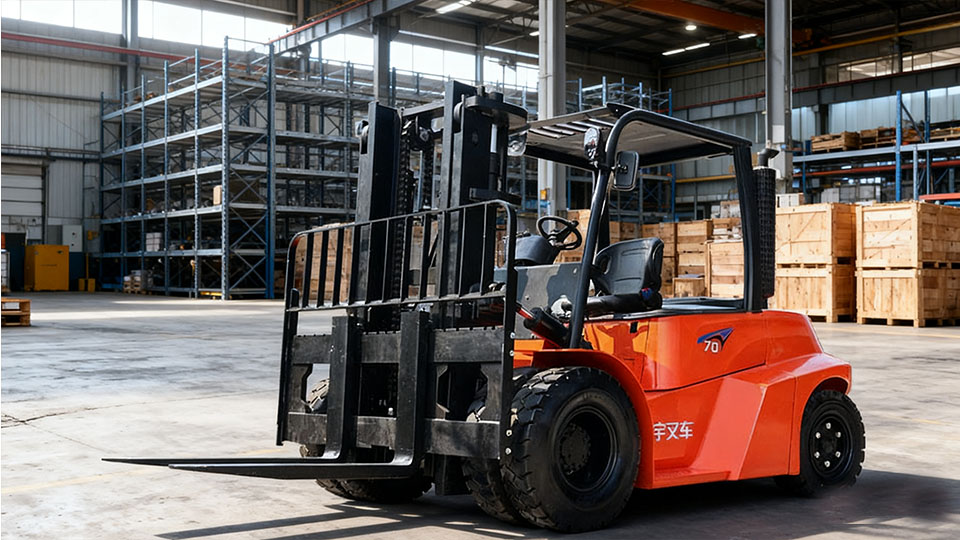
Industrial-scale diesel forklifts used in shipping ports, steel fabrication facilities, and heavy construction sites represent the highest consumption category. These machines, with engine powers ranging from 150 to 278 horsepower, can consume 10 to 15 liters per hour or more. While their absolute fuel consumption is substantial, operational cost analysis must consider productivity gains: a single heavy-duty unit may complete tasks that would require multiple trips with smaller forklifts, potentially reducing total fleet fuel consumption when measured on a per-ton-moved basis.
Theoretical Framework for Fuel Consumption Calculation
Beyond empirical benchmarks, diesel forklift fuel consumption can be estimated using engineering formulas derived from internal combustion engine thermodynamics. The foundational calculation approach begins with a general industry rule of thumb: a diesel forklift engine will consume approximately 2.0 to 3.5 liters of fuel per hour for every 100 horsepower it produces. This provides a rough baseline for initial estimation.
For a more precise manufacturer-endorsed calculation, the following formula applies:
Hourly Consumption (liters) = Engine Horsepower (HP) × Specific Fuel Consumption (SFC) × Conversion Factor
Where:
Specific Fuel Consumption (SFC) for a standard diesel engine typically ranges from 0.3 to 0.4 pounds of fuel per horsepower per hour
Conversion Factor from pounds of diesel to liters is approximately 0.173 (since one liter of diesel fuel weighs roughly 5.76 pounds)
For example, a 100 HP diesel forklift would theoretically consume:
100 HP × 0.35 lb/HP/hr × 0.173 = 6.055 liters per hour
This value serves as a strong theoretical starting point under ideal, steady-state conditions. However, real-world consumption deviates from this theoretical baseline due to load variability, idle time, hydraulic demands, and operator behavior.
Critical Variables Affecting Hourly Consumption
Understanding typical consumption requires acknowledging that "typical" is a statistical abstraction. Multiple variables cause significant deviation from baseline figures, and fleet managers must account for these factors when budgeting and optimizing operations.
Engine Technology and Emission Compliance
Modern diesel forklifts are subject to stringent emission regulations, including EPA Tier 4 Final in North America and Euro Stage V in Europe. These standards mandate dramatic reductions in particulate matter (PM) and nitrogen oxides (NOx). To achieve compliance, manufacturers employ technologies such as Diesel Particulate Filters (DPF), Selective Catalytic Reduction (SCR) systems using Diesel Exhaust Fluid (DEF), and Exhaust Gas Recirculation (EGR). While these systems reduce environmental impact, they can increase fuel consumption by 3–8% compared to pre-Tier 4 engines due to backpressure from DPFs and the energy demands of exhaust after-treatment. Newer models with optimized electronic fuel injection and variable geometry turbochargers partially offset these losses, with some manufacturers achieving fuel efficiency benchmarks of ≤3.5 liters per hour under standard load for 3-ton models.
Duty Cycle Intensity: The VDI 60 Standard
The VDI 60 duty cycle—a rigorous German engineering standard measuring fuel consumption over 60 intensive lifting and transport cycles within a single hour—provides a standardized baseline for comparing forklift efficiency across manufacturers. However, real-world operations rarely achieve VDI 60 intensity consistently throughout a shift.
Light-duty cycles (retail stock replenishment, light assembly support): typically achieve only 40–60% of VDI 60 intensity. A forklift rated at 4.0 L/h under VDI 60 conditions may consume only 2.0 to 2.5 L/h in actual light-duty operation.
Medium-duty cycles (standard warehousing with mixed loading/unloading): typically operate at 60–80% of VDI 60 intensity, representing the baseline assumption for most per-shift consumption estimates.
Heavy-duty cycles (continuous loading, port logistics, steel handling): may approach or exceed VDI 60 intensity, pushing consumption to the upper bounds of manufacturer specifications.
Idle Time and Operational Discipline
One of the most overlooked consumption drivers is engine idling. Diesel forklift engines at idle typically consume 0.3 to 0.4 gallons per hour (approximately 1.1 to 1.5 liters per hour), depending on engine displacement and idle speed settings. A 3.5-ton forklift with a 3.0 L/h active consumption rate may still burn 1.0 L/h at idle. In a poorly managed operation where a forklift idles for 2 hours within an 8-hour shift, idle consumption adds 2 liters to the shift total—a 10–15% increase over productive-only consumption.
Modern diesel forklifts increasingly incorporate auto-idle shutdown systems that automatically stop the engine after predetermined idle intervals—typically 5 to 10 minutes. These systems can reduce annual fuel consumption by 15–20% in operations with significant idle periods. Beyond technological solutions, operator behavior profoundly impacts idle-time consumption. Trained operators who consistently shut down engines during breaks exceeding three minutes and avoid unnecessary warm-up idling can achieve per-shift consumption reductions of 10–20%.
Load Weight and Hydraulic Demand
Fuel consumption scales directly with the mechanical work performed. A forklift operating at 50% of rated capacity on flat, smooth surfaces will consume significantly less fuel than the same unit lifting maximum loads at full mast extension on inclined ramps. Hydraulic systems demand substantial engine power during lifting operations, and frequent high-reach stacking cycles increase consumption disproportionately compared to horizontal transport tasks.
Terrain and Environmental Conditions
Outdoor operations on rough terrain, gravel, or unpaved surfaces increase rolling resistance and require higher engine output to maintain travel speed. Pneumatic tires, commonly used for outdoor applications, must be maintained at correct air pressure to minimize rolling resistance. Underinflated tires can increase fuel consumption by 5–10%. Additionally, extreme ambient temperatures affect engine efficiency: cold-start conditions require longer warm-up periods and richer fuel mixtures, while high-heat environments may reduce air density and combustion efficiency.
Transmission Architecture: Hydrostatic vs. Powershift
Two transmission architectures dominate the diesel forklift market: hydrostatic (variable displacement pump driving a hydraulic motor) and powershift (torque converter with multi-speed gearbox). Hydrostatic transmissions provide infinite speed control and superior inching capability, reducing operator fatigue by 30–40% in applications requiring frequent direction changes. However, hydrostatic systems consume 15–20% more fuel than powershift at steady-state travel because of hydraulic efficiency losses. Powershift transmissions are simpler and more durable for applications with long travel distances (yard operations, container terminals) but require clutch pedal use for precise inching. Transmission failure data from 1,200 diesel forklifts shows that hydrostatic units have a mean time between failures (MTBF) of 8,000 hours, compared to 12,000 hours for powershift units. However, hydrostatic repair costs are 40–50% lower because failed components are individual pumps and motors rather than entire gearbox assemblies.
Comparative Analysis: Diesel vs. LPG vs. Electric
Understanding diesel forklift fuel consumption requires contextual comparison with alternative power sources. The decision between diesel, LPG, and electric forklifts hinges on three variables: duty cycle, operating environment, and fuel infrastructure.
Diesel forklifts achieve 6–8 hours of continuous operation on a 15-gallon tank, compared to 4–5 hours for a standard LPG cylinder. Refueling a diesel forklift takes 3 minutes; changing an LPG cylinder takes 5–6 minutes; recharging an electric forklift requires 8 hours for a full charge or 30–45 minutes for a fast charge (which reduces battery life by 40%). For multi-shift operations, diesel requires no battery swapping infrastructure, no spare batteries costing $6,000–10,000 each, and no dedicated charging area with ventilation.
Metric Diesel (8,000 lb capacity) LPG (8,000 lb) Electric (8,000 lb)
Fuel/energy cost per hour (USD) $4.20–$5.80 $5.50–$7.50 $1.80–$2.50
Maintenance cost per hour (USD) $1.20–$1.80 $1.40–$2.10 $0.80–$1.20
Battery/replacement cost per hour $0.05 $0.03 $0.90–$1.30
Total cost per hour $5.45–$7.65 $6.93–$9.63 $3.50–$5.00
Electric appears cheaper per hour until battery replacement is included. A single 48V, 900Ah battery costs $8,000–12,000 and lasts 4–5 years in heavy use, adding over $1 per hour. Diesel forklifts also maintain power output throughout the shift; electric units experience voltage drop below 30% charge, reducing lift speed and travel speed by up to 40% in the final hour of operation.
Practical Measurement and Fleet Management Methodologies
Accurate fuel consumption tracking is essential for cost control and operational optimization. The most reliable method for determining a specific forklift's consumption rate is empirical measurement:
Step 1: Fill the diesel tank to maximum capacity at the beginning of a shift.
Step 2: Record the exact operating hours (distinguishing between clock hours and productive engine runtime).
Step 3: At the end of the shift, refill the tank and record the precise volume of fuel added.
Step 4: Divide the fuel added by the operating hours to obtain liters per hour.
For fleet-wide optimization, telematics systems have become increasingly prevalent. These systems track fuel consumption in real-time, correlate usage with operator identification, monitor idle time, and generate efficiency reports. Advanced systems can calculate fuel consumption per pallet moved rather than per hour, providing a more meaningful productivity metric. When sites oversize trucks, accept rough layouts, or neglect filters and tires, liters per hour climb and stay high. Conversely, right-sized forklifts, smooth travel paths, strict preventive maintenance, and trained operators can pull a fleet toward the lower end of each fuel band.
Economic and Environmental Context
At April 2026 diesel prices of approximately $3.29 per liter in some markets, a single 2-ton diesel forklift operating 2,000 hours per year at 2.5 liters per hour would incur annual fuel costs exceeding $16,000. This figure does not include maintenance expenses, which for diesel forklifts typically range from $3,000 to $5,000 annually due to engine-related servicing—oil changes, filter replacements, fuel system checks, and exhaust maintenance—recurring every 250–500 operating hours.
From an environmental perspective, diesel forklifts produce significant CO₂ emissions. A 2.5-ton diesel forklift consuming 2–3 liters per hour generates approximately 5,280–7,920 grams of CO₂ per hour from combustion alone, plus an additional 1,000–1,800 grams from the well-to-tank fuel production process. In contrast, lithium-ion electric forklifts operating on the European average grid mix produce approximately 1,375 grams of CO₂ per hour—a reduction of roughly 75%. This environmental differential, combined with rising fuel costs and tightening emission regulations, is accelerating the shift toward fleet electrification in indoor and light-duty applications. However, for heavy-duty outdoor operations requiring continuous high-torque performance, diesel forklifts remain economically and operationally justified despite their higher fuel consumption.
Conclusion
The amount of diesel a forklift consumes per operating hour cannot be expressed as a single figure—it is a distribution dependent on capacity class, duty cycle, engine technology, and operational discipline. As a practical summary:
Compact forklifts (1.5–2.5 ton): 2.0–3.8 L/h
Standard forklifts (3–3.5 ton): 2.0–5.0 L/h
Heavy-duty forklifts (5–7 ton): 3.0–6.0 L/h (up to 8 L/h under maximum load)
Industrial forklifts (10+ ton): 10–15+ L/h
For general budgeting purposes, a broad industry estimate places typical diesel forklift consumption at 3 to 6 liters per hour for the most common 3-to-5-ton capacity range under standard operating conditions. Fleet managers should treat fuel consumption as a controllable Key Performance Indicator rather than a fixed cost. Through empirical measurement, telematics monitoring, operator training, preventive maintenance, and idle-time management, organizations can achieve consumption reductions of 10–20% below baseline averages—translating to substantial financial savings and reduced environmental impact across the operational lifecycle of their diesel forklift fleets.
Name: selena
Mobile:+86-13176910558
Tel:+86-0535-2090977
Whatsapp:8613181602336
Email:vip@mingyuforklift.com
Add:Xiaqiu Town, Laizhou, Yantai City, Shandong Province, China
