
vip@mingyuforklift.com
+86-0535-2090977

Abstract
Animal husbandry and farm operations present some of the most demanding environments for material handling equipment. Unlike controlled warehouse or factory settings, agricultural outdoor operations expose machinery to mud, manure, corrosive moisture, temperature extremes, and uneven terrain while requiring the movement of irregular loads ranging from bulk feed and hay bales to livestock and veterinary supplies. Selecting appropriate outdoor handling equipment demands technical evaluation of terrain characteristics, load profiles, climatic conditions, biosecurity requirements, and total cost of ownership under punishing duty cycles. This article provides a systematic framework for evaluating and selecting outdoor handling equipment tailored to the unique operational realities of modern animal husbandry.
1. Introduction: The Agricultural Handling Challenge
Farm-based material handling diverges fundamentally from industrial logistics in nearly every dimension. The operating surface is rarely concrete; it is compacted earth, gravel, pasture, or mud that varies seasonally and daily with weather. Loads are non-standard—round hay bales weighing half a ton, bulk feed in flexible totes, manure spreaders, portable fencing panels, and occasionally live animals. Operating hours extend from pre-dawn feeding to late-evening barn checks, often in conditions that would idle construction or warehouse equipment.
For animal husbandry operations specifically, handling equipment must navigate a complex landscape of biosecurity protocols, animal welfare considerations, and regulatory compliance while maintaining economic viability on thin agricultural margins. The wrong equipment selection results not merely in inefficiency but in concrete financial losses: spoiled feed, injured livestock, missed veterinary windows, operator fatigue, and premature machinery failure. The selection process therefore requires rigorous technical matching of equipment capabilities to the multifaceted demands of the farm environment.
2. Terrain Analysis: The Foundation of Equipment Selection
Before evaluating specific machines, the operator must characterize the physical terrain across which equipment will travel.
Surface Composition: Dairy operations with concrete feed lanes and paved barnyards face different traction and ground-pressure requirements than beef cattle ranches with native pasture access or pig farms with compacted clay lots that turn to impassable mud during spring thaw. Equipment selection must account for the weakest surface condition encountered during normal operations, not merely the ideal summer scenario.
Slope and Drainage: Farm topography influences stability requirements significantly. Equipment operating on slopes greater than 5 degrees requires enhanced stability features, lower centers of gravity, and often four-wheel drive. Poor drainage areas that accumulate standing water or slurry demand higher ground clearance and sealed electrical systems.
Access Widths: Gate openings between pastures, barn aisles, and storage shed doors dictate maximum machine width. A loader that cannot pass through a 2.4-meter gate is useless regardless of its lift capacity. Standard agricultural gate widths, barn door clearances, and lane widths must be documented and treated as hard constraints in equipment specification.
3. Load Profile Characterization
Animal husbandry generates diverse handling tasks that must be catalogued before equipment selection.
Bulk Feed and Forage: Hay bales—whether small square, large square, or round—represent high-volume, seasonal handling peaks. Round bales weighing 400–600 kilograms require bale spears or grapple attachments and sufficient lift capacity at full extension. Bagged feed, mineral supplements, and bedding materials arrive on pallets or in bulk totes requiring pallet fork capability.
Manure and Compost: Manure handling represents a continuous, high-volume material flow in confined animal operations. Front-end loaders, skid-steer loaders, or compact wheel loaders move manure from barns to storage or composting areas. Corrosive manure gases and moisture demand protected components and frequent washdown capability.
Livestock Movement: While dedicated livestock handling systems exist, general farm equipment frequently assists in moving portable panels, chutes, and handling equipment. Some operations use equipment to relocate portable shelters or feeding rings across pasture.
Veterinary and Supply Logistics: Pharmaceuticals, veterinary equipment, and replacement parts must move from storage to barns, often under time-sensitive conditions requiring reliable all-weather mobility.
4. Equipment Category Evaluation
The agricultural equipment market offers several categories suited to outdoor animal husbandry, each with distinct economic and technical profiles.
Compact Utility Tractors with Loaders: Perhaps the most versatile option for small to medium operations, compact tractors (20–60 horsepower) with front-end loaders handle palletized feed, move manure, and operate PTO-driven implements such as blowers or pumps. Their three-point hitch expands functionality beyond material handling to tillage and mowing. However, their loader cycle speeds and maneuverability in tight confinement buildings lag dedicated skid-steer loaders.
Skid-Steer and Compact Track Loaders: These units excel in confined spaces such as freestall barns, feeding alleys, and manure storage areas. Skid-steer loaders with wheels perform well on firm surfaces but struggle in mud; compact track loaders distribute weight across rubber tracks, dramatically improving flotation on soft ground and reducing ground disturbance in pastures. Lift capacity ranges from 600 kilograms to over 1.5 tons, with radial or vertical lift paths selected based on dump height requirements into spreaders or trucks.
Rough Terrain Forklifts (Telehandlers): For operations requiring significant lift height—stacking hay in barns, loading feed trucks, or placing materials in elevated storage—telehandlers offer extendable booms and substantial lift capacities. They bridge the gap between forklifts and cranes, providing reach and height that neither tractors nor skid-steers achieve. However, their size and cost make them economical only for larger operations or those with specific high-reach requirements.
All-Terrain Forklifts and Mast Forklifts: Standard warehouse forklifts are unsuitable for farm conditions, but all-terrain variants with pneumatic tires, increased ground clearance, and sealed components adapt to outdoor farm use. These units suit operations with significant palletized feed or supply handling on semi-improved surfaces.
Utility Vehicles (UTVs) and ATVs: While not material handling equipment in the traditional sense, UTVs with cargo beds or small trailers handle light logistics across large acreages. They move tools, vaccines, and small supplies to remote pastures or buildings faster than walking and more economically than firing up a tractor for a five-kilogram payload.
5. Traction, Flotation, and Ground Disturbance
The interaction between equipment and ground surface is a critical technical parameter in farm selection.
Tire vs. Track Systems: Pneumatic tires provide speed and lower maintenance on firm surfaces but sink and slip in mud or loose manure. Foam-filled or solid tires eliminate puncture risk from barn debris but transmit more vibration and provide less traction cushioning. Rubber tracks offer superior flotation—distributing machine weight across a larger footprint—enabling operation on soft pasture without tearing turf or creating ruts that become mud wallows. For rotational grazing operations where equipment must cross pasture regularly, track systems or flotation tires are essential to prevent pasture degradation.
Four-Wheel Drive Requirements: Two-wheel drive equipment suffices for firm, level feed lanes and barnyards. However, any operation encountering mud, snow, or slopes should specify four-wheel drive. The incremental cost is modest compared to the operational limitations of stuck equipment during critical feeding or manure removal windows.
Ground Pressure Calculations: For sensitive areas such as septic drain fields, pasture renovation sites, or around underground water lines, ground pressure measured in pounds per square inch or kilopascals becomes a selection criterion. Compact track loaders typically exert ground pressure below 35 kPa, comparable to a human footprint, while wheeled skid-steers may exceed 55 kPa.
6. Power Source Selection: Diesel, Electric, and Alternative Fuels
The choice of powerplant involves trade-offs between torque, emissions, noise, fuel availability, and maintenance.
Diesel Engines: Diesel remains the dominant power source for agricultural handling equipment due to high torque at low RPM, fuel efficiency under load, and widespread refueling infrastructure on farms. Modern Tier 4 Final or Stage V diesel engines incorporate exhaust after-treatment (DPF, SCR) that introduces maintenance complexity and heat generation concerns in confined barn spaces. Diesel particulate filter regeneration cycles must be understood by operators to prevent fire risks near combustible bedding or dust.
Electric and Hybrid Options: Battery-electric loaders and forklifts are emerging in agricultural markets, particularly for indoor barn use where ventilation is limited and noise stress affects livestock. Electric units eliminate tailpipe emissions in enclosed barns, reduce noise that disturbs animals, and simplify maintenance by eliminating engine oil, coolant, and fuel systems. However, battery range limitations, charging infrastructure requirements, and performance degradation in extreme cold constrain their outdoor utility. For operations with short-cycle, predictable routes—such as moving feed from storage to a nearby feed mixer—electric equipment may prove economically viable.
Propane and Natural Gas: Converted propane engines offer cleaner combustion than diesel with reduced particulate emissions, making them suitable for semi-enclosed barns. Propane stores indefinitely without degradation, unlike diesel which requires winterization and algae prevention. On-farm propane infrastructure is common for grain drying and heating, creating fuel availability synergy.
7. Attachment Strategy and Implement Compatibility
The economic justification for farm handling equipment depends heavily on attachment versatility.
Bale Handling: Round bale spears, grapples, and squeeze attachments must match bale dimensions and densities. A single round bale spear suffices for basic movement, while hydraulic grapples provide security when transporting bales over uneven terrain or stacking at height. Large square bale handlers require different clamp geometries.
Pallet and Fork Work: Standard pallet forks handle bagged feed, bedding bales, and supply deliveries. Forks with adjustable spacing accommodate non-standard pallet sizes common in agricultural supply chains. Fork covers or load backrests prevent damage to feed bags and improve stability.
Buckets and Scrapers: General-purpose buckets move manure, bedding, snow, and bulk materials. High-dump buckets extend reach for loading spreaders or trucks. Manure scrapers and barn cleaners, whether powered by the loader hydraulics or PTO, automate the most labor-intensive daily task in confined animal operations.
Grapples and Forks for Debris: Storm cleanup, demolition of old structures, and brush clearing require grapple attachments that extend equipment utility beyond routine material handling, improving capital utilization rates.
8. Environmental Protection and Component Sealing
Farm environments destroy improperly protected equipment through accelerated corrosion, contamination, and thermal stress.
Corrosion Resistance: Manure gases, urine, silage acids, and road salt create highly corrosive conditions. Galvanized or powder-coated frames, stainless steel fasteners, and sealed electrical connectors extend service life. Equipment specifically marketed for agricultural or waste-handling applications typically incorporates enhanced corrosion protection compared to construction-grade equivalents.
Sealed Systems: Axles, bearings, and electrical enclosures must resist pressure washing and immersion in manure slurry. IP ratings for electrical components should be verified, with IP65 or higher recommended for frequent washdown environments.
Cooling System Protection: Radiators and cooling fins clog rapidly in dusty barn environments and during hay handling. Reversible cooling fans that purge debris, wide-fin radiators, and debris screens reduce overheating incidents that idle equipment during critical work windows.
9. Operator Environment and Ergonomic Safety
Farm equipment operators often work extended shifts under physical and mental stress. Ergonomic design reduces fatigue, which directly correlates with accident prevention and productivity.
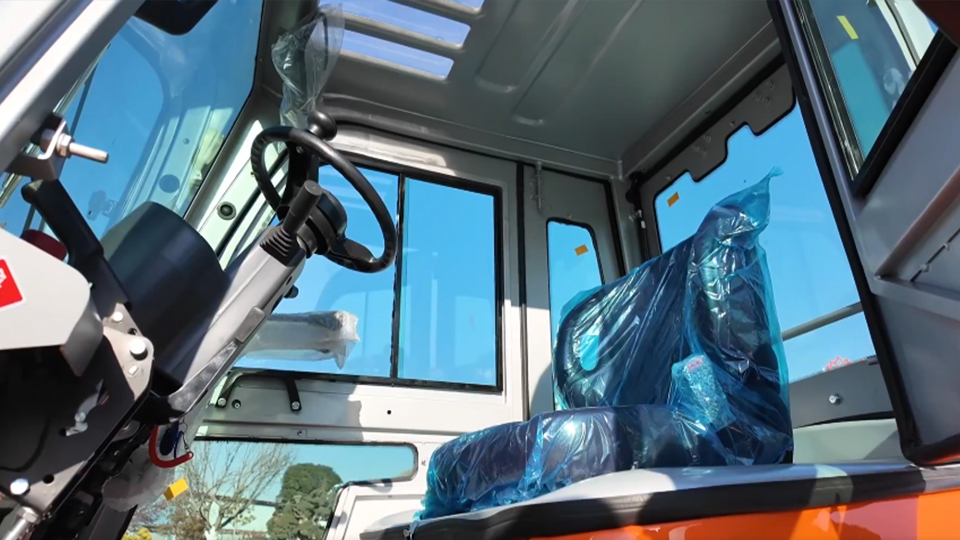
Cab Design: Enclosed cabs with heating, ventilation, and air filtration protect operators from dust, ammonia, and temperature extremes. Suspended seats reduce spinal stress during transport across rough terrain. For operations working in all weather, cab enclosure is not a luxury but a productivity and retention tool.
Visibility: Operating around livestock, in tight barns, and near equipment requires excellent sight lines. Large glass areas, rear-view cameras, and convex mirrors reduce blind spots. In operations where children or untrained helpers may be present, visibility becomes a safety-critical specification.
Controls: Joystick controls integrated into the armrest reduce operator movement and fatigue. Pilot-hydraulic or electro-hydraulic controls provide precise, low-effort operation that improves smoothness when handling fragile loads or working near animals.
10. Biosecurity and Sanitation Protocols
Modern animal husbandry operates under strict biosecurity frameworks where equipment can vector disease between barns, farms, or production zones.
Washdown Compatibility: Equipment must withstand high-pressure washing with disinfectants and foaming agents. This demands sealed electrical systems, protected bearings, and corrosion-resistant finishes. Equipment with numerous crevices, unsealed harnesses, or exposed wiring quickly becomes a biosecurity liability.
Zone Dedication: Some operations dedicate specific equipment to specific barns or production phases (breeding, nursery, finishing) to prevent cross-contamination. In such cases, multiple smaller units may replace a single large machine, altering the economic calculation toward lower-capacity, lower-cost equipment.
Tire and Track Decontamination: Equipment moving between farms or between distinct zones within a large operation requires tire washing stations. Track systems are more difficult to decontaminate between zones than smooth tires, presenting a biosecurity trade-off against their traction advantages.
11. Maintenance Architecture and Uptime
Farm operations often lack dedicated maintenance staff and cannot tolerate extended downtime during planting, harvest, or critical animal care periods.
Service Accessibility: Daily service points—engine oil checks, grease fittings, air filters, and hydraulic fluid levels—must be accessible from ground level without disassembly. Equipment requiring panels to be removed for routine checks will be neglected in practice.
Dealer and Parts Network: Equipment from manufacturers with strong agricultural dealer networks ensures parts availability and technician expertise. Exotic or construction-oriented brands may offer lower purchase prices but impose unacceptable downtime costs when proprietary components fail during critical periods.
Preventive Maintenance Scheduling: Maintenance must align with seasonal farm calendars. Major overhauls should occur during lower-demand periods, while pre-season inspections prevent failures during peak dependency windows.
12. Regulatory Compliance and Safety Standards
Agricultural equipment operates under regulatory frameworks that vary by jurisdiction but increasingly emphasize rollover protection, operator certification, and emissions compliance.
ROPS and FOPS: Roll-Over Protective Structures and Falling Object Protective Structures are mandatory in many regions and prudent everywhere. Open-station equipment without ROPS should be rejected for any slope or overhead work application.
Operator Training and Certification: Many jurisdictions now require formal training and certification for agricultural loader and forklift operators. Equipment selection should account for training requirements; complex machines with unintuitive controls increase training burden and accident risk.
Emissions Compliance: Non-road diesel emissions regulations continue tightening. Equipment purchased for long service life should comply with current and anticipated future standards to avoid operational restrictions or resale limitations.
13. Economic Analysis and Total Cost of Ownership
The purchase price of farm handling equipment often misleads operators about true economic impact.
Utilization Rate: The most expensive machine is the one that sits idle. Small operations should evaluate whether a versatile tractor-loader can handle 90% of tasks acceptably, rather than acquiring dedicated skid-steer, telehandler, and forklift units that each see only occasional use.
Fuel and Fluid Costs: Diesel consumption per operating hour, DEF (diesel exhaust fluid) consumption for modern emissions-compliant engines, hydraulic fluid replacement intervals, and grease requirements accumulate significantly over equipment life.
Resale Value: Agricultural equipment from reputable brands with strong dealer support retains value better than discount alternatives. Depreciation curves should be modeled over the expected holding period.
Labor Substitution: The economic justification for mechanized handling often rests on labor savings. In regions with high agricultural labor costs or scarce labor availability, equipment that reduces headcount or shifts tasks to lower-skill operators generates rapid payback.
14. Conclusion
Selecting outdoor handling equipment for animal husbandry and farms is an exercise in environmental matching and economic discipline. The ideal machine does not merely lift the required load; it traverses the actual terrain, withstands the corrosive atmosphere, complies with biosecurity protocols, fits through existing accessways, and operates reliably when animals depend on timely feeding and care.
Successful selection begins with honest documentation of the operating environment—surfaces, slopes, weather patterns, and access constraints—followed by rigorous load profiling across seasonal cycles. Equipment categories should be evaluated not on specification sheet superiority but on functional fit to documented tasks. Power source selection must balance torque requirements against ventilation constraints and fuel logistics. Attachment versatility maximizes capital productivity, while corrosion protection and sealed systems determine whether equipment survives its first service contract.
As animal agriculture intensifies and labor availability tightens globally, the role of mechanized material handling on farms only grows. The operations that thrive will be those that treat equipment selection as a technical systems engineering problem—matching machine to mission with the same precision they apply to nutrition, genetics, and veterinary care. In the unforgiving environment of the working farm, the right handling equipment is not merely an operational convenience; it is a foundational pillar of animal welfare, biosecurity, and economic survival.
Name: selena
Mobile:+86-13176910558
Tel:+86-0535-2090977
Whatsapp:8613181602336
Email:vip@mingyuforklift.com
Add:Xiaqiu Town, Laizhou, Yantai City, Shandong Province, China