
vip@mingyuforklift.com
+86-0535-2090977

1. The Engineering of Off-Road Capability
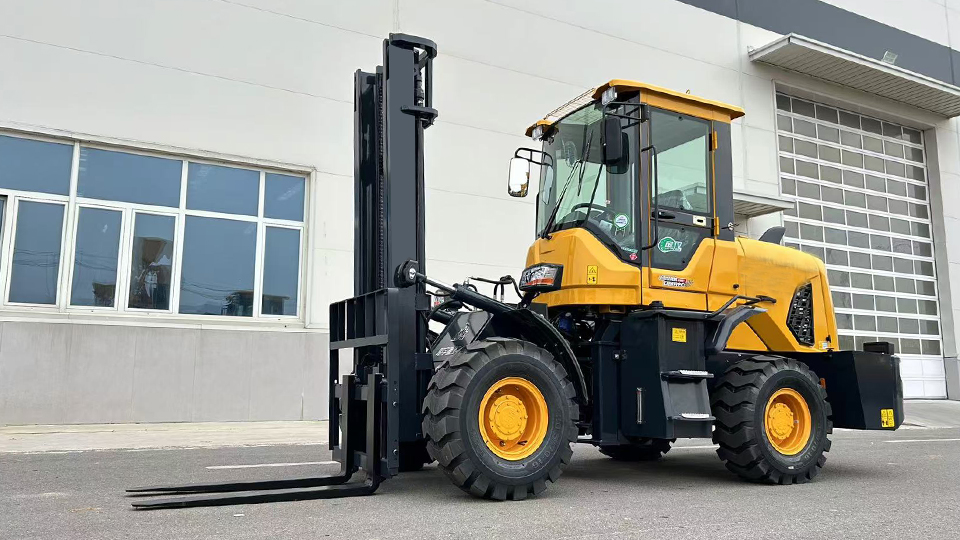
To understand the uses of an off-road forklift, one must first understand the mechanical advantages that differentiate it from a standard mast forklift.
Pneumatic Tires: These are large, deep-treaded tires that provide "flotation." This allows the machine to distribute its weight over a larger surface area, preventing it from sinking into mud or sand.
Articulated Chassis or Four-Wheel Drive: Many off-road models feature 4WD and 4-wheel steering, allowing for maximum traction and maneuverability in confined, muddy spaces.
Differential Lock: This mechanical feature locks the drive wheels together, ensuring that if one wheel is spinning in the mud, the other still receives power to pull the machine out
Oscillating Axles: These allow the wheels to move up and down independently, keeping all four tires in contact with the ground even when driving over rocks or debris.
2. Construction Site Operations
The most prevalent use of off-road forklifts is in the construction industry. Before a building has a finished floor, it is a site of dirt, ruts, and scattered materials.
Material Distribution
In the early stages of a project, semi-trucks deliver lumber, steel beams, and pallets of bricks to the edge of the site. A standard forklift cannot venture into the "red dirt" to retrieve them. Off-road forklifts act as the bridge, transporting these heavy materials from the delivery zone directly to the footings of the structure.
Scaffolding Support
The Telehandler (a specific type of off-road forklift with a telescoping boom) is used to lift pallets of mortar or bricks directly onto elevated scaffolding. Because they have outriggers for stability, they can lift thousands of pounds several stories high.
3. Agriculture and Farming
Agriculture requires the movement of heavy, bulk goods over vast acreage. Off-road forklifts are indispensable in this sector.
Field Harvesting
During harvest season, large "bins" or "totes" are placed in the fields. Off-road forklifts follow the harvesting crews, picking up full bins of apples, potatoes, or citrus and loading them onto flatbed trailers located on unpaved farm roads.
Livestock Management
Farmers use these machines to move large hay bales (which can weigh up to 1,500 lbs) and pallets of feed across muddy paddocks. The high ground clearance is critical here to avoid "high-centering" on uneven pasture land.
4. Lumber Yards and Forestry
The timber industry involves moving long, heavy, and often unbalanced loads over gravel or dirt yards.
Log Handling: Specialized off-road lifts equipped with "log clamps" (grapples) are used to move raw timber from transport trucks to the mill.
Finished Lumber: Once the wood is milled, it is stacked in outdoor drying yards. The weight of green lumber is immense, and the stability of an off-road forklift’s wide stance is required to prevent tipping on the gravel surface.
5. Infrastructure and Utility Work
Off-road forklifts are frequently seen in the development of power lines, wind farms, and pipelines.
Pipeline Laying: They are used to move segments of heavy pipe into position across remote, cross-country stretches.
Utility Pole Installation: In remote areas where crane trucks cannot reach, a rough terrain forklift can carry and help position utility poles into their pre-dug holes.
6. Military and Disaster Relief
The military uses highly specialized, often armored, off-road forklifts for logistical support in "expeditionary" environments.
Supply Drops: When supplies are dropped in remote areas without a developed port or airport, off-road forklifts are the only way to clear the landing zone.
Disaster Recovery: Following a flood or earthquake, roads are often covered in debris. Rough terrain forklifts are used by NGOs and government agencies to move pallets of water and medical supplies over ruined infrastructure.
7. Safety and Stability Considerations
Using a forklift off-road introduces a variable that indoor operators never face: the changing slope.
The Dynamic Center of Gravity
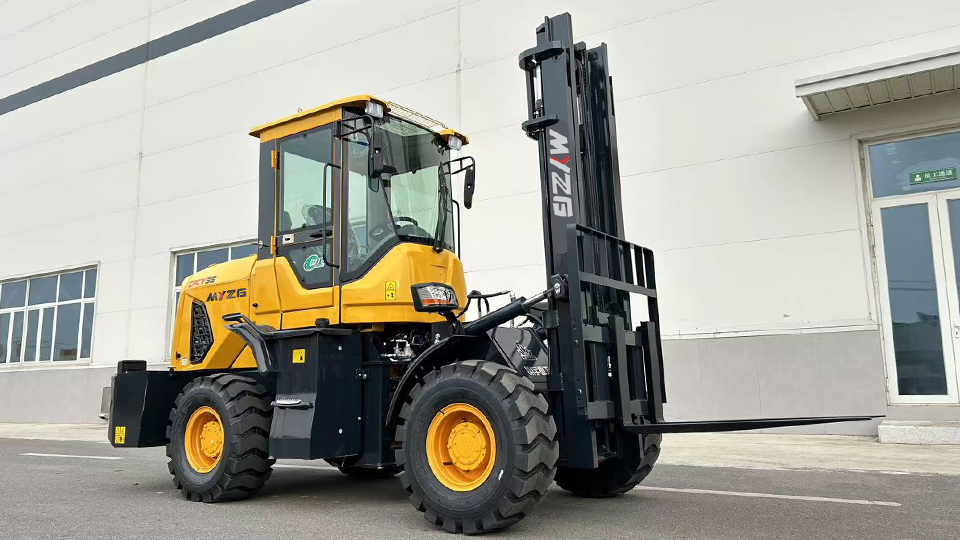
On a flat warehouse floor, the center of gravity is predictable. On a 10-degree incline, the center of gravity shifts toward the downhill side. Off-road forklifts are often equipped with frame leveling (or "tilt-to-ground") systems. This allows the operator to tilt the entire chassis of the machine to keep the mast perfectly vertical, even if the wheels are on a slope.
Technical Warning: Most forklift tip-overs occur when an operator attempts to turn on a slope or drives with the load raised too high on uneven ground.
Conclusion
The off-road forklift is the vital link between civilized infrastructure and the raw environment. By combining the lifting power of a crane with the mobility of a tractor, these machines enable large-scale construction, efficient farming, and rapid disaster response. As engineering improves, we are seeing more "hybrid" models that offer the precision of a warehouse truck with the brute force of a Class VII machine.
Name: selena
Mobile:+86-13176910558
Tel:+86-0535-2090977
Whatsapp:8613181602336
Email:vip@mingyuforklift.com
Add:Xiaqiu Town, Laizhou, Yantai City, Shandong Province, China
