
vip@mingyuforklift.com
+86-0535-2090977

Introduction
Warehouse real estate is among the most expensive operational assets in the supply chain. In major logistics hubs, industrial lease rates have climbed steadily, driven by e-commerce growth, last-mile delivery demands, and limited new construction. For many distribution and fulfillment operations, the traditional response to capacity constraints—building or leasing additional square footage—is financially untenable. The alternative, and increasingly the preferred strategy, is to extract more productivity from existing cubic volume by narrowing aisles and deploying specialized material handling equipment.
This article examines narrow-aisle warehouse solutions, the equipment technologies that enable them, and the operational adjustments required to achieve space utilization improvements of up to 40%. It is written for warehouse managers, supply chain engineers, and facility planners who must balance throughput, safety, and capital investment in environments where every square foot carries a cost.
The Economics of Aisle Width
Understanding the Traditional Layout
In a conventional warehouse using counterbalance forklifts, aisles are typically 3.6 to 4.3 meters (12 to 14 feet) wide. This dimension accommodates the truck's turning radius, the load's swing arc, and a modest safety buffer. While functional, this layout dedicates 25% to 35% of total floor space to aisles rather than rack positions. In a 10,000-square-meter facility, that translates to 2,500–3,500 square meters of non-productive aisle space.
The Narrow-Aisle Threshold
Narrow-aisle (NA) solutions reduce aisle widths to approximately 2.1 to 2.7 meters (7 to 9 feet), while very-narrow-aisle (VNA) configurations compress aisles to 1.5 to 1.8 meters (5 to 6 feet). The transition from wide to narrow aisle is not merely a matter of painting new floor lines; it requires a fundamental rethinking of equipment, rack configuration, and operational workflow. The payoff, however, is substantial: by reducing aisle widths from 3.7 meters to 2.1 meters, a facility can increase rack bay count by 30% to 40%, directly boosting pallet positions without expanding the building footprint.
Equipment Technologies for Narrow Aisles
Reach Trucks: The Narrow-Aisle Workhorse
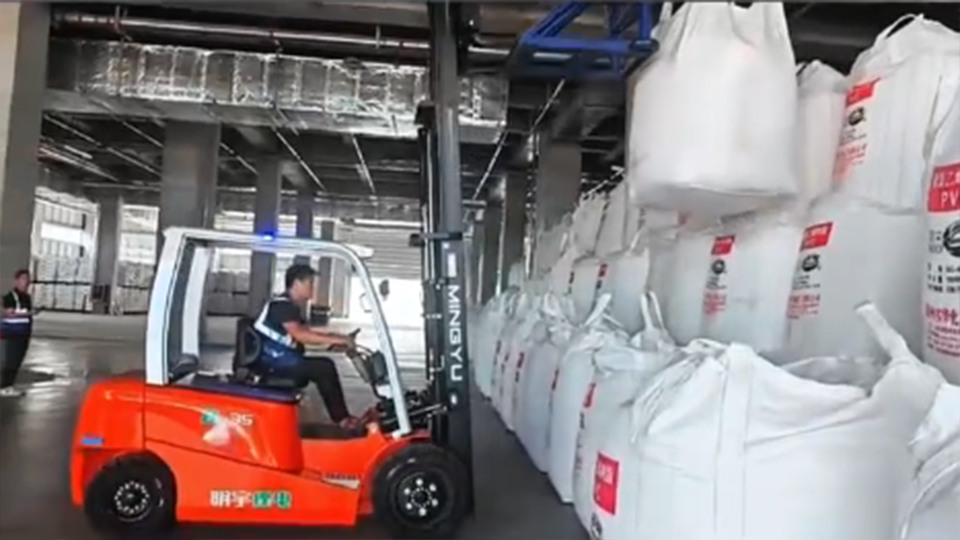
Reach trucks are the most common solution for 2.1- to 2.7-meter aisles. Unlike counterbalance forklifts, which carry the load in front of the front wheels, reach trucks position the mast on a telescoping carriage that extends forward to retrieve or deposit pallets, then retracts to nest the load within the wheelbase for travel. This design eliminates the need for the truck itself to enter the rack bay, dramatically reducing the required aisle width.
Modern reach trucks offer lift heights exceeding 12 meters (40 feet), enabling high-density vertical storage. They are typically battery-electric, with AC drive motors and regenerative braking that recaptures energy during deceleration and lowering. Advanced models include camera-assisted height selection, tilt correction, and automated aisle entry alignment that reduces operator fatigue and rack impact incidents.
Key specifications to evaluate when selecting a reach truck for narrow-aisle deployment include:
Minimum aisle width (MAW): The manufacturer's stated MAW must be matched against the actual aisle dimension, including rack deflection tolerances and floor flatness deviations.
Residual capacity at height: As lift height increases, the truck's rated capacity decreases due to mast deflection and stability considerations. Verify that the residual capacity at the top beam level exceeds the heaviest anticipated load.
Battery compartment dimensions: Narrow-aisle operations often run multi-shift schedules; ensure the battery can be swapped or fast-charged within the available floor space.
Very-Narrow-Aisle Trucks: Turret Trucks and Order Pickers
When aisle widths drop below 2.1 meters, reach trucks become impractical. Very-narrow-aisle solutions employ turret trucks (also called swing-reach or pivot trucks) or man-up order pickers. Turret trucks feature a mast that rotates 180 degrees, allowing the truck to travel straight down the aisle while the forks swing left or right to access either side of the rack. This eliminates the need for the truck to turn within the aisle.
Turret trucks are capital-intensive—often 2.5 to 3 times the cost of a reach truck—but they unlock the highest space utilization. They are almost exclusively deployed in high-throughput distribution centers with significant pallet-in/pallet-out volume. Because the operator travels with the load to heights of 15 meters or more, these trucks require robust overhead guard structures and integrated operator cabs with climate control and fall protection.
Man-up order pickers, by contrast, are designed for piece-pick or case-pick operations rather than full-pallet handling. The operator platform elevates with the forks, allowing direct access to individual cartons. In e-commerce fulfillment, where order profiles are characterized by high SKU diversity and low lines per order, man-up VNA pickers are indispensable.
Automated Guided Vehicles (AGVs) and Autonomous Mobile Robots (AMRs)
The narrow-aisle paradigm is increasingly intersecting with automation. AGVs and AMRs designed for narrow aisles use laser guidance, vision systems, or magnetic tape to navigate confined spaces with millimeter precision. Unlike human-operated trucks, autonomous vehicles do not suffer from fatigue-induced rack impacts and can operate in lights-out environments.
Three-dimensional pallet shuttle systems represent another automation frontier. These systems use self-propelled shuttles that travel within the rack structure itself, retrieving and depositing pallets under the command of a warehouse control system. By eliminating the aisle entirely at upper rack levels, shuttle systems can push space utilization above 85%, though they require substantial capital investment and fixed rack infrastructure.
Rail-Guided and Wire-Guided Systems
For the narrowest aisles and highest lifts, mechanical guidance systems ensure that trucks remain centered and do not drift into the rack. Rail guidance uses physical rails embedded in the floor, while wire guidance employs an inductive wire loop that the truck's sensor follows. Both systems reduce operator steering burden and minimize the risk of rack collision. Wire-guided reach trucks and turret trucks are common in VNA applications where operator error could result in catastrophic rack collapse.
Rack and Infrastructure Design
Selective Rack Optimization
Narrow aisles demand precise rack engineering. Selective pallet rack—the most common storage medium—must be configured with beam levels spaced to match the load heights and the truck's lift increments. In wide-aisle warehouses, beam spacing is often generous and inconsistent; narrow-aisle conversions require standardization to maximize vertical cube utilization.
Rack uprights must be rated for the actual load weights and the seismic zone of the facility. Narrow-aisle rack is more susceptible to impact damage because trucks operate in closer proximity; therefore, upright protectors, double-column reinforcement at aisle entries, and end-of-row guards are essential. Rack inspections should be conducted quarterly, with any deflected or damaged components replaced immediately.
Floor Flatness and Levelness
Perhaps the most underappreciated factor in narrow-aisle success is floor quality. VNA trucks operating at 12 to 15 meters require floors that meet strict flatness (FF) and levelness (FL) specifications, typically F-min 60 or higher under the ACI 117 standard. A floor with undulations or localized slopes will cause the truck to sway at height, increasing rack impact risk and operator discomfort. Before converting to VNA, facilities should commission a laser floor survey and budget for grinding or resurfacing if deficiencies are found.
Lighting and Environmental Control
Narrow aisles reduce natural light penetration and can create shadow zones that obscure rack labels and hazards. LED aisle lighting with motion sensors is standard in modern narrow-aisle facilities. For refrigerated or frozen environments, ensure that condensation and frost do not accumulate on floors or rack surfaces, as this compromises traction and load stability.
Operational Workflow Adjustments
Slotting and Velocity Analysis
Narrow-aisle density is only valuable if the right SKUs are stored in the right locations. A velocity-based slotting strategy places fast-moving items in the most accessible positions—typically lower beam levels and aisles closest to shipping docks—while slow movers occupy upper levels and remote aisles. Without intelligent slotting, narrow-aisle gains in pallet positions can be offset by increased travel time and picker congestion.
Warehouse management systems (WMS) should support dynamic slotting that reevaluates SKU velocity weekly or monthly. In automated environments, the WMS interfaces with the warehouse control system (WCS) to direct AGVs or shuttles to optimal locations in real time.
Traffic Management and Aisle Allocation
In wide-aisle warehouses, two trucks can pass each other in a single aisle. In narrow and very-narrow configurations, aisles are typically one-way or dedicated to a single truck at a time. This requires disciplined traffic management, often enforced by WMS-directed aisle allocation or physical zone controls. Attempting to run multiple trucks in a narrow aisle simultaneously invites collision and deadlock.
Training and Change Management
The transition to narrow-aisle operations is not merely a facilities project; it is an organizational change initiative. Operators accustomed to counterbalance forklifts must be retrained on reach truck or turret truck dynamics, including the telescoping carriage, height-dependent stability, and the psychological adjustment of operating at elevation in a confined aisle. Refresher training should be conducted annually, with incident-based retraining after any rack impact or near-miss.
Maintenance technicians must also adapt. Narrow-aisle trucks have complex mast assemblies, guidance sensors, and onboard electronics that require diagnostic tools and specialized expertise. Establishing a preventive maintenance schedule with the equipment manufacturer or an authorized dealer is critical to minimizing downtime in a high-density environment where a single truck failure can paralyze an entire aisle.
Measuring the 40% Improvement
Baseline Assessment
Before committing to a narrow-aisle conversion, establish quantitative baselines:
Pallet positions per 1,000 square meters: Count current rack bays and divide by total warehouse area, excluding offices and staging zones.
Aisle percentage: Measure total aisle area and express it as a percentage of total floor space.
Cube utilization: Calculate the percentage of available vertical cube (to the clear ceiling height) that is occupied by pallet load volume.
Throughput per labor hour: Measure pallets moved or lines picked per operator hour in the current configuration.
Post-Implementation Validation
After conversion, re-measure the same metrics. A successful narrow-aisle project should demonstrate:
30–40% increase in pallet positions from reduced aisle widths and optimized vertical storage.
Aisle percentage reduction from 30% to 15–18% of total floor space.
Cube utilization increase from 50–60% to 75–85%.
Maintained or improved throughput per labor hour, confirming that density gains were not offset by congestion or equipment inefficiency.
If throughput declines, investigate slotting logic, aisle allocation discipline, and equipment reliability before concluding that the aisle width is too aggressive.
Common Pitfalls in Narrow-Aisle Implementation
Underestimating Floor Requirements
Facilities that convert to VNA without addressing floor flatness often experience chronic rack impacts, mast vibration, and premature truck wear. The cost of floor remediation must be included in the business case; it is not an optional contingency.
Overlooking Fire Suppression and Building Codes
High-density storage affects fire code compliance. Narrow aisles can impede sprinkler water penetration, and increased rack height may trigger requirements for in-rack sprinkler systems or early suppression fast-response (ESFR) heads. Engage fire protection engineers early in the design process to avoid costly retrofits.
Specifying Equipment Without Load Data
Selecting a reach truck based on catalog specifications rather than actual load dimensions and weights is a frequent error. Loads that overhang the pallet, are unusually tall, or have uneven weight distribution will reduce effective capacity and may contact adjacent rack beams. Conduct a load profile analysis before finalizing equipment specifications.
Neglecting Change Management
The most technically perfect narrow-aisle layout will fail if operators resist the new equipment or circumvent traffic controls. Invest in training, solicit operator feedback during pilot phases, and celebrate early wins to build organizational buy-in.
Conclusion
Narrow-aisle warehouse solutions represent one of the most capital-efficient strategies for addressing capacity constraints in modern logistics. By reducing aisle widths from conventional dimensions to 2.1 meters or less, and by deploying reach trucks, turret trucks, or automated shuttle systems, facilities can increase pallet positions by 30% to 40% without expanding their building footprint. Achieving this improvement, however, requires meticulous attention to floor quality, rack engineering, equipment specification, slotting logic, and operator training. The narrow-aisle transition is not a simple reconfiguration; it is a systems-level redesign of how a warehouse stores, moves, and manages inventory. Organizations that approach it with discipline and comprehensive planning will unlock not only space utilization gains but also the operational agility required to compete in an era of relentless e-commerce growth and customer expectations for speed.
Name: selena
Mobile:+86-13176910558
Tel:+86-0535-2090977
Whatsapp:8613181602336
Email:vip@mingyuforklift.com
Add:Xiaqiu Town, Laizhou, Yantai City, Shandong Province, China
