
vip@mingyuforklift.com
+86-0535-2090977

Introduction
Forklifts are among the most versatile and indispensable pieces of material handling equipment in warehouses, manufacturing facilities, distribution centers, and construction sites worldwide. Yet, despite their ubiquity and apparent simplicity, forklifts harbor a deceptively complex physics problem at their core: the stability triangle. This invisible geometric boundary is the single most critical factor separating safe operation from catastrophic failure. Understanding the stability triangle is not merely an academic exercise—it is the foundation upon which all safe forklift operation rests. When operators, supervisors, and safety professionals truly grasp this concept, they gain something far more valuable than theoretical knowledge: they gain the ability to recognize, assess, and control the safety margin in real time, under real conditions, with real consequences.
The Occupational Safety and Health Administration (OSHA) reports that forklift accidents result in approximately 85 fatalities and 34,900 serious injuries annually in the United States alone. A substantial portion of these incidents involve tip-overs, which are directly attributable to violations of stability triangle principles. The economic cost is staggering—billions of dollars in medical expenses, lost productivity, equipment damage, and legal liability—but the human cost is immeasurable. Every tip-over represents a moment where the invisible boundary was crossed, where the safety margin was exhausted, and where physics took over without mercy.
The Physics of Forklift Stability
At its most fundamental level, a forklift is a counterbalanced lever system. Unlike automobiles, which distribute weight across four points of contact with the ground, forklifts rely on a three-point suspension system. The front two wheels serve as the fulcrum, while the rear steer axle—typically mounted on a pivot pin—acts as the third contact point. This configuration creates an imaginary triangle connecting these three points, known as the stability triangle.
The stability triangle is not a physical structure; it is a conceptual tool that defines the boundaries of safe operation. The center of gravity of the combined forklift and load must remain within this triangle for the vehicle to remain stable. If the center of gravity shifts beyond any of the triangle's edges, the forklift will tip over. This tipping can occur in any direction—forward, backward, or laterally—and the results are often devastating. Forklift tip-overs account for a significant percentage of forklift-related fatalities and serious injuries annually, making the stability triangle one of the most consequential concepts in industrial safety.
The mathematics behind the stability triangle are elegantly simple yet profoundly important. The longitudinal stability line, running between the front wheels, determines forward and backward stability. The lateral stability lines, extending from each front wheel to the pivot pin on the rear axle, determine side-to-side stability. The area enclosed by these three lines represents the "safe zone" where the combined center of gravity must remain.
For a typical counterbalanced forklift, the front axle width might range from 38 to 48 inches, while the distance from the front axle to the rear pivot pin might be 60 to 80 inches. These dimensions define the stability triangle's geometry, but the critical insight is that the triangle's size is fixed by the machine's design, while the combined center of gravity is constantly moving. The operator's task is to ensure that this moving point never crosses the boundary.
The Combined Center of Gravity: A Dynamic Variable
Perhaps the most misunderstood aspect of forklift stability is that the center of gravity is not fixed. It is a dynamic variable that changes constantly based on multiple factors. When a forklift is unloaded, its center of gravity lies somewhere near the rear of the vehicle, close to the counterweight. This is by design—the counterweight's mass offsets the weight of the mast and carriage assembly at the front.
When a load is picked up, everything changes. The load's own center of gravity adds to the equation, shifting the combined center of gravity forward toward the load center. The farther forward the load is carried, and the higher it is lifted, the more dramatically the center of gravity shifts. This is why load centers are specified by manufacturers—typically 24 inches for standard counterbalanced forklifts. Exceeding the rated load center is one of the most common causes of forward tip-overs, as operators may not realize that moving the load even a few inches beyond specification can push the combined center of gravity beyond the front stability line.
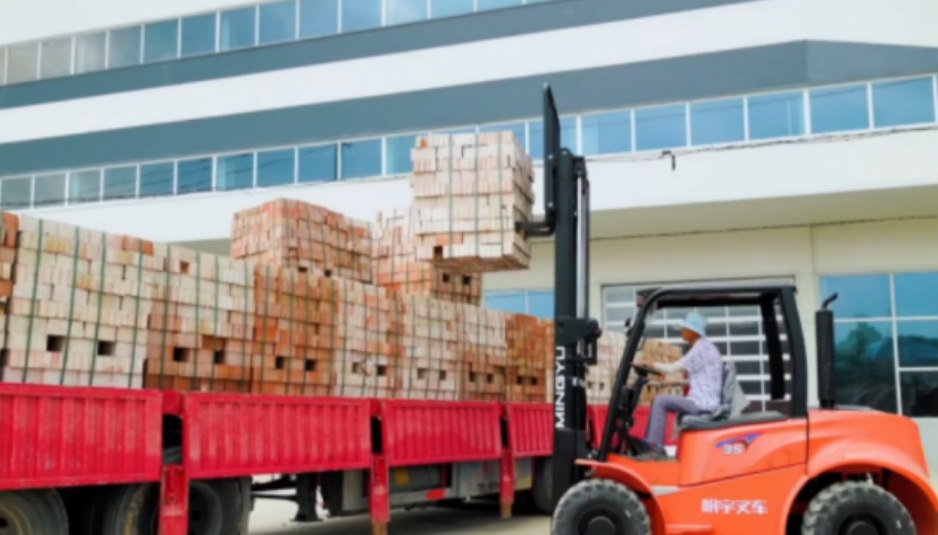
Height compounds this effect exponentially. As the mast raises a load, the center of gravity of the load itself rises, increasing the moment arm and magnifying any destabilizing forces. This is why traveling with an elevated load is prohibited by safety regulations—the raised center of gravity dramatically reduces the margin for error. A sudden stop, turn, or uneven surface that might be manageable with a low load becomes a tipping hazard when the load is elevated.
Consider a 5,000-pound capacity forklift with a 24-inch load center. If an operator picks up a 4,000-pound load whose center of gravity is actually 30 inches from the carriage face—just six inches beyond specification—the effective load moment increases from 120,000 inch-pounds to 160,000 inch-pounds, a 33% increase. The forklift's stability margin, designed for the rated load center, is now critically compromised. The combined center of gravity has shifted significantly forward, and any additional destabilizing factor—braking, turning, or slope—may push it beyond the front stability line.
The Safety Margin: More Than a Number
Manufacturers specify load capacities at specific load centers and lift heights, but these ratings represent ideal conditions on perfectly level surfaces with no dynamic forces. The real world is rarely so accommodating. The safety margin is the buffer between the rated capacity and the actual forces acting on the forklift in any given moment.
Understanding the safety margin requires operators to think beyond the rated capacity plate. Factors that erode the safety margin include: uneven or sloped surfaces, which shift the center of gravity laterally; acceleration and deceleration, which create inertial forces; cornering, which generates centrifugal force; mast tilt angles, which move the load forward or backward; and tire condition, which affects grip and can allow lateral sliding before the operator even realizes stability is compromised.
On a slope, the stability triangle effectively tilts with the grade. Driving across a slope shifts the center of gravity toward the downhill side of the stability triangle, reducing lateral stability. Driving up or down a slope shifts the center of gravity toward the rear or front stability line, respectively. This is why forklifts should always be driven up slopes with the load upgrade and down slopes in reverse—this orientation keeps the combined center of gravity within the triangle by leveraging the counterweight's position.
The safety margin is also affected by load shape and distribution. A uniformly distributed pallet of goods has a predictable center of gravity at its geometric center. But an irregularly shaped load, a partially loaded pallet, or a load with offset weight distribution shifts the center of gravity in unpredictable ways. A roll of paper, a drum of liquid, or an off-center casting can each create a center of gravity that is not where the operator assumes it to be.
The Human Factor: Perception vs. Reality
One of the most dangerous aspects of forklift operation is that instability is not always perceptible until it is too late. Unlike driving a car, where understeer or oversteer provides tactile feedback, a forklift can transition from stable to tipping with little warning. The rear steer axle is designed to lift off the ground slightly during normal operation, which can create a false sense of security. Operators may feel the forklift "settle" or "shift" without recognizing that they are approaching the stability limit.
Training programs often emphasize the stability triangle, but classroom understanding does not always translate to operational awareness. Experienced operators can develop an intuitive sense of the stability margin, but this intuition must be grounded in conscious awareness of the variables at play. Complacency is the enemy of safety margin management. An operator who has lifted thousands of loads successfully may underestimate the risk of a slightly heavier load, a slightly higher lift, or a slightly uneven surface—yet these small deviations can compound into a tip-over scenario.
Psychological research on risk perception reveals that humans consistently underestimate low-probability, high-consequence events. An operator may rationalize that a minor overload is acceptable because "nothing happened last time." This normalization of deviance gradually erodes the safety margin until an incident becomes inevitable. Breaking this cycle requires a cultural commitment to respecting the stability triangle as an absolute boundary, not a guideline.
Practical Applications: Maintaining the Safety Margin
Maintaining an adequate safety margin requires both knowledge and discipline. Pre-operation inspections should include verification of tire condition and pressure, as soft or damaged tires alter the forklift's geometry and reduce stability. Operators must know the weight and center of gravity of every load, refusing to lift unmarked or suspicious loads without verification.
During operation, the safety margin is preserved through deliberate technique. Loads should be carried as low as possible during travel, with the mast tilted back slightly to position the load against the carriage. Speed must be controlled, particularly around corners and on ramps. Acceleration and braking should be smooth and gradual to minimize inertial forces. When stacking, operators must be aware that raising a load to full height while extended forward represents the point of minimum stability—the moment when the center of gravity is farthest from the vehicle's center and highest above the ground.
Attachment use requires special consideration. Attachments such as carton clamps, push-pull systems, or extended forks change the weight distribution and effective load center. Manufacturers provide derated capacity charts for attachments, and these must be strictly observed. An attachment that adds weight to the carriage shifts the center of gravity forward even before a load is applied, effectively reducing the available safety margin from the outset.
Environmental conditions also demand attention. Wet or icy surfaces reduce traction and can cause unexpected sliding. Outdoor operations may encounter wind loads that exert lateral force on elevated loads. Floor defects, expansion joints, and debris can create sudden jolts that shift the center of gravity momentarily beyond the stability triangle. Each of these factors consumes a portion of the safety margin, leaving less room for operator error.
Regulatory Context and Industry Standards
The stability triangle concept is embedded in forklift design standards and operational regulations worldwide. OSHA standards in the United States require operator training to include "truck-related topics" including "operating instructions, warnings, and precautions," which encompasses stability fundamentals. The American National Standards Institute (ANSI) B56.1 standard specifies stability testing requirements that manufacturers must meet, including longitudinal, lateral, and dynamic stability tests under defined conditions.
These standards are not arbitrary. They are based on extensive engineering analysis and incident data that consistently point to stability-related incidents as a leading cause of forklift accidents. Compliance with rated capacities and operational guidelines is not merely a regulatory requirement—it is the minimum threshold for maintaining the safety margin under controlled conditions.
International standards, including ISO 3691-1, establish similar stability requirements for industrial trucks. European regulations under the Machinery Directive require manufacturers to conduct comprehensive stability testing and to provide clear capacity documentation. These global standards reflect a universal recognition that the stability triangle is the cornerstone of forklift safety engineering.
Advanced Considerations: Beyond the Basics
For safety professionals and experienced operators, understanding the stability triangle opens the door to more sophisticated risk assessment. Load moment indicators and stability control systems, increasingly common on modern forklifts, use sensors and algorithms to monitor the center of gravity in real time. These systems can provide warnings or even limit operation when the stability margin is compromised. However, technology is not a substitute for understanding. Operators who rely solely on electronic aids without comprehending the underlying physics may find themselves unprepared when technology fails or when operating older equipment without such features.
Environmental factors also demand advanced awareness. Outdoor operations expose forklifts to wind loads that can exert significant force on elevated loads, effectively pushing the center of gravity beyond the stability triangle. Cold storage applications affect battery performance and tire flexibility, altering the vehicle's dynamic characteristics. Each operational environment presents unique challenges to maintaining the safety margin.
Fleet managers and safety directors should conduct regular stability audits, assessing whether operational practices align with stability triangle principles. Are operators consistently traveling with loads at the correct height? Are load weights verified before lifting? Are attachments properly accounted for in capacity planning? Are slope operations conducted with correct orientation? These questions reveal whether the organization truly understands the safety margin or merely pays it lip service.
Conclusion
The forklift stability triangle is far more than a diagram in a training manual. It is the geometric representation of a physical truth that governs every movement a forklift makes. Understanding it means understanding that safety is not a static condition but a dynamic balance—a margin that must be actively managed, moment by moment, decision by decision.
When operators internalize this concept, they move beyond rote compliance with rules and develop operational wisdom. They recognize that the rated capacity is a starting point, not a target. They understand that every variable—load weight, load center, lift height, travel speed, surface condition, mast tilt, and attachment configuration—either preserves or erodes the safety margin. They become active participants in their own safety rather than passive operators of machinery.
In the end, the stability triangle teaches us that forklift safety is fundamentally about respect for physics. The laws of mechanics are immutable and unforgiving. Understanding the stability triangle means understanding that the safety margin is not something granted by equipment design or regulatory compliance—it is something earned through knowledge, vigilance, and disciplined operation every single time the ignition is turned on. The triangle is invisible, but its boundaries are real. Cross them, and gravity will not negotiate. Understand them, and the margin for safety becomes a margin for life.
Name: selena
Mobile:+86-13176910558
Tel:+86-0535-2090977
Whatsapp:8613181602336
Email:vip@mingyuforklift.com
Add:Xiaqiu Town, Laizhou, Yantai City, Shandong Province, China