
vip@mingyuforklift.com
+86-0535-2090977

Introduction
Electric stackers are the backbone of modern warehouse operations, quietly moving thousands of pounds of inventory through narrow aisles with precision and efficiency. Yet like any piece of powered industrial equipment, their reliability depends entirely on the quality of maintenance they receive. A well-maintained stacker can deliver 8–12 years of faithful service, while a neglected one may become a safety hazard and a financial drain within just a few seasons.
The challenge for most warehouse managers and maintenance technicians is knowing precisely what to do—and when. Manufacturer manuals provide exhaustive checklists, but they rarely offer a practical, hour-by-hour roadmap that aligns with real-world operating conditions. This article bridges that gap, providing a detailed maintenance schedule centered on three critical milestones: 50 hours, 100 hours, and 500 hours of operation. These intervals represent the transition points from break-in care, through early operational validation, and into the rhythm of long-term preventive maintenance.
Whether you operate a compact walk-behind electric stacker in a retail backroom or a ride-on reach stacker in a high-volume distribution center, the principles outlined here will help you maximize uptime, ensure operator safety, and protect your capital investment.
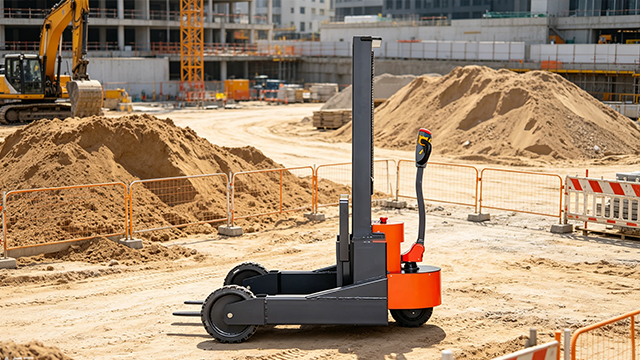
The 50-Hour Service: Establishing the Baseline
The 50-hour mark typically arrives within the first two to four weeks of operation for a stacker in regular use. This interval is best understood as a break-in validation service—an opportunity to catch manufacturing tolerances, installation issues, and early wear patterns before they compound into serious problems.
Why 50 Hours Matters
New stackers undergo a period of mechanical settling. Fasteners torque themselves into final positions under vibration, hydraulic seals compress to their optimal seating, and electrical contacts burnish their surfaces. The 50-hour service is designed to inspect the machine after this initial "shakedown" period and correct any deviations before they become chronic failures.
The 50-Hour Maintenance Checklist
Brake System Verification
The brake system is your first priority. Switch the tiller handle between its operational zones (typically marked A and B) and confirm that the electromagnetic brake produces a crisp, audible clicking sound. This confirms that the brake solenoid is engaging properly. Next, measure the brake clearance; it should fall within the range of 0.2–0.8 mm (0.00787–0.0315 inches). Clearance outside this range indicates either excessive pad wear or an adjustment issue that requires immediate correction.
Battery and Electrical Foundation
For lead-acid battery systems, the 50-hour service is when you establish the baseline for battery health. Check the electrolyte level in each cell and top up with purified or distilled water if necessary—never use tap water, as minerals will degrade cell performance. After a full charge, verify that the specific gravity of the electrolyte reads approximately 1.265 (equivalent to 10.67 lb/gal), which indicates a fully charged, healthy battery. Clean the battery casing and terminals with a damp cloth, sealing the caps first to prevent water ingress.
Contactor Inspection
The main electrical contactor—the high-current switch that controls power to the drive and lift motors—should be inspected for signs of arcing or pitting on its contact surfaces. Minor roughness can be polished with fine-grit sandpaper, but significant erosion or welding marks indicate a contactor that will fail prematurely and should be replaced.
General Fastener and Hardware Check
All visible fasteners, including those securing the mast, fork carriage, overhead guard, and chassis components, should be checked for proper torque. Pay particular attention to the mast anchor bolts and the wheel axle fasteners, as these experience the highest dynamic loads during operation.
Hydraulic System Baseline
Lower the forks to their lowest position and check the hydraulic oil level against the manufacturer's specification. For typical electric stackers, this ranges from 5 liters for 2.5-meter lift heights to 6 liters for 3.5-meter configurations. Note the oil color and clarity; any cloudiness or metallic particles indicate contamination that requires investigation.
The 100-Hour Service: Deepening the Inspection
By the time a stacker reaches 100 operating hours, it has moved beyond the break-in phase and into steady-state operation. This milestone is often overlooked in basic maintenance programs, but it represents a critical inflection point where early operational patterns begin to reveal themselves.
What Changes at 100 Hours
At 100 hours, the stacker has accumulated enough runtime for wear patterns to emerge, but not so much that minor issues have escalated into major repairs. This is the ideal window to perform a comprehensive functional audit—going beyond visual inspection to test the performance of every critical system under load.
The 100-Hour Maintenance Checklist
Hydraulic System Performance Test
While the 50-hour service established baseline fluid levels, the 100-hour service evaluates hydraulic performance under stress. Raise a rated load to full height and observe the lifting speed; any significant reduction from the manufacturer's specification may indicate a worn hydraulic pump, a partially blocked filter, or internal cylinder leakage. Lower the load and check for "drift"—if the forks descend more than a few millimeters per minute under a static load, the lift cylinder seals are beginning to degrade.
Mast Chain and Roller Inspection
The lifting chains and mast rollers are among the most heavily stressed components on any stacker. At 100 hours, inspect each chain link for signs of stretching, corrosion, or cracked pins. Apply a high-quality chain lubricant and operate the mast through several full cycles to distribute it evenly. Check the mast rollers for flat spots, excessive wear, or binding in their channels. The mast should raise and lower smoothly without jerking or unusual noise.
Steering System Evaluation
The tiller or steering mechanism should be checked for looseness, binding, or excessive play. In walk-behind stackers, the tiller handle's return-to-center action should be crisp and predictable. For ride-on models, verify that the steering wheel has no more than minimal free play before the wheels begin to turn. Lubricate all steering linkage pivot points according to the manufacturer's specifications.
Wheel and Tire Assessment
Inspect all wheels—drive wheels, load wheels, and stabilizer wheels—for damage, chunking, or uneven wear patterns. Polyurethane wheels, common on electric stackers, should show no signs of delamination or cracking. Check that wheel bearings rotate smoothly without grinding or excessive looseness. Uneven wear often indicates an alignment issue or an operator habit (such as pivoting in place) that should be corrected through training.
Electrical System Deep Dive
Beyond the battery and contactor checked at 50 hours, the 100-hour service should include inspection of all wiring harnesses for chafing, pinching, or exposure to heat sources. Test the functionality of all microswitches, limit switches, and the emergency stop circuit. Verify that the controller displays no fault codes and that all indicator lights and the audible alarm operate correctly.
Operator Feedback Integration
The 100-hour service is an excellent time to interview the primary operator(s) about any anomalies they've noticed—unusual noises, intermittent electrical issues, or changes in handling characteristics. Operator observations often reveal problems that formal inspection protocols miss.
The 500-Hour Service: The First Major Overhaul
The 500-hour milestone represents the first significant maintenance event in a stacker's lifecycle. For a machine operating a single eight-hour shift, this arrives approximately every three months; for multi-shift operations, it may come within six weeks. This service transitions the stacker from basic preventive care into a structured renewal cycle.
The Strategic Importance of 500-Hour Maintenance
By 500 hours, consumable components have reached the end of their initial service life, while major systems require detailed assessment to ensure they remain within specification. This service is often the point at which warranty claims are evaluated, so thorough documentation is essential.
The 500-Hour Maintenance Checklist
Filter and Fluid Replacement
The 500-hour service is when most manufacturers recommend the first replacement of critical filters and fluids. This includes:
Hydraulic oil filter: Replace regardless of apparent condition; by 500 hours, the filter media has captured enough particulate matter to begin restricting flow.
Hydraulic oil: If the oil shows any discoloration, contamination, or if the stacker operates in a high-dust environment, perform a complete fluid change. Even in clean conditions, consider an oil analysis to establish a baseline for future services.
Air filters (if equipped): For stackers with battery compartment cooling fans or motor air intakes, replace or clean air filters to prevent overheating.
Motor Carbon Brush Inspection
The drive motor, lift motor, and (if equipped) steering motor should be inspected for carbon brush wear. Measure the remaining brush length against the manufacturer's minimum specification—typically 5 mm or one-quarter of original length. Inspect the commutator surfaces for scoring, discoloration, or out-of-roundness. Significant commutator damage indicates that the motor will require a rewind or replacement in the near future.
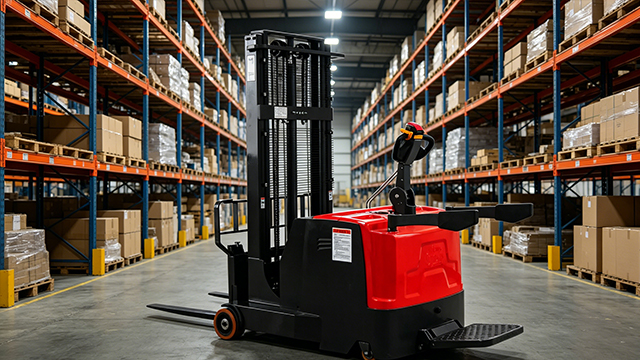
Brake System Renewal
At 500 hours, the electromagnetic brake requires more than adjustment—it needs component-level inspection. Remove brake dust accumulation from the brake drum or disc surfaces. Measure brake pad or shoe thickness and replace if worn below the service limit. Check the brake coil resistance with a multimeter to confirm it remains within specification; a coil drawing excessive current will overheat and fail.
Structural and Safety Component Inspection
Perform a detailed inspection of all welded joints, particularly in the mast, carriage, and chassis. Look for hairline cracks, especially at stress concentration points like mast cross-member welds and fork heel radii. Check the overhead guard for damage from impacts and verify that all safety labels and capacity plates remain legible.
Battery Maintenance (Lead-Acid Systems)
For lead-acid batteries, the 500-hour service should include an equalization charge—a controlled overcharge that helps balance the specific gravity across all cells and prevents sulfation. Check each cell with a hydrometer after equalization; specific gravity readings should not vary by more than 0.030 between cells. Greater variation indicates a weak cell that will soon fail.
Lithium-Ion Battery Considerations
If your stacker uses a lithium-ion battery, the 500-hour service focuses on the battery management system (BMS). Use the manufacturer's diagnostic software to check for cell imbalance, charge cycle count, and any thermal event history. Verify that the charging connector pins show no signs of arcing or overheating.
Lubrication of All Points
Every grease fitting, pivot point, and sliding surface identified in the manufacturer's lubrication chart should be serviced. This includes mast channels, chain anchor points, tilt cylinder pins, and steering kingpins. Use only the lubricant grades specified by the manufacturer—substituting automotive grease for high-pressure molybdenum-disulfide grease, for example, can lead to premature wear in heavily loaded joints.
Documentation, Compliance, and Record-Keeping
Throughout all three maintenance intervals—and indeed, throughout the entire life of the stacker—meticulous record-keeping is non-negotiable. Under OSHA 29 CFR 1910.178, employers must maintain records of all inspections and repairs to demonstrate that equipment is in safe operating condition. These records become strategic assets, revealing failure patterns, informing repair-versus-replace decisions, and supporting warranty claims.
Modern maintenance management software can automate much of this documentation, but even a well-maintained paper logbook satisfies regulatory requirements. The key is consistency: every inspection, every fluid change, and every component replacement must be recorded with the date, operating hours, technician signature, and any observations or recommendations.
Adjusting the Schedule for Operating Conditions
The 50/100/500-hour framework provides a solid baseline, but real-world conditions demand flexibility. Stackers operating in harsh environments require accelerated maintenance intervals:
High-dust or particulate environments (woodworking, cement handling): Halve all filter replacement intervals and increase air filter inspection frequency.
Cold storage operations: Battery maintenance becomes critical; check electrolyte levels weekly and ensure batteries are fully charged before storage in sub-freezing conditions.
Corrosive or wet environments: Increase inspection frequency for electrical connectors, wheel bearings, and structural components. Apply corrosion inhibitors to exposed metal surfaces.
Multi-shift operations: A stacker running 16–24 hours per day reaches 500 hours in just 3–4 weeks. Consider implementing a 250-hour intermediate service to prevent maintenance gaps.
Conclusion
A stacker's maintenance schedule is not merely a manufacturer recommendation—it is the operational contract that ensures safety, productivity, and return on investment. The 50-hour service establishes the mechanical and electrical baseline after break-in. The 100-hour service deepens the inspection to catch emerging wear patterns before they escalate. The 500-hour service represents the first major renewal point, replacing consumables and assessing the health of critical systems.
By treating these three milestones with the seriousness they deserve, warehouse operators can extend stacker lifespans well beyond the typical 8–12 year range, minimize unplanned downtime, and—most importantly—ensure that every operator returns home safely at the end of each shift. In material handling, as in all industrial disciplines, prevention is not just better than cure; it is the only sustainable strategy.
Name: selena
Mobile:+86-13176910558
Tel:+86-0535-2090977
Whatsapp:8613181602336
Email:vip@mingyuforklift.com
Add:Xiaqiu Town, Laizhou, Yantai City, Shandong Province, China
