
vip@mingyuforklift.com
+86-0535-2090977

Introduction
The material handling industry encompasses a diverse spectrum of equipment designed to operate across vastly different environments. While ordinary internal combustion (IC) forklifts have long served as the backbone of warehouse, manufacturing, and distribution operations, rough terrain forklifts address a fundamentally different class of challenges. These machines are engineered to navigate unpaved surfaces, construction sites, agricultural fields, lumber yards, and other environments where conventional forklifts would be rendered inoperable or unsafe.
Understanding the technical distinctions between rough terrain forklifts and ordinary IC forklifts is essential for equipment procurement professionals, site managers, and safety officers who must match machinery capabilities to ground conditions, load requirements, and operational constraints. This article provides an in-depth technical analysis of the engineering differences, performance characteristics, and application boundaries that separate these two categories of powered industrial trucks.
Design Philosophy and Chassis Architecture
The foundational divergence between rough terrain forklifts and ordinary IC forklifts begins with their chassis design philosophy.
Ordinary Internal Combustion Forklifts are engineered for operation on smooth, hard, and relatively level surfaces. Their chassis is typically a welded steel frame optimized for strength-to-weight ratio within the constraints of indoor and paved outdoor environments. The frame is rigid, with minimal suspension articulation, because the operating surface is assumed to provide consistent support across all wheels. Ground clearance is minimal—usually just enough to accommodate the underside components and allow transit over small obstructions like dock plates or expansion joints. The wheelbase is designed around stability requirements for load handling on flat surfaces, with the counterweight positioned to optimize the stability triangle for level-ground operation.
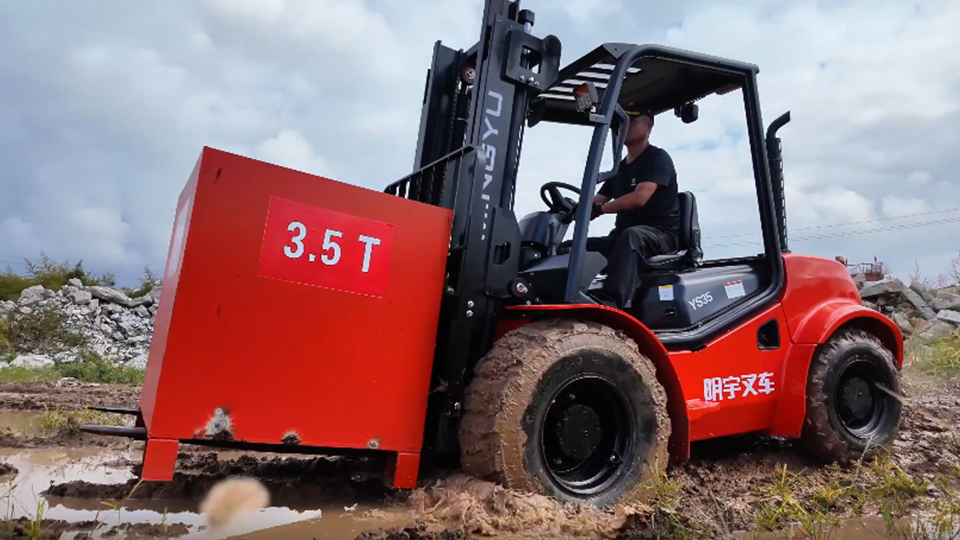
Rough Terrain Forklifts are built around an entirely different set of assumptions. Their chassis must accommodate uneven ground where wheels may encounter elevation differences of several inches or more. These machines feature significantly higher ground clearance—often 12 to 18 inches (300 to 450 mm) or more—to clear rocks, ruts, debris, and vegetation. The frame construction is heavier and more robust, designed to withstand torsional stresses induced by uneven terrain. Many rough terrain forklifts incorporate articulated steering or all-wheel-drive configurations that allow the chassis to flex and maintain traction across irregular surfaces. The overall construction prioritizes durability and off-road capability over the compact dimensions and maneuverability that define ordinary IC forklifts.
Tire Technology and Ground Interface
The interface between the machine and the ground represents one of the most critical technical distinctions between these two forklift categories.
Ordinary IC forklifts are equipped with either cushion tires or pneumatic tires, depending on the application. Cushion tires are solid rubber compounds bonded to steel bands, designed for indoor use on smooth concrete or asphalt. They provide a small turning radius and low ground clearance, making them ideal for warehouse aisles but completely unsuitable for unpaved surfaces. Pneumatic tires on ordinary IC forklifts are typically standard-duty designs with relatively shallow tread patterns, intended primarily for shock absorption on paved surfaces and light outdoor duty on compacted gravel or improved yards. These tires offer minimal traction on loose soil, mud, or steep grades.
Rough terrain forklifts employ heavy-duty pneumatic tires with aggressive, deep-lug tread patterns similar to those found on agricultural or construction equipment. These tires are significantly larger in diameter and width, providing a larger contact patch for improved flotation on soft ground. The tread design is optimized for self-cleaning in muddy conditions and for biting into loose or uneven surfaces. Some rough terrain forklifts utilize foam-filled pneumatic tires or solid rubber pneumatic-style tires to eliminate the risk of punctures from construction debris, nails, or sharp rocks. The tire construction itself is heavier-duty, with reinforced sidewalls to resist damage from impacts and abrasion.
Suspension Systems and Axle Design
Suspension engineering diverges dramatically between these two equipment types.
Ordinary IC forklifts typically feature solid axle designs with no suspension articulation. The front drive axle and rear steer axle are rigidly mounted to the chassis. Any shock absorption is provided entirely by the tires. This design is acceptable because the operating surface is assumed to be uniform; the lack of suspension contributes to stability during load handling by maintaining consistent geometry between the mast, carriage, and ground. Some models incorporate minimal spring or hydraulic damping in the seat or mast mounts to improve operator comfort, but the axle-to-chassis relationship remains fixed.
Rough terrain forklifts require sophisticated suspension systems to maintain traction, stability, and operator comfort across irregular terrain. Many models feature live axles with limited articulation, allowing wheels to move independently in response to ground contours. Some advanced designs incorporate hydraulic or mechanical suspension systems that actively manage axle movement. The mast may be mounted on a suspension isolator to reduce shock transmission to the load and operator. Articulated steering systems—where the chassis bends in the middle—allow the front and rear sections to conform to terrain independently, maintaining four-wheel contact even when the ground is highly irregular. This articulation is fundamental to maintaining traction and preventing tipping on slopes or uneven ground.
Powertrain and Drivetrain Configurations
The power and traction requirements of off-road operation necessitate fundamentally different drivetrain engineering.
Ordinary IC forklifts are predominantly rear-wheel-drive configurations with a front-mounted drive axle. The engine—typically gasoline, diesel, or liquid petroleum gas (LPG)—powers the drive wheels through a mechanical or hydrostatic transmission. Two-wheel drive is standard because the operating environment does not demand all-wheel traction. Engine sizing is optimized for the duty cycle of intermittent load handling on flat surfaces, with power output generally sufficient for hydraulic lift functions and moderate travel speeds. Transmissions are often automatic or powershift designs focused on smooth operation and fuel efficiency in stop-and-start applications.
Rough terrain forklifts almost universally employ four-wheel-drive (4WD) configurations. The drivetrain must deliver power to all wheels to maintain traction when one or more wheels lose grip on loose or uneven surfaces. Diesel engines predominate due to their high torque output at low RPM, durability under severe duty cycles, and fuel availability in remote or construction environments. Engine displacement and power output are substantially higher than comparable-capacity ordinary IC forklifts to overcome rolling resistance on soft ground and to power hydraulic systems under demanding conditions. Transmissions are heavy-duty designs, often with multiple ranges and differential locks that allow the operator to distribute power optimally across terrain conditions. Some models feature hydrostatic or continuously variable transmissions that provide precise speed control during delicate load placement on slopes.
Mast and Load Handling Systems
While both categories of forklifts share the fundamental mast-and-carriage lifting architecture, implementation details differ significantly.
Ordinary IC forklifts utilize masts designed for vertical lift on level surfaces. The mast channels, chains, and hydraulic cylinders are optimized for smooth, precise lifting and lowering. Side shift and fork positioning are common features that enhance productivity in warehouse environments. The mast tilt function—typically 6 to 12 degrees backward and 3 to 6 degrees forward—is calibrated for load engagement and placement on flat, hard surfaces. Load backrests are standard to prevent loads from falling backward onto the operator.
Rough terrain forklifts require masts that can tolerate the dynamic forces induced by uneven ground travel. Mast construction is heavier, with reinforced channels and larger-diameter lift cylinders to withstand shock loading. Tilt ranges are often greater to accommodate load leveling on slopes; some models offer mast tilt up to 15 degrees or more to ensure that loads remain vertical when the chassis is inclined. Load backrests are more robust, and overhead guards are built to withstand falling objects and impacts that are more likely in construction or outdoor environments. Some rough terrain forklifts offer telescopic boom configurations rather than traditional masts, effectively functioning as telehandlers that can reach forward and upward to place loads on elevated surfaces or across obstacles.
Stability and Center of Gravity Management
Stability engineering must account for fundamentally different operating conditions.
Ordinary IC forklifts are designed around the stability triangle concept, assuming a level and consistent operating surface. The center of gravity is managed through counterweight placement, wheelbase dimensions, and load center ratings calibrated for flat-ground operation. Stability systems may include load weight indicators and speed reduction when the mast is elevated, but these systems assume a horizontal reference plane. Operating on even modest grades with an ordinary IC forklift significantly compromises stability and is generally discouraged by manufacturers.
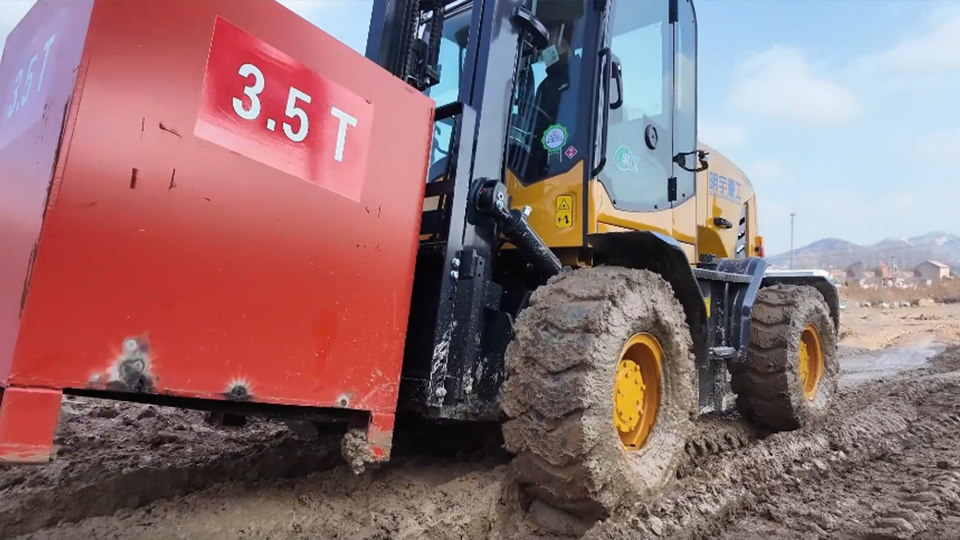
Rough terrain forklifts must maintain stability across variable grades and uneven surfaces. The center of gravity shifts dynamically as the chassis tilts in response to terrain. Engineers address this through wider wheelbases, lower centers of gravity, and sometimes outrigger systems that deploy during load handling to create a broader stability base. Gradeability ratings—expressed as the maximum slope the machine can climb or descend—are a critical specification, often ranging from 20 to 40 percent depending on the model and load condition. Frame leveling systems may be incorporated to allow the operator to hydraulically adjust the chassis attitude independent of the ground slope, maintaining a level platform for load handling. Load charts for rough terrain forklifts typically specify reduced capacities for operations on slopes or uneven ground.
Operator Environment and Visibility
The operator compartment reflects the distinct demands of each operating environment.
Ordinary IC forklifts feature operator compartments designed for repetitive, cyclical operations in confined spaces. Seated operation is standard, with ergonomics optimized for forward and rearward visibility during frequent direction changes. Overhead guards are relatively compact, and the overall operator sightlines are designed around rack engagement, pallet placement, and interaction with pedestrians in warehouse environments. Climate control options may be limited, as many units operate indoors where ambient conditions are controlled.
Rough terrain forklifts prioritize operator protection and visibility in harsh, open environments. Cab enclosures with weather protection, heating, and air conditioning are common to shield operators from dust, rain, and temperature extremes. The operator position is elevated relative to ordinary IC forklifts to improve visibility over uneven terrain and obstacles. Rollover protective structures (ROPS) and falling object protective structures (FOPS) are integrated into the cab design to meet construction equipment safety standards. Visibility is optimized for ground-level obstacle detection, with larger windows and often camera systems to assist with rearward visibility. The controls are typically more robust and may be designed for operation while wearing gloves in cold or dirty conditions.
Application Environments and Operational Boundaries
The intended operating environment is the primary determinant in selecting between these equipment types.
Ordinary IC forklifts are the standard choice for warehouses, distribution centers, manufacturing facilities, and paved outdoor yards. They excel in environments with smooth concrete or asphalt surfaces, defined traffic patterns, and moderate climate conditions. Their compact turning radius and maneuverability make them ideal for loading docks, rail cars, and tight storage areas. They are not suitable for mud, loose soil, steep grades, or surfaces with significant debris.
Rough terrain forklifts are purpose-built for construction sites, agricultural operations, lumber yards, mining operations, and any environment where paved surfaces are absent or incomplete. They transport materials across building sites, load and unload trucks on unimproved ground, handle pipe and building materials in rough yards, and operate in forestry and land-clearing applications. They are essential for infrastructure projects, oil and gas operations, and military logistics in field conditions. Attempting to use a rough terrain forklift in a standard warehouse would be counterproductive due to its large size, wide turning radius, and potential floor damage from aggressive tires.
Regulatory Standards and Safety Considerations
Safety standards and regulatory frameworks differ between these categories.
Ordinary IC forklifts are governed by standards such as ANSI B56.1 in the United States, which specifies safety requirements for low-lift and high-lift trucks. Operator training requirements under OSHA regulations focus on warehouse and industrial environments, pedestrian interaction, and indoor air quality considerations for exhaust emissions. Stability testing is conducted on level, hard surfaces.
Rough terrain forklifts may fall under different regulatory categories depending on jurisdiction and configuration. In some regions, they are classified as construction equipment and subject to standards such as those promulgated by the Society of Automotive Engineers (SAE) for rough terrain forklifts. Safety standards address rollover protection, falling object protection, and performance on grades. Operator training must encompass off-road driving techniques, slope operation, and terrain assessment. Emissions regulations may be less stringent than for indoor IC forklifts, though modern engines increasingly incorporate Tier 4 Final or equivalent aftertreatment systems.
Maintenance and Durability Engineering
The duty cycle and operating environment dictate different maintenance philosophies.
Ordinary IC forklifts operate in relatively clean environments with predictable maintenance intervals. Service schedules focus on engine oil and filter changes, hydraulic fluid maintenance, brake adjustments, and tire wear monitoring. Exposure to corrosive materials or moisture is generally limited, and component life can be accurately predicted based on operating hours.
Rough terrain forklifts face accelerated wear from dust, mud, vibration, and shock loading. Air filtration systems are heavy-duty to prevent engine damage in dusty environments. Seals and bearings experience higher stress due to contamination and dynamic loading. Underbody components require protection from impact damage. Maintenance intervals may be shorter, and inspections must address structural integrity, suspension wear, and drivetrain condition more frequently. The cost of ownership is higher on a per-hour basis due to increased consumable usage and the heavy-duty nature of replacement parts.
Cost Analysis and Economic Considerations
The economic profiles of these equipment types reflect their specialized engineering.
Ordinary IC forklifts offer lower acquisition costs, broader parts availability, and lower operating costs in their intended environment. The market is highly competitive, with numerous manufacturers offering standardized configurations. Total cost of ownership is optimized for high-utilization indoor applications.
Rough terrain forklifts command premium prices due to their heavy-duty construction, 4WD systems, and specialized components. Parts are more expensive and may have longer lead times. However, in environments where ordinary IC forklifts cannot operate, the rough terrain forklift represents the only viable solution, making its cost irrelevant to the comparison—no alternative exists. The economic justification is based on operational necessity rather than cost optimization.
Conclusion
Rough terrain forklifts and ordinary internal combustion forklifts represent two distinct engineering solutions optimized for incompatible operating environments. Ordinary IC forklifts deliver efficiency, precision, and economy on smooth, hard surfaces in controlled environments. Rough terrain forklifts provide essential capability across unpaved, irregular, and demanding terrain where conventional equipment would fail.
The selection between these categories is not a matter of preference but of operational necessity. Attempting to deploy ordinary IC forklifts in rough terrain creates unacceptable safety risks and operational inefficiencies. Conversely, using rough terrain forklifts in warehouse environments squanders their specialized capabilities and introduces unnecessary costs and space requirements. Understanding the technical distinctions in chassis design, tire technology, suspension systems, powertrains, and stability engineering enables informed equipment selection that aligns machinery capabilities with ground truth conditions.
Name: selena
Mobile:+86-13176910558
Tel:+86-0535-2090977
Whatsapp:8613181602336
Email:vip@mingyuforklift.com
Add:Xiaqiu Town, Laizhou, Yantai City, Shandong Province, China
