
vip@mingyuforklift.com
+86-0535-2090977

1. The Core Anatomy: Structural Components
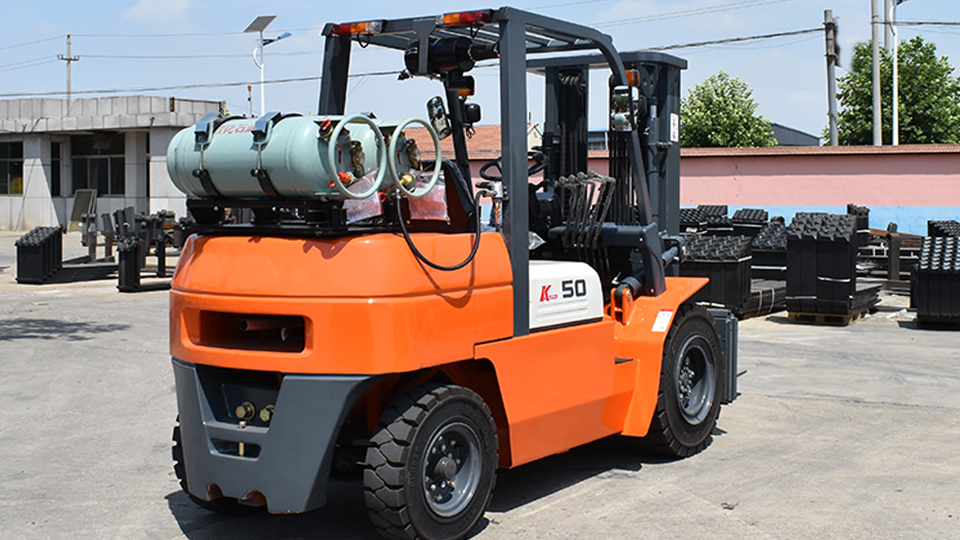
A forklift is composed of several integrated systems.2 Each plays a critical role in the machine's ability to lift, transport, and stack.3
The Truck Frame
The frame is the base of the machine to which the mast, axles, wheels, counterweight, and power source are attached.4 Unlike a car's chassis, which is designed for crumple zones and passenger comfort, a forklift frame is a rigid, heavy steel structure designed to minimize flex under immense vertical loads.5
The Counterweight
Located at the rear of the vehicle, the counterweight is a massive cast-iron hunk of metal.6 Its sole purpose is to offset the weight being lifted at the front. In electric forklifts, the lead-acid battery—which can weigh upwards of $3,000$ lbs—serves as a significant portion of this counterweight.
The Mast and Carriage
The mast is the vertical assembly that performs the lifting.7 It consists of interlocking rails that provide lateral stability.8 Attached to the mast is the carriage, which serves as the mounting point for the forks (or tines).9
2. The Physics of Operation: The Stability Triangle
The most critical technical concept in forklift operation is the Stability Triangle. Most people assume a forklift is stable because it has four wheels, but from a physics perspective, it operates as a three-point suspension system.10
The Three Points of Support
The left front drive wheel.
The right front drive wheel.
The center of the rear steering axle (the pivot point).
These three points form a triangle. As long as the Center of Gravity (CG)—which is the combined center of the truck and the load—remains inside this triangle, the forklift stays upright.11
The Fulcrum Principle
The forklift acts as a Class 1 Lever. The front wheels act as the fulcrum.
Effort: The counterweight at the rear.
Load: The weight on the forks at the front.
If the load is too heavy or the "Load Center" (the distance from the forks to the center of the load) is too far forward, the CG moves outside the stability triangle toward the front, causing the rear wheels to lift off the ground.12
3. The Power Systems: Hydraulics and Propulsion
A forklift requires two types of power: one to move the vehicle (propulsion) and one to move the load (hydraulics).
The Hydraulic System
The hydraulic system is the "muscle" of the forklift. It works based on Pascal’s Law, which states that pressure applied to a confined fluid is transmitted undiminished in all directions.13
The Pump: Driven by the engine or an electric motor, it creates a constant flow of hydraulic oil.14
Control Valves: These manage the direction of the fluid. When the operator pushes the lift lever, the valve directs high-pressure oil into the lift cylinders.15
The Lift Cylinders: These are hollow tubes with a piston inside.16 As oil enters, the pressure pushes the piston up.
The Chain Mesh: Most masts use a heavy-duty leaf chain. The cylinders push the inner mast sections up, and the chains pull the carriage up at a $2:1$ ratio, allowing the forks to move faster than the hydraulic pistons themselves.
Propulsion: IC vs. Electric
Internal Combustion (IC): These use LPG, Diesel, or Gasoline.17 They utilize a traditional drivetrain with a torque converter and a transaxle to provide high torque for heavy lifting and ramp climbing.
Electric (AC/DC): Modern electric forklifts use AC motors controlled by sophisticated inverters. They offer "regenerative braking," where the motor acts as a generator when slowing down, feeding energy back into the battery.18
4. Steering Geometry
Forklifts steer from the rear axle. This design is counterintuitive to most drivers but is essential for warehouse work.
Because the rear wheels steer, the forklift pivots around the front wheels. This allows the machine to have a "zero-point" turn capability, enabling it to turn $90$ degrees into a narrow warehouse aisle. However, this creates rear-end swing. When an operator turns left, the back of the forklift swings out wide to the right—a common hazard in tight spaces.19
5. Vital Technical Specifications
When evaluating a forklift's performance, engineers look at specific mathematical ratings found on the Data Plate:
Rated Capacity: The maximum weight the truck can lift (e.g., $5,000$ lbs).
Load Center: Usually $24$ inches. This is the distance from the face of the forks to the center of the load's gravity. If a load is $60$ inches deep, the load center becomes $30$ inches, and the rated capacity must be "derated" (mathematically reduced) to prevent tipping.
Free Lift: The distance the forks can rise before the mast sections start to extend upward.20 This is crucial for working inside containers or trailers with low ceilings.
6. Safety Engineering Systems
Modern forklifts are equipped with Operator Presence Systems (OPS) and Active Stability Systems.21 These use sensors to detect if the operator is seated; if not, the hydraulic and drive functions are electronically locked.22 High-end models also feature sensors that automatically slow the truck down if it senses a sharp turn while the mast is fully extended, keeping the center of gravity safely within the stability triangle.
Conclusion
A forklift is more than a vehicle; it is a mobile balancing act. By utilizing the mechanical advantage of hydraulics and the physics of the stability triangle, it transforms a few gallons of fuel or a battery charge into the power to move tons of material. Understanding these technical foundations is the first step toward safe operation and efficient warehouse management.
Name: selena
Mobile:+86-13176910558
Tel:+86-0535-2090977
Whatsapp:8613181602336
Email:vip@mingyuforklift.com
Add:Xiaqiu Town, Laizhou, Yantai City, Shandong Province, China