
vip@mingyuforklift.com
+86-0535-2090977

Introduction
Anyone who has spent time in warehouses, distribution centers, or manufacturing facilities has observed a peculiar phenomenon: forklifts frequently travel in reverse, with operators twisted in their seats looking backward while driving. This seemingly counterintuitive practice—driving heavy machinery while facing away from the direction of travel—isn't arbitrary operator preference but rather the result of decades of ergonomic research, accident analysis, and engineering optimization. Understanding why forklifts are reversed requires examining visibility constraints, load dynamics, safety statistics, and the biomechanics of operator positioning. This comprehensive analysis explores the technical reasons behind rearward forklift operation, the engineering solutions developed to address associated risks, and the ongoing evolution of forklift design that may eventually eliminate this necessity.
The Fundamental Visibility Problem
Forward Visibility Obstruction
The primary driver of rearward forklift operation lies in fundamental visibility constraints when traveling forward with elevated loads. Counterbalance forklifts—the most common industrial truck type—carry loads directly in front of the mast, creating a substantial blind spot that obscures the operator's forward view. A standard pallet measuring 40×48 inches positioned at typical travel heights (12-24 inches above ground) blocks approximately 15-20 square feet of the operator's direct forward vision.
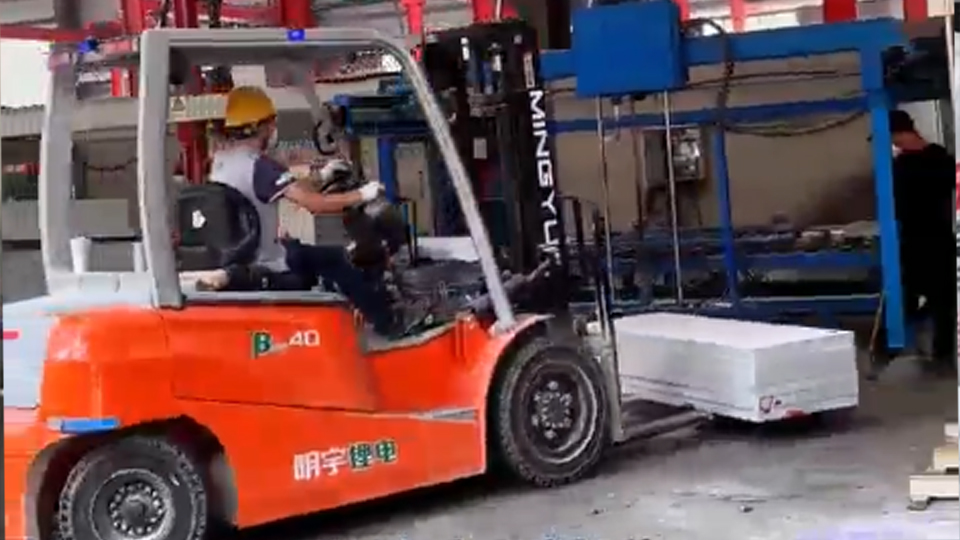
When carrying loads at higher elevations, such as during stacking operations or when navigating ramps, this obstruction becomes even more severe. A load elevated to 96 inches (common rack height) can completely eliminate ground-level forward visibility for operators in standard seated positions. The mast assembly itself—comprising vertical rails, hydraulic cylinders, and carriage mechanisms—adds additional visual interference even when no load is present.
Engineering studies using eye-tracking technology have quantified this visibility impairment. Research published in the Journal of Occupational and Environmental Hygiene demonstrated that forklift operators spend approximately 35-40% of their operating time with obstructed forward vision when carrying loads, forcing them to rely on peripheral vision and indirect observation through mast gaps. This fundamental design constraint creates an unavoidable safety dilemma: travel forward blind, or travel reverse while maintaining visual contact with the travel path.
Rearward Visibility Advantages
When operating in reverse, forklifts present dramatically improved sightlines. The rear of a typical counterbalance forklift lacks the mast assembly, creating an open field of view spanning approximately 180 degrees horizontally. Operators can directly observe pedestrians, obstacles, aisle intersections, and floor conditions without visual obstruction. This visibility advantage becomes particularly critical in environments with pedestrian traffic, narrow aisles, or dynamic operational conditions.
The rearward visibility benefit extends beyond simple obstruction removal. Forklift design optimizes rearward sightlines through specific engineering choices: rear mast posts are minimized, overhead guards use thin structural members positioned to avoid sightline interference, and counterweight shaping creates lower rear profiles. These design elements collectively create what safety engineers term "clear sight operation"—unobstructed visual contact with the travel path.
Load Dynamics and Stability Engineering
Center of Gravity Considerations
Forklift stability depends critically on maintaining the combined center of gravity (CG) within the stability triangle—the imaginary pyramid formed by lines connecting the front and rear wheels. When carrying loads, the CG shifts forward toward the load center. Traveling forward with elevated loads creates dynamic forces that further shift the CG, potentially destabilizing the truck during acceleration, braking, or turning maneuvers.
Traveling in reverse with loads positioned low and close to the ground optimizes stability by keeping the CG rearward within the stability envelope. This positioning minimizes the moment arm created by load mass during travel, reducing tipping risks during operational maneuvers. Engineering analysis demonstrates that a 5,000-pound load carried at 24 inches load center creates significantly reduced overturning moments when the forklift travels reverse versus forward, particularly during braking events where load inertia generates forward-shift forces.
The stability benefit becomes more pronounced with heavier loads or extended load centers. When handling loads approaching rated capacity, reverse travel provides an additional safety margin that forward travel cannot match. This stability engineering consideration directly influences operational procedures and training protocols, establishing reverse travel as the preferred mode for heavy-load transport.
Mast and Load Positioning
Forklift mast design incorporates specific engineering features that facilitate reverse travel. The mast tilting mechanism—typically providing 6 degrees forward tilt and 12 degrees backward tilt—allows operators to position loads optimally for rearward visibility. Backward mast tilt raises the load slightly while angling it toward the operator, creating sightlines beneath the load while maintaining load security against the carriage.
When traveling forward, operators must either lower loads to ground level (reducing productivity and increasing mast wear) or accept substantially impaired visibility. Reverse travel eliminates this trade-off, allowing efficient travel speeds with loads positioned at optimal heights for subsequent stacking operations. This operational efficiency—maintaining productive travel speeds without sacrificing visibility—drives reverse travel adoption in high-throughput environments.
Biomechanics and Operator Ergonomics
The Twisted Posture Problem
While reverse travel solves visibility constraints, it creates significant ergonomic challenges. Operators must rotate their upper bodies 90-180 degrees to observe the travel path behind the forklift, maintaining this twisted posture throughout travel movements. This position—termed "truck twist" in ergonomic literature—generates substantial biomechanical stress on the cervical spine, thoracic region, and lumbar structures.
Research by the National Institute for Occupational Safety and Health (NIOSH) has documented the physical demands of this posture. Sustained neck rotation exceeding 30 degrees creates muscular fatigue and increases risk of cumulative trauma disorders. Operators frequently report neck pain, shoulder discomfort, and lower back strain associated with prolonged reverse travel operations. The ergonomic cost of reverse travel represents a significant occupational health consideration, driving both regulatory attention and engineering innovation.
Mitigation Through Design
Forklift manufacturers have developed several engineering solutions to address the ergonomic burden of reverse travel. The most significant innovation—rear-facing operator positions—eliminates the twisted posture entirely by orienting the operator to face the rear of the truck during normal operation. Reach trucks, order pickers, and some specialized counterbalance designs position operators at 90-degree angles to the travel direction or facing directly rearward, eliminating neck rotation while maintaining visibility.
For traditional sit-down counterbalance forklifts where rear-facing orientation isn't practical, ergonomic improvements focus on reducing the physical demands of twisted postures. Suspension seats with lateral support help stabilize operators during reverse travel. Adjustable steering columns allow operators to position controls optimally for different viewing angles. Some designs incorporate rotating operator compartments that swivel to face the direction of travel, though these add mechanical complexity and cost.
Safety Statistics and Accident Analysis
Incident Data Patterns
Analysis of forklift-related accidents reveals clear patterns supporting reverse travel protocols. OSHA accident investigations consistently identify forward travel with obstructed vision as a contributing factor in collisions with pedestrians, racking systems, and other equipment. The Bureau of Labor Statistics reports that struck-by accidents involving forklifts result in approximately 85 fatalities and 34,900 serious injuries annually, with visibility limitations cited in a substantial percentage of incidents.
Conversely, accidents occurring during reverse travel predominantly involve backing over pedestrians or collisions with objects in the operator's peripheral vision zones. However, these incidents occur at substantially lower rates than forward-visibility accidents, suggesting that rearward travel—despite its ergonomic costs—provides net safety benefits through improved operator awareness.
The Pedestrian Visibility Paradox
An interesting safety dynamic emerges regarding pedestrian visibility. While reverse travel improves operator sightlines, it simultaneously positions the forklift's rear—lacking warning lights, beacons, and sometimes audible alarms—toward pedestrian traffic. Forward travel presents the forklift's front, typically equipped with headlights, warning beacons, and highly visible mast structure, to approaching pedestrians.
This paradox has driven regulatory requirements for additional safety equipment. Modern forklifts incorporate rear-mounted blue spotlights projecting warning symbols onto the floor behind the truck, reversing alarms, and rear-mounted strobe lights. These engineering controls address the visibility asymmetry created by reverse travel protocols, ensuring that pedestrians receive adequate warning even when the forklift's less-visible rear leads travel direction.
Operational Environments and Situational Factors
Aisle and Facility Design
Warehouse layout significantly influences reverse travel frequency. Narrow aisle operations—common in modern high-density storage systems—often require reverse travel for simple navigation regardless of load status. VNA (Very Narrow Aisle) trucks and reach trucks operate almost exclusively in reverse during travel movements, with forward movement limited to final approach and deposit operations.
Facility design elements including aisle width, intersection frequency, and traffic patterns establish operational contexts where reverse travel becomes the default mode. Engineering optimization of warehouse layouts must account for reverse travel requirements, ensuring adequate sightlines at intersections and minimizing the distance of reverse travel where possible.
Load Characteristics and Handling Requirements
Specific load types necessitate reverse travel regardless of general visibility considerations. Oversized loads extending beyond the pallet perimeter may create complete forward visibility obstruction, making reverse travel mandatory. Fragile or high-value loads may require the operator's continuous visual monitoring, achievable only through rearward travel positioning.
Liquid loads, unstable stacking configurations, and hazardous materials similarly drive reverse travel requirements. The operational necessity of monitoring these loads during transport outweighs the ergonomic costs of twisted postures, establishing reverse travel as the only safe handling mode.
Technological Solutions and Future Directions
Camera and Sensor Systems
Modern forklift technology offers solutions to the visibility challenges driving reverse travel. Rear-view cameras mounted on the overhead guard or mast provide forward-facing operators with real-time video feeds of the travel path behind the truck. These systems eliminate the need for physical head-turning while maintaining visibility, though they introduce new considerations regarding screen positioning, image latency, and operator attention division.
Advanced systems incorporate 360-degree camera coverage, creating bird's-eye view displays that eliminate all blind spots. Object detection sensors and pedestrian recognition systems using radar, lidar, or computer vision provide automated warnings or intervention capabilities. These technologies promise to eventually eliminate the visibility constraints that necessitate reverse travel, though current implementation remains limited by cost and reliability factors in industrial environments.
Autonomous and Semi-Autonomous Operation
The ultimate solution to reverse travel challenges lies in removing human operators entirely. Autonomous forklifts—already deployed in controlled warehouse environments—travel optimally in any direction without visibility constraints, using sensor arrays for navigation. These systems eliminate both the visibility problem and the ergonomic burden of twisted postures, representing the technological endpoint of forklift evolution.
Semi-autonomous features including automatic speed optimization, path planning, and collision avoidance assist human operators in maintaining safety during necessary reverse travel. These systems reduce the cognitive burden of rearward operation while preserving human oversight for complex handling tasks.
Training and Operational Protocols
Standard Operating Procedures
Despite technological advances, reverse travel remains standard practice in most forklift operations. Training programs emphasize proper techniques for minimizing ergonomic impact: using mirrors where available, rotating body position rather than just neck rotation, limiting continuous reverse travel duration, and planning travel paths to minimize rearward distance.
Safety protocols establish specific requirements for reverse travel including speed limitations (typically 3-5 mph maximum), mandatory horn signals at intersections, and spotter requirements for extended reverse movements. These operational controls address the residual risks of rearward travel while preserving its visibility benefits.
Regulatory Framework
OSHA standards governing forklift operation (29 CFR 1910.178) do not explicitly mandate reverse travel but require operators to maintain safe travel paths with adequate visibility. Industry consensus standards from ANSI and ITSDF provide more specific guidance, generally recommending reverse travel when forward visibility is obstructed by loads or mast structure. These standards influence employer policies and liability considerations, establishing reverse travel as de facto required practice.
Conclusion
The practice of operating forklifts in reverse emerges from fundamental engineering constraints rather than historical accident or operator preference. The visibility obstruction created by forward-mounted loads, combined with stability optimization and safety statistics demonstrating reduced accident rates, establishes reverse travel as the technically correct operational mode despite its ergonomic costs. This engineering solution to a design constraint—carrying loads in front while needing to see where you're going—represents a pragmatic compromise between competing requirements.
As technology advances, the necessity of reverse travel diminishes. Camera systems, sensors, and autonomous operation promise futures where forklifts travel optimally in any direction without human visibility constraints or ergonomic penalties. Until these technologies achieve universal adoption and regulatory acceptance, however, reverse travel remains an essential skill for forklift operators and a defining characteristic of industrial truck operation.
Understanding the technical reasons behind reverse forklift operation—visibility engineering, load dynamics, safety statistics, and ergonomic trade-offs—enables informed decisions regarding equipment selection, facility design, and operational protocols. Rather than viewing reverse travel as an inconvenience, recognizing it as an engineered safety solution allows organizations to optimize the associated procedures, training, and technological investments that maximize both safety and productivity in materials handling operations.
Name: selena
Mobile:+86-13176910558
Tel:+86-0535-2090977
Whatsapp:8613181602336
Email:vip@mingyuforklift.com
Add:Xiaqiu Town, Laizhou, Yantai City, Shandong Province, China