
vip@mingyuforklift.com
+86-0535-2090977

In material handling, "capacity" is not a fixed number.1 While a forklift may be marketed and sold as a "5,000-lb unit," that rating is a conditional promise rather than an absolute capability. The process of reducing this maximum rated capacity due to specific operational factors is known as derating.2
Understanding why and how a forklift derates is critical for safety. In fact, approximately 25% of forklift-related fatalities involve tip-overs—an accident often caused by an operator exceeding the "residual" (derated) capacity of the machine.
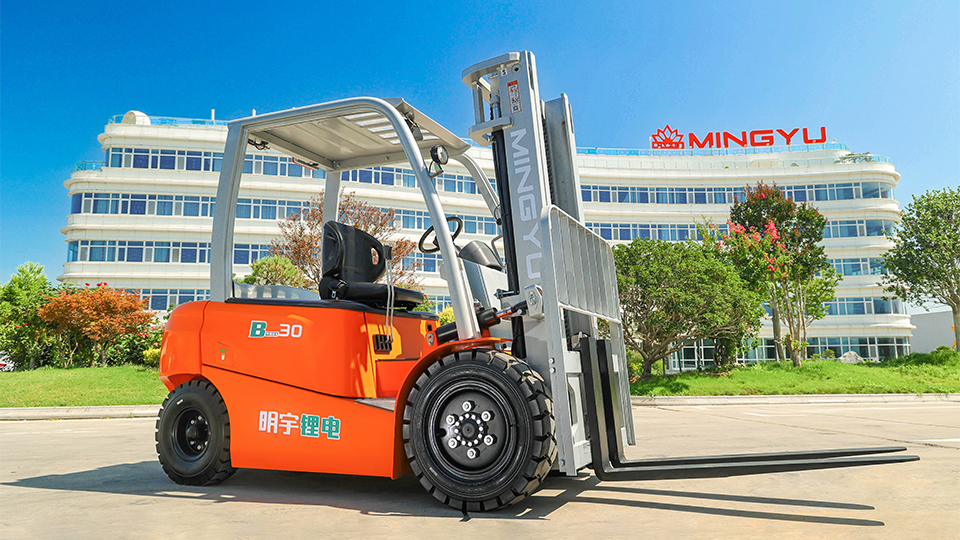
1. The Seesaw Principle: Counterbalance Physics
To understand derating, one must first view the forklift not as a truck, but as a mobile seesaw.3
A counterbalanced forklift uses its heavy rear chassis and battery (on electric models) or cast-iron weights (on IC models) to offset the load on the forks. The front axle acts as the fulcrum (pivot point).4
The physics can be expressed through the concept of Load Moment:
$$\text{Moment} = \text{Weight} \times \text{Distance from Fulcrum}$$
As the load moves further away from the fulcrum or higher into the air, the "leverage" it exerts against the truck increases.5 If the moment of the load exceeds the moment of the counterweight, the forklift tips forward.6
2. Key Factors That Cause Derating
Several variables dictate the "Net" or "Residual" capacity—the actual weight a forklift can safely handle in a specific scenario.7
A. Load Center Extension
The "Nominal Capacity" of a forklift is typically rated at a 24-inch (600mm) load center.8 This assumes a standard 48-inch pallet where the weight is perfectly centered.
If you pick up a load that is 72 inches long, the center of gravity shifts from 24 inches to 36 inches. This 12-inch shift significantly increases the overturning moment.
Rule of Thumb: For every inch the load center moves beyond the rated specification, the forklift can lose approximately 100 lbs of capacity.9
B. Lift Height (Vertical Derating)
As a load is raised, the forklift becomes less stable for two reasons:
Mast Deflection: At high elevations, the steel mast can flex slightly forward, pushing the load center further away from the fulcrum.
Dynamic Forces: A load at 20 feet has significantly more "sway" than a load at 2 feet. Even a small tilt of the mast at great heights moves the center of gravity drastically.
C. Attachments (The "Double Hit")
Adding a side-shifter, paper roll clamp, or fork extensions causes a "double hit" to the forklift’s capacity:
Dead Weight: The attachment itself can weigh hundreds or thousands of pounds, which must be subtracted from the lifting capacity.
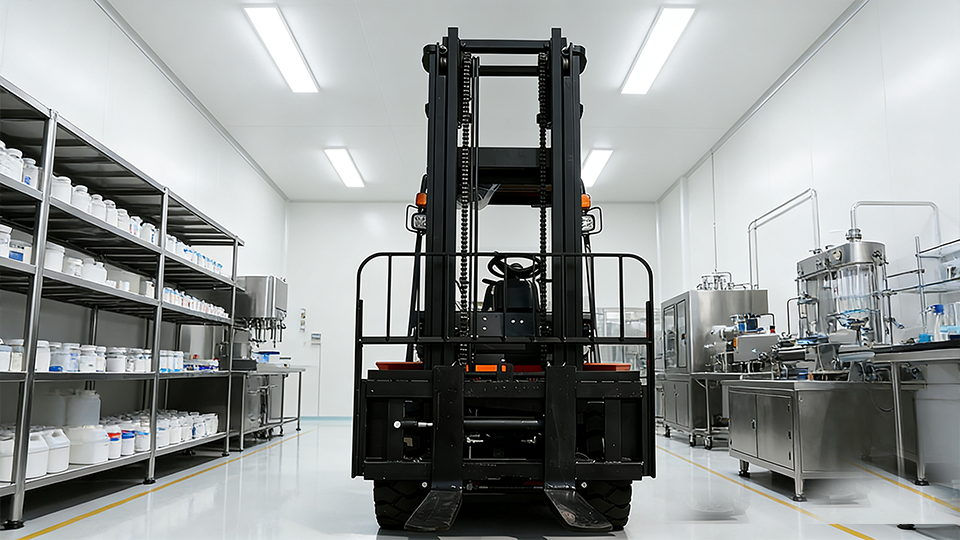
Effective Thickness (Lost Load): Attachments move the load further forward from the carriage, effectively increasing the load center before you even pick up a pallet.
|
Attachment |
Typical Weight Impact |
Typical Distance Impact |
|
Side Shifter |
-200 to -400 lbs |
+2 to +4 inches |
|
Paper Roll Clamp |
-1,200 to -2,500 lbs |
+10 to +15 inches |
|
Fork Extensions |
-50 to -150 lbs |
Dependent on length |
3. The Mathematics of Derating
Engineers use a standard formula to estimate the new capacity when the load center changes. This is often called the Capacity Formula:
$$\text{New Capacity} = \frac{\text{Rated Capacity} \times (\text{Rated Load Center} + \text{Front Overhang})}{\text{Actual Load Center} + \text{Front Overhang}}$$
Front Overhang: The distance from the center of the front axle to the front face of the forks (usually around 15–20 inches).
Example: You have a 5,000-lb forklift with a 24" load center and an 18" overhang. You need to lift a load with a 36" load center.
$$\text{New Capacity} = \frac{5,000 \times (24 + 18)}{36 + 18} = \frac{210,000}{54} \approx 3,888 \text{ lbs}$$
Your 5,000-lb forklift has just "derated" to less than 3,900 lbs.
4. The Stability Triangle and Pyramid
It is a common misconception that forklifts only tip forward. Stability is actually maintained within a Stability Triangle.10
The two front tires and the center of the rear axle (which pivots) form the base.11
When the forks are raised, this triangle becomes a Stability Pyramid.12
As the load goes higher, the "safe zone" for the center of gravity shrinks toward the peak of the pyramid.13 Any lateral force—such as turning too quickly or driving on a slight slope—can move the center of gravity outside this narrow zone, causing a lateral tip-over.14
5. Summary: Reading the Data Plate
The most important tool for an operator is the Data Plate (or Nameplate). By law (OSHA 1910.178), if an attachment is added or a mast is changed, the manufacturer must provide an updated data plate reflecting the new derated capacities.15
An operator must never guess capacity. If the load is non-standard, taller than usual, or handled with an attachment, they must consult the plate to find the specific residual capacity for that exact lift height and load center.16
Name: selena
Mobile:+86-13176910558
Tel:+86-0535-2090977
Whatsapp:8613181602336
Email:vip@mingyuforklift.com
Add:Xiaqiu Town, Laizhou, Yantai City, Shandong Province, China
