
vip@mingyuforklift.com
+86-0535-2090977

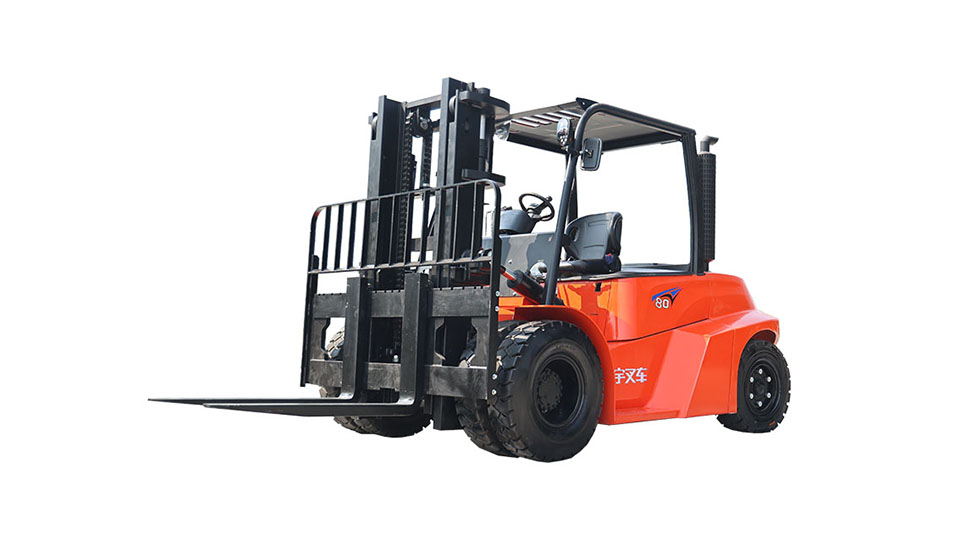
In the high-stakes world of warehousing and industrial logistics, the forklift is as ubiquitous as the pallet itself. Among its most prominent safety features is the Overhead Guard (OHG)—that cage-like steel structure sitting directly above the operator.1 A common question among trainees and safety managers alike is whether this guard acts as a "safety net" for falling operators or if it is purely for falling objects.
The short answer is technical: A forklift overhead guard is designed to protect you from falling objects, not to protect you from falling off the machine.2 However, the engineering behind it is a fascinating study in structural integrity and risk management.
1. The Design Intent: FOP vs. Fall Protection
To understand why an overhead guard might not "save" a falling person, we have to look at its engineering standard. Most overhead guards are classified as Falling Object Protective Structures (FOPS).
Falling Object Protection (FOP)
The primary mission of the OHG is to shield the operator from "nuisance" drops—small packages, loose boxes, or bagged materials that might slip from a high rack.3
The "Crush and Deflect" Principle: Unlike a roll cage in a race car, which is designed to stay rigid, many forklift guards are engineered to "crush and deflect."4
Structural Failure by Design: If a maximum-capacity load (e.g., a 5,000 lb pallet) falls from 20 feet, the guard is actually designed to deform.5 The leg receiving the heaviest impact will buckle to redirect the weight away from the operator’s "survival zone" (the space between the seat and the steering wheel).6
Why It Isn't a Fall Arrest System
Fall protection systems, such as harnesses and guardrails, are governed by different OSHA standards (like 29 CFR 1910.140).7 An overhead guard does not meet the requirements for a "walking-working surface" or a "guardrail."
Open Grid Design: Most OHGs use a slatted or mesh design to ensure the operator has upward visibility. These gaps are large enough for a limb or a person to slip through during a fall.
Surface Grip: The top of an OHG is usually smooth steel—dangerously slick and never intended to be stepped on.
2. The Physics of a Forklift Fall
Falls involving forklifts typically happen in two ways: the operator falling out of the cab, or the forklift itself tipping over.
The "Mouse Trap" Effect
During a lateral tip-over, the most natural human instinct is to jump out of the falling vehicle. This is almost always fatal.
When a forklift tips, the overhead guard moves much faster than the operator can jump. The operator often ends up pinned between the OHG and the floor—a phenomenon safety experts call the "mouse trap."
Technical Note: This is why seatbelts are mandatory on sit-down forklifts. The seatbelt keeps you inside the protection of the overhead guard so that if the machine tips, the guard takes the impact against the ground, and you remain in the survival zone.
3. When the Guard Does Involve Fall Safety
There is one specific scenario where the overhead guard is integrated into fall protection: Forklift Work Platforms.
When a forklift is used to lift a person (using an OSHA-approved safety cage or "man-basket"), the overhead guard of the forklift acts as a barrier between the worker and the mast.
Mast Guards: A screen or mesh is often added to the OHG to prevent the person in the basket from reaching into the moving parts of the mast.
Tie-off Points: In some specialized reach trucks, the overhead guard may have engineered anchorage points for a personal fall arrest system (PFAS). However, you should never tie a lanyard to a standard OHG unless the manufacturer has specifically rated that point for 5,000 lbs of force.
4. Comparing Standards: ANSI B56.1 vs. OSHA 1910.178
The technical "bible" for forklift construction is the ANSI B56.1 standard. It mandates that overhead guards must pass a "Drop Test."
|
Test Parameter |
Standard Requirement |
|
Test Load |
Usually a bundle of lumber or a weighted pallet. |
|
Drop Height |
Specified based on the truck's capacity. |
|
Success Criteria |
The guard must not deform enough to touch the operator's head or steering wheel. |
This test confirms the guard is a shield against downward force. It does not test for lateral falls or for supporting a dangling human weight.
5. Critical Safety Rules for Operators
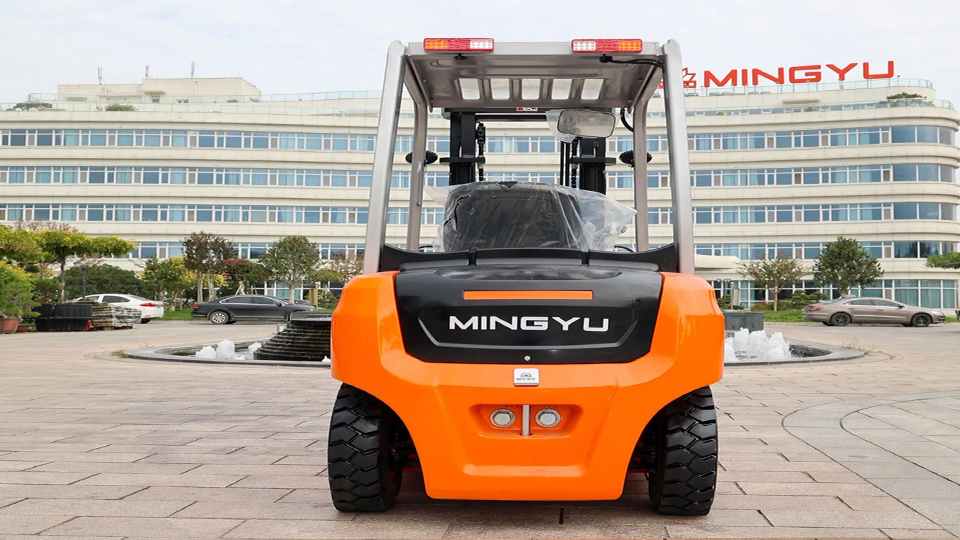
To ensure the overhead guard does its job without becoming a hazard, follow these technical guidelines:
Never Modify the Guard: Drilling holes to mount a fan or welding a bracket for a clipboard can compromise the structural integrity.8 Any modification requires written approval from the manufacturer.
Daily Inspections: Check for "hairline cracks" in the welds. A cracked weld means the guard may not "deflect" as intended during a load drop.
Stay Inside the Frame: Keep your hands and feet inside the pillars of the OHG at all times.9 If a load begins to fall, do not jump. Lean away from the point of impact, grip the steering wheel firmly, and stay planted in your seat.
Conclusion: A Shield, Not a Net
The overhead guard is an engineering marvel designed to keep you safe from the vertical hazards of a warehouse.10 While it won't catch you if you fall, and it isn't a replacement for a proper fall-arrest system when working at heights, it is your primary defense against the thousands of pounds of inventory stored above your head.11
Name: selena
Mobile:+86-13176910558
Tel:+86-0535-2090977
Whatsapp:8613181602336
Email:vip@mingyuforklift.com
Add:Xiaqiu Town, Laizhou, Yantai City, Shandong Province, China
