
vip@mingyuforklift.com
+86-0535-2090977

Abstract
Dual-fuel forklifts, capable of operating on both liquefied petroleum gas (LPG) and gasoline, represent a significant advancement in material handling equipment. The ability to switch between fuel modes—either automatically or manually—while accounting for load variation presents unique engineering challenges and operational benefits. This article examines the technical mechanisms, control strategies, and safety protocols governing fuel mode transitions in dual-fuel forklifts under varying load conditions, drawing from current manufacturer specifications and operational guidelines.
1. Introduction
In modern warehouse and logistics operations, material handling equipment must balance performance, emissions compliance, and operational flexibility. Dual-fuel forklifts address these competing demands by enabling operators to switch between LPG and gasoline, selecting the optimal fuel based on environmental requirements, fuel availability, and load demands .
LPG burns significantly cleaner than gasoline, producing fewer carbon monoxide, hydrocarbon, and particulate emissions, making it suitable for indoor operations where air quality is paramount . Conversely, gasoline typically delivers higher power output, which proves advantageous for heavy outdoor lifting tasks. The engineering challenge lies not merely in providing two fuel systems, but in ensuring seamless, safe transitions between them—particularly when the forklift is under load.
2. System Architecture and Core Components
2.1 Dual-Fuel System Overview
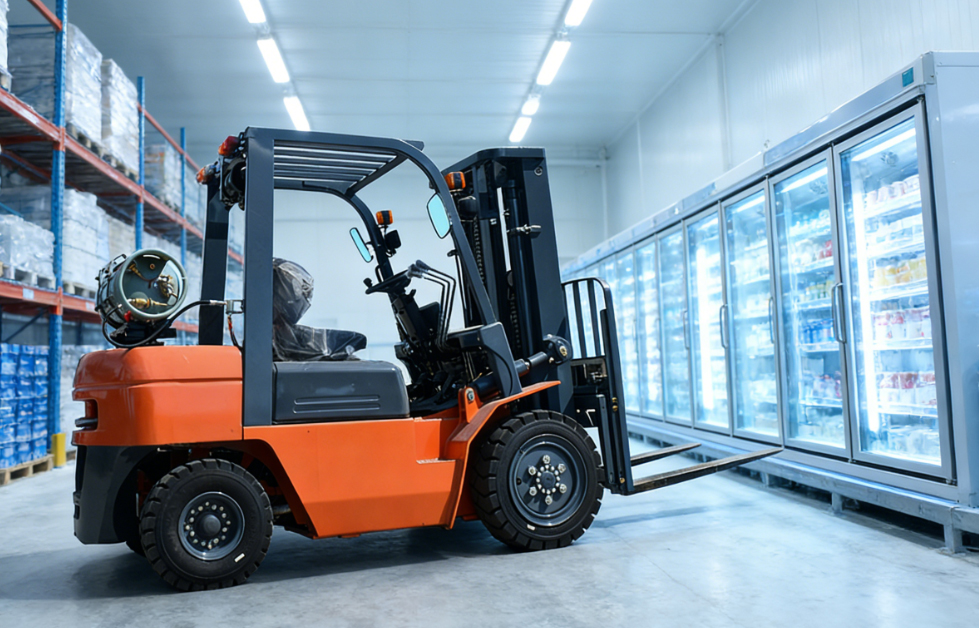
A dual-fuel forklift integrates two complete fuel delivery systems, each with dedicated components, unified under a central control mechanism .
Gasoline Subsystem:
Standard fuel tank (typically rear-mounted)
Electric fuel pump
Carburetor or electronic fuel injection (EFI) system
Dedicated fuel lines and filtration
LPG Subsystem:
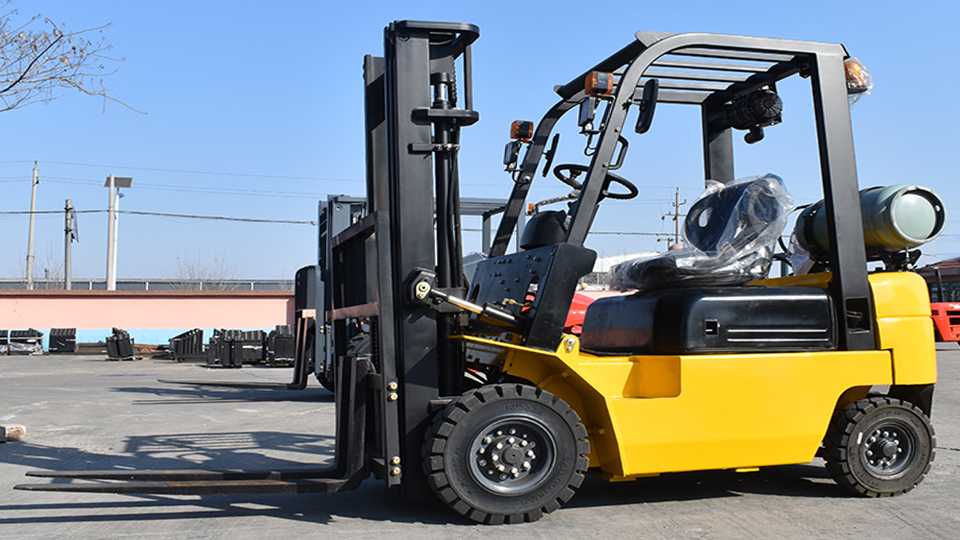
Pressurized LPG cylinder (horizontal rear mounting)
Vaporizer/regulator assembly (engine coolant-heated)
LPG mixer or dedicated gas injectors
High-pressure liquid lines and low-pressure vapor lines
Safety lock-off solenoid valve
Control Interface:
Fuel selector switch (three-position: GAS / NEUTRAL / LPG)
Electronic Control Unit (ECU) or mechanical governor
Fuel-specific indicator lamps
The vaporizer/regulator represents a critical LPG component, using engine coolant heat (typically 70°C–85°C operating temperature) to convert high-pressure liquid propane into low-pressure vapor suitable for combustion .
3. Fuel Mode Switching Mechanisms
3.1 Manual Switching Protocols
Manual fuel switching remains the predominant method in current dual-fuel forklift designs. However, manufacturer protocols vary significantly regarding whether switching can occur with the engine running.
Kubota H12 Dual-Fuel Engine (On-the-Fly Switching):
For engines such as the Kubota H12, operators may switch fuels without shutting down the engine, provided the forklift is safely stopped and the transmission is in neutral . The procedure involves:
Bring the forklift to a complete stop
Place the shift lever in neutral
Rotate the fuel changeover switch to the desired position
Resume operation
GCT K21/K25 Dual-Fuel Engine (Engine-Stop Switching):
Other engine architectures, such as the GCT K21 and K25, require a more conservative approach :
Stop the forklift safely and shift to neutral
Rotate the ignition key to OFF, shutting down the engine
Rotate the fuel changeover switch to the desired fuel position
Restart the engine using standard starting procedures
Carburetor-Based Systems (Residual Fuel Purge):
Older or carburetor-equipped systems often employ a neutral position purge cycle. When switching from gasoline to LPG (or vice versa), the operator places the switch in NEUTRAL, slightly depresses the accelerator, and allows the engine to consume residual fuel until it stalls . Only then is the switch moved to the new fuel position and the engine restarted. This prevents fuel mixing in the carburetor, which could cause rough running or combustion anomalies.
3.2 Automatic Switching Systems
While fully automatic fuel switching is less common in conventional dual-fuel forklifts, advanced control systems are emerging. Woodward's dual-fuel control systems, originally developed for larger engine applications, demonstrate the technical feasibility of automated fuel transitions .
In such systems, the ECU monitors engine speed, load, and fuel demand via transducers. During a fuel transition:
Both fuel actuators respond proportionally to fuel requirements
The transfer percentage is dictated by a gas transducer
Governor control voltage (typically 0 to -8 Vdc) modulates actuator position
At no load, actuator voltage ranges 1–2 V; at full load, approximately 6 V
For forklift applications, automatic switching would require:
Real-time load sensing (hydraulic pressure transducers)
Engine speed and temperature monitoring
Closed-loop air-fuel ratio control for both fuels
Predictive algorithms to anticipate load changes
4. Load Variation Dynamics and Switching Challenges
4.1 Load-Dependent Engine Behavior
Forklift engine load varies dramatically during operation. When unloaded, the engine operates at minimal throttle with low fuel demand. Under full load (maximum rated capacity, typically 1.5–5.5 tonnes depending on model), fuel demand increases substantially, and the engine operates at higher throttle positions and richer mixtures .
The center of gravity shifts dynamically based on load mass, mast tilt, and lift height, affecting not only stability but also hydraulic system pressure and, consequently, engine load .
4.2 Switching Under Load: Technical Risks
Switching fuel modes while the engine is under significant load presents several technical challenges:
Fuel Delivery Latency:
When switching from gasoline to LPG, the gasoline fuel pump deactivates immediately, but LPG must travel from the cylinder through the vaporizer before reaching the engine. During this transition, the engine may experience a momentary fuel deficit, causing power sag or stall—particularly dangerous if the forklift is lifting a heavy load .
Vaporizer Response Time:
The LPG vaporizer relies on engine coolant temperature (70°C–85°C optimal). Under heavy load, coolant temperatures may rise, potentially improving vaporization. However, during cold starts or low-load operation, the vaporizer may not provide sufficient vapor pressure, leading to lean conditions and power loss .
Combustion Characteristic Differences:
Gasoline and LPG have different stoichiometric ratios, flame speeds, and octane ratings. Gasoline requires approximately 14.7:1 air-fuel ratio, while LPG (propane) requires approximately 15.5:1. Switching between these ratios without proper ECU adaptation can cause knocking, misfire, or catalytic converter damage.
Inertial Load Effects:
When lifting heavy loads, the hydraulic pump places a sudden inertial load on the engine. If a fuel switch occurs during this transient, the engine may lack sufficient torque to maintain speed, causing the hydraulic system to lose pressure and potentially drop the load .
4.3 Manufacturer Safety Protocols
Recognizing these risks, manufacturers universally prohibit fuel switching while the forklift is in motion or under operational load . Standard safety protocols include:
Stationary Requirement: The forklift must be completely stopped before switching fuels
Neutral Transmission: The shift lever must be in neutral to prevent unexpected movement
Warm-Up Period: Engines should reach normal operating temperature (coolant 70°C–85°C) before fuel switching to ensure proper vaporizer function
No Switching Under Lift: Fuel changes are prohibited while loads are elevated
5. Advanced Control Strategies for Load-Adaptive Switching
5.1 Predictive Load Sensing
Modern dual-fuel control systems can incorporate predictive algorithms that anticipate load changes based on operator input. Hydraulic pressure sensors on the lift and tilt circuits provide real-time load data. When the ECU detects an impending heavy lift, it can:
Lock out fuel switching until the operation completes
Pre-condition the target fuel system (e.g., pre-pressurize LPG lines)
Adjust ignition timing and throttle position to compensate for fuel characteristic differences
5.2 Graduated Transition Control
Rather than abrupt fuel cutoff/activation, advanced systems can implement graduated transitions:
Phase 1 (Preparation): Activate target fuel system while maintaining current fuel flow
Phase 2 (Overlap): Briefly supply both fuels in controlled proportions (bi-fuel blending)
Phase 3 (Completion): Cut off original fuel, complete transition
Woodward's dual-fuel control documentation describes this principle, where "when the control is in a condition of transfer... both actuators respond to the fuel requirements at a percentage dictated by the extent of the transfer" .
5.3 Load-Compensated Governor Control
Engine governors in dual-fuel systems must maintain speed stability across varying loads. The governor control amplifier outputs 0 to -8 Vdc, with fuel actuators responding proportionally . During fuel transitions under load, the governor must:
Detect speed droop caused by fuel delivery interruption
Rapidly adjust actuator position to maintain set speed
Compensate for different torque characteristics between fuels
6. Operational Guidelines and Best Practices
6.1 Pre-Operation Checks
Before each shift, operators should:
Verify both fuel systems are functional and leak-free
Confirm LPG cylinder valve opens/closes properly
Check that the fuel selector switch operates smoothly through all positions
Ensure gasoline tank contains at least 1/4 fuel (emergency reserve requirement)
6.2 Fuel Selection Strategy
Indoor Operations (LPG Preferred):
Lower emissions (CO, HC, PM)
Reduced ventilation requirements
Quieter operation
Outdoor Heavy-Duty Operations (Gasoline Preferred):
Higher power output for demanding lifts
Better cold-start performance in extreme conditions
Availability when LPG supply is limited
6.3 Maintenance of Dual-Fuel Systems
Regular maintenance is critical for reliable fuel switching :
LPG System:
Inspect vaporizer/regulator for leaks or freeze-up
Check lock-off valve operation
Examine high-pressure lines for wear or damage
Verify pressure relief valve functionality
Gasoline System:
Standard fuel system checks (pump, filter, injectors/carburetor)
Prevent fuel degradation by operating on gasoline periodically (manufacturers recommend at least several kilometers every two weeks, or approximately 10 kg monthly)
Switching Mechanism:
Inspect electrical connections to selector switch
Test solenoid valves for proper activation
Verify ECU/governor calibration
7. Safety Systems and Emergency Protocols
7.1 Automatic Safety Lockouts
Modern dual-fuel forklifts incorporate multiple safety features:
LPG Leak Detection: If leaks are detected, the LPG lock-off valve closes automatically, and the system defaults to gasoline operation (if available)
Overspeed Protection: Governor systems reduce fuel to minimum if engine speed exceeds set limits
Neutral-Start Interlock: Engine cannot start unless transmission is in neutral
7.2 Emergency Procedures
If fuel system malfunction occurs during operation:
Immediately close the LPG cylinder outlet valve
Switch to gasoline mode (if operational) or neutral
Move to a safe location away from ignition sources
Engage parking brake and shut down engine
Contact qualified maintenance personnel
8. Future Developments
The evolution of dual-fuel forklift technology points toward greater automation and integration:
Electronic Fuel Injection (EFI) Adaptation:
Modern EFI systems can adapt fuel maps dynamically, enabling smoother transitions between gasoline and LPG with minimal power interruption.
Telematics Integration:
Fleet management systems can monitor fuel switching events, load profiles, and system health, enabling predictive maintenance and operator training optimization.
Hybrid Dual-Fuel Architectures:
Emerging designs may integrate dual-fuel capability with electric hybrid systems, further reducing emissions while maintaining the flexibility of liquid fuels for extended outdoor operation.
9. Conclusion
Dual-fuel forklift fuel mode switching under load variation represents a complex interplay of mechanical, electronic, and thermal systems. While current manual switching protocols prioritize safety by requiring stationary, neutral-position operation, advances in electronic control systems offer pathways toward more sophisticated, load-adaptive automatic switching.
The fundamental engineering challenge—maintaining consistent engine torque and speed during fuel transitions while hydraulic loads vary—requires careful coordination of fuel delivery, ignition timing, and governor response. Manufacturers' conservative switching protocols reflect the critical safety imperative: preventing engine stall or power loss during load-bearing operations.
As electronic control technology advances, graduated fuel transitions with real-time load compensation may enable seamless automatic switching even under moderate load variations. However, the physical differences between gasoline and LPG combustion characteristics, combined with the safety-critical nature of material handling operations, ensure that human oversight and proper operator training remain essential components of dual-fuel forklift operation.
For fleet managers and operators, understanding the technical nuances of fuel mode switching—particularly the relationship between load variation, vaporizer temperature, and fuel delivery latency—is essential for maximizing equipment uptime, ensuring safety, and optimizing the operational flexibility that makes dual-fuel forklifts a valuable asset in diverse material handling environments.
Name: selena
Mobile:+86-13176910558
Tel:+86-0535-2090977
Whatsapp:8613181602336
Email:vip@mingyuforklift.com
Add:Xiaqiu Town, Laizhou, Yantai City, Shandong Province, China
