
vip@mingyuforklift.com
+86-0535-2090977

1. The Core Powerplant: The Diesel Engine
At the heart of the machine is a four-stroke compression-ignition engine.4 While similar in principle to a car engine, forklift engines are tuned for high torque at low RPMs rather than high-speed travel.
The Compression-Ignition Cycle
Unlike gasoline engines that use spark plugs, diesel engines rely on heat of compression.5
Intake: The piston moves down, drawing only air into the cylinder.
Compression: The piston rises, compressing the air into a tiny fraction of its original volume (often a 20:1 ratio). This raises the air temperature to over 500°C.
Combustion: Just before the piston reaches the top, a high-pressure injector sprays a fine mist of diesel fuel into the superheated air. The fuel ignites spontaneously, forcing the piston down with immense power.
Exhaust: The piston rises again, pushing the spent gases out through the exhaust manifold.6
Shutterstock
This process provides the mechanical energy required to turn the crankshaft, which serves as the primary energy distributor for both the wheels and the lifting equipment.
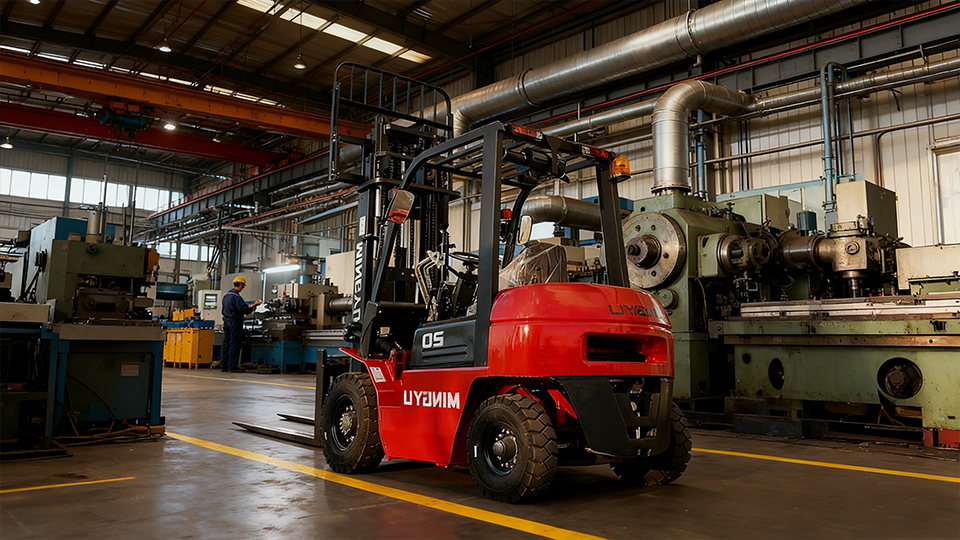
2. Power Transmission: Moving the Machine7
The torque generated by the engine must be transferred to the drive wheels.8 Most modern diesel forklifts use one of two systems: Torque Converter (Powershift) or Hydrostatic Drive.9
Torque Converter (Mechanical)
This is common in larger, heavy-duty trucks. A torque converter uses a "fluid coupling" to transfer power from the engine to the transmission.10 This allows the forklift to come to a stop without stalling the engine, much like an automatic car. The transmission then uses gears to drive the front axle.11
Hydrostatic Drive (Hydraulic)
Many high-performance forklifts (like those from Linde) use a hydrostatic system.12 Here, the diesel engine drives a variable-displacement hydraulic pump rather than a gearbox. This pump sends high-pressure oil to hydraulic motors at the wheels.13
Precision: It allows for incredibly smooth acceleration and braking.
Dynamic Braking: When the operator lifts their foot off the pedal, the fluid flow stops, naturally braking the machine without wearing out mechanical brake pads.
3. The Hydraulic System: The "Muscles"
The primary function of a forklift is to lift.14 This is achieved through Pascal’s Law: pressure applied to a confined fluid is transmitted undiminished in all directions.15
The Hydraulic Pump
Directly coupled to the engine’s crankshaft is a hydraulic pump (usually a gear or vane pump).16 As long as the engine is running, the pump is moving hydraulic oil from the reservoir through the system.17
Control Valve Block
When the operator moves a lever, they are essentially opening a gate in the control valve block.18 This directs the high-pressure oil toward specific actuators:
Lift Cylinders: Large, single-acting cylinders that push the mast stages upward.19
Tilt Cylinders: Double-acting cylinders located at the base of the mast. They can pull or push to angle the mast forward (to pick up a load) or backward (to secure a load).20
Shutterstock
4. The Lifting Mechanism: Mast and Chain21
While the hydraulics provide the push, the actual lifting height is often doubled or tripled by a pulley and chain system.
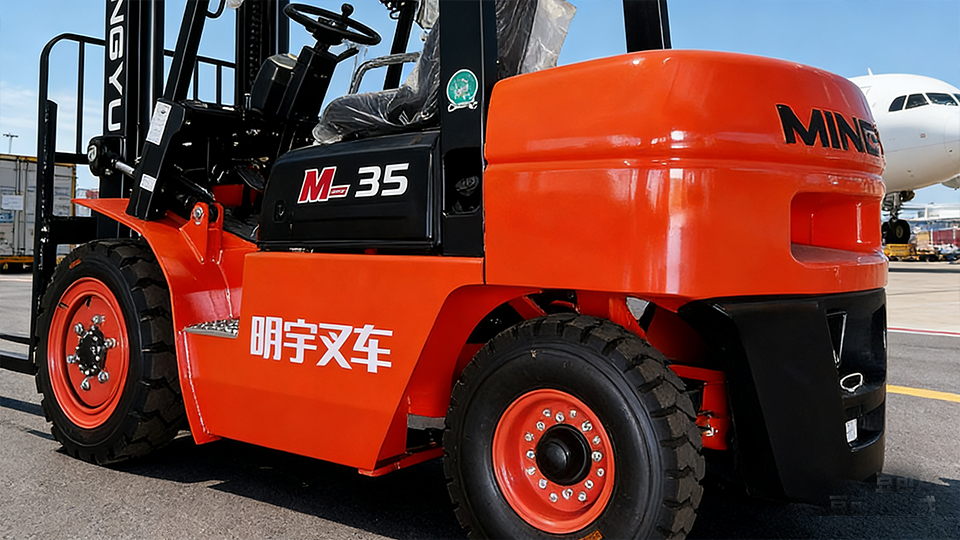
The hydraulic cylinders are attached to the inner sections of the mast.22 However, the carriage (which holds the forks) is attached to heavy-duty roller chains.23 These chains loop over pulleys at the top of the hydraulic rams. As the cylinder extends 1 meter, the chain pulls the forks up 2 meters. This "mechanical advantage" allows the forklift to reach high shelves while keeping the mast compact enough to drive through doorways.
5. Stability and Physics: The Teeter-Totter Principle
A forklift operates on the principle of a Class 1 Lever. The front wheels act as the fulcrum.
The Load: Is the weight on the forks (the effort).
The Counterweight: Is the massive cast-iron block at the rear of the machine.24
For the forklift to remain stable, the "moment" (weight x distance from fulcrum) of the counterweight must be greater than the "moment" of the load. This is why diesel forklifts have a Load Center rating (usually 500mm or 600mm). If the load is too far forward on the forks, the center of gravity shifts past the front wheels, and the forklift will tip forward.
6. Steering: The Rear-Wheel Advantage
Unlike a car, forklifts steer from the rear axle.25
Maneuverability: Rear-wheel steering allows the forklift to pivot around its front wheels, creating a much tighter turning radius—essential for narrow warehouse aisles.26
Tail Swing: Operators must be mindful of "rear-end swing."27 When you turn the steering wheel left, the back of the forklift swings wide to the right.
7. Exhaust and Emissions Control
Because diesel combustion produces soot (particulate matter) and Nitrogen Oxides (28$NO_x$), modern diesel forklifts are equipped with sophisticated "After-Treatment" systems:29
Diesel Particulate Filter (DPF): Traps soot.30 Periodically, the engine performs "regeneration," where it raises the exhaust temperature to burn off the trapped carbon.31
SCR (Selective Catalytic Reduction): Many large trucks use Diesel Exhaust Fluid (DEF/AdBlue) which is injected into the exhaust to convert $NO_x$ into harmless nitrogen and water vapor.
Summary Table: Component Functions
|
Component |
Technical Function |
|
Diesel Engine |
Converts fuel to rotational energy (torque). |
|
Hydraulic Pump |
Converts mechanical torque into fluid pressure. |
|
Counterweight |
Offsets the weight of the load to prevent tipping. |
|
Lift Cylinder |
Uses fluid pressure to extend the mast vertically. |
|
Control Valve |
Directs fluid flow based on operator input. |
|
Drive Axle |
Transmits engine power to the front wheels for locomotion. |
The diesel forklift is an engineering marvel of efficiency. By using a single power source (the engine) to drive both a high-torque transmission and a high-pressure hydraulic system, it remains the most capable tool for moving the world's heaviest materials
Name: selena
Mobile:+86-13176910558
Tel:+86-0535-2090977
Whatsapp:8613181602336
Email:vip@mingyuforklift.com
Add:Xiaqiu Town, Laizhou, Yantai City, Shandong Province, China
