
vip@mingyuforklift.com
+86-0535-2090977

Introduction
In the material handling industry, one of the most frequently asked operational questions is deceptively simple: How many gallons of diesel does a forklift use per hour? Yet this seemingly straightforward query opens the door to a complex landscape of engineering variables, capacity classifications, duty cycles, and environmental factors that collectively determine real-world fuel burn rates. For fleet managers in North America—where gallons remain the standard unit of liquid fuel measurement—understanding hourly diesel consumption in precise volumetric terms is essential for budgeting, logistics planning, refueling infrastructure design, and total cost of ownership calculations.
This article provides a comprehensive technical analysis of diesel forklift fuel consumption expressed in gallons per hour, examining consumption benchmarks across the full spectrum of machine capacities, the engineering and operational drivers that influence fuel burn, comparative data against alternative power sources, and evidence-based strategies for minimizing gallon-per-hour consumption in commercial operations.
Establishing the Gallon-per-Hour Framework
Unlike over-the-road vehicles where fuel economy is measured in miles per gallon, forklift fuel efficiency is inherently expressed in the inverse: gallons consumed per operating hour. This inversion reflects the fundamental nature of forklift operations. Forklifts do not primarily traverse distances; they perform work—lifting, transporting, placing, and retrieving loads in short, repetitive cycles. The relevant metric is not how far a forklift travels on a gallon of fuel, but how much productive work it accomplishes before consuming that gallon.
A single US gallon of diesel fuel contains approximately 137,380 British Thermal Units (BTU) of energy, or roughly 38.3 megajoules per litre. The efficiency with which a forklift engine converts this chemical energy into mechanical work determines how many gallons are burned per hour. Modern diesel forklift engines typically achieve thermal efficiencies of 30–45%, meaning that 30–45% of the fuel's energy content is converted into useful mechanical work, while the remainder is lost as heat through exhaust, cooling systems, and radiation.
Capacity-Based Fuel Consumption Benchmarks in Gallons per Hour
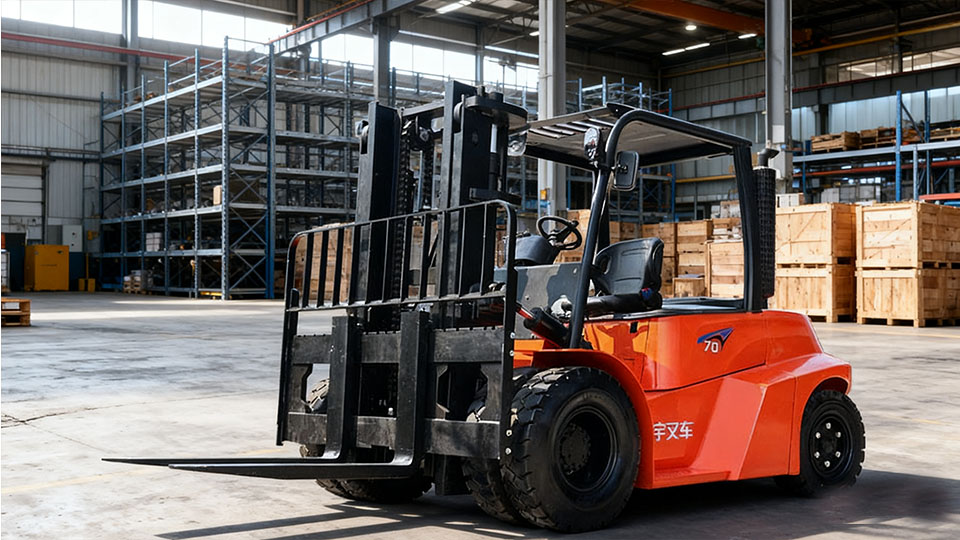
Diesel forklift fuel consumption scales directly and predictably with rated lift capacity. The relationship is not strictly linear—doubling capacity does not precisely double consumption—but the trend is unmistakable. The following capacity-based breakdown provides gallon-per-hour benchmarks derived from manufacturer specifications, independent testing data, and industry operational reports.
Compact and Light-Duty Diesel Forklifts (Under 5,500 lbs / 2.5 tonnes)
Compact diesel forklifts serve niche applications including small warehouses with outdoor yards, agricultural operations, light manufacturing, and specialized indoor-outdoor facilities. Their engines are smaller, their hydraulic systems less demanding, and their overall fuel appetite modest.
Fuel consumption: 0.4 to 0.7 US gallons per hour (1.5 to 2.6 litres per hour)
Engine displacement: Typically 1.5 to 2.5 litres
Rated power: 30 to 50 horsepower (22 to 37 kW)
Typical applications: Light pallet handling, nursery operations, small-scale distribution, agricultural feed and supply movement
A 2-tonne (4,400 lb) diesel forklift operating under moderate conditions will typically consume approximately 0.5 to 0.6 gallons per hour. These machines are often characterized by high idle-to-work ratios in their typical applications, which can inflate effective consumption above the mechanical baseline. In operations where the forklift spends 30–40% of its operating time idling, the productive work accomplished per gallon decreases proportionally.
Standard Industrial Diesel Forklifts (5,500 to 11,000 lbs / 2.5 to 5 tonnes)
This capacity range represents the industrial workhorse segment—the machines that move the majority of palletized goods in warehouses, distribution centers, lumber yards, and manufacturing facilities across North America.
Fuel consumption: 0.7 to 1.2 US gallons per hour (2.6 to 4.5 litres per hour)
Engine displacement: Typically 2.5 to 4.0 litres
Rated power: 50 to 90 horsepower (37 to 67 kW)
Typical applications: General warehousing, freight terminals, lumber and building supply, steel distribution, container depots
A standard 3-tonne (6,600 lb) diesel forklift—the most common capacity class globally—typically consumes between 0.7 and 0.9 gallons per hour under standard working conditions. This assumes moderate load factors (50–75% of rated capacity), level operating surfaces, and reasonably efficient operating patterns. When pushed to maximum capacity or operated in demanding cycles, consumption can rise to 1.0 to 1.1 gallons per hour.
The 5-tonne (11,000 lb) models at the upper end of this range demonstrate proportionally higher consumption. A machine of this capacity, moving heavy loads in a freight terminal or steel yard, will typically burn 1.0 to 1.3 gallons per hour. The increased engine displacement, higher hydraulic flow requirements, and greater traction demands all contribute to this elevated consumption.
Heavy-Duty Diesel Forklifts (11,000 to 22,000 lbs / 5 to 10 tonnes)
Heavy-duty diesel forklifts are engineered for the most demanding material handling applications—ports, heavy manufacturing, large-scale construction, and mining support operations. Their fuel consumption reflects their substantial power and capability.
Fuel consumption: 1.2 to 1.8 US gallons per hour (4.5 to 6.8 litres per hour)
Engine displacement: Typically 4.0 to 6.0 litres
Rated power: 90 to 160 horsepower (67 to 119 kW)
Typical applications: Port container handling, heavy machinery movement, large-scale construction material handling, mining logistics
A 7-tonne (15,400 lb) diesel forklift operating in a port environment, handling loaded shipping containers or heavy industrial equipment, will typically consume 1.4 to 1.7 gallons per hour. These machines often operate in harsh conditions—salt air, temperature extremes, and continuous heavy loading—that push consumption toward the upper end of the range.
The 10-tonne (22,000 lb) models represent the upper boundary of standard forklift classifications before transitioning into specialized container handlers and heavy lift trucks. These machines can consume 1.6 to 2.0 gallons per hour under heavy-duty cycles, with consumption spiking during sustained maximum-capacity operations.
Extra Heavy-Duty and Specialized Diesel Forklifts (Above 22,000 lbs / 10 tonnes)
Beyond standard forklift classifications lie specialized machines designed for extreme lifting applications. These include heavy container handlers, large rough-terrain forklifts, and specialized industrial lift trucks.
Fuel consumption: 1.8 to 3.5+ US gallons per hour (6.8 to 13.2+ litres per hour)
Engine displacement: Typically 6.0 to 12.0+ litres
Rated power: 160 to 400+ horsepower (119 to 298+ kW)
Typical applications: Heavy container handling, large vessel loading, mining equipment logistics, major construction projects
The wide range in this category reflects the diversity of machine configurations and applications. A 15-tonne specialized forklift in continuous port operation might consume 2.2 to 2.8 gallons per hour, while the largest rough-terrain models with 400+ horsepower engines can exceed 3.5 gallons per hour during peak demand periods.
Manufacturer-Specific Gallon-per-Hour Data
Leading forklift manufacturers publish fuel consumption data, typically derived from standardized test protocols. Understanding these benchmarks—and their real-world applicability—is essential for accurate operational planning.
Hyster-Yale Diesel Forklift Consumption
Hyster, a dominant force in the North American forklift market, provides specific fuel consumption figures for its diesel-powered XT series. These machines consume between 0.71 and 0.95 US gallons per hour, depending on lift capacity and engine configuration. Hyster explicitly notes that these figures are derived from standardized VDI 2198 test cycles, which simulate typical forklift operating patterns including travel, lifting, lowering, and idle periods.
Critically, Hyster cautions that real-world consumption can vary by plus or minus at least 20% from these test figures based on duty cycle intensity, operator behavior, environmental conditions, and maintenance status. This means a 3-tonne Hyster diesel forklift with a test-cycle consumption of 0.8 gallons per hour could realistically consume anywhere from 0.64 to 0.96 gallons per hour in actual operation.
Toyota Material Handling Diesel Forklifts
Toyota's 8-Series diesel forklifts incorporate advanced common-rail fuel injection and electronic engine management systems. Independent testing of Toyota's 3-tonne diesel models indicates consumption rates of approximately 0.74 to 0.85 gallons per hour under moderate load factors. Toyota claims efficiency improvements of 5–10% compared to previous-generation models, attributed to optimized combustion chamber design, improved turbocharger matching, and more sophisticated electronic control strategies.
Mitsubishi and Caterpillar Diesel Forklifts
Mitsubishi and Caterpillar diesel forklifts in the 3–5 tonne range typically report fuel consumption between 0.79 and 1.19 gallons per hour. These machines often feature robust, proven industrial diesel engines that prioritize reliability and torque delivery over absolute fuel efficiency. In demanding applications, their consumption tends toward the higher end of the range, but their durability and parts availability make them favorites in certain industrial segments.
Linde Hydrostatic Diesel Forklifts
Linde's distinctive hydrostatic drive diesel forklifts represent a significant departure from conventional torque converter automatic transmissions. By using variable displacement hydraulic pumps and motors to transmit power, Linde eliminates the slip losses inherent in torque converters. Real-world data for Linde's 3-tonne hydrostatic diesel models shows consumption rates of 0.63 to 0.79 gallons per hour—representing a meaningful efficiency advantage of 10–20% over conventional transmissions in high-cycle applications with frequent direction changes.
Engineering Factors Driving Gallon-per-Hour Consumption
Understanding why diesel forklifts consume the amounts they do requires examination of the engineering systems that convert fuel into productive work.
Diesel Engine Technology and Combustion Efficiency
The heart of every diesel forklift is its compression-ignition engine, and the technology embedded in that engine profoundly impacts gallons burned per hour.
Direct Injection vs. Indirect Injection: Modern diesel forklifts universally employ direct injection, where fuel is sprayed directly into the combustion chamber. This approach enables higher compression ratios and more complete combustion than older indirect injection systems, where fuel was injected into a pre-chamber. The efficiency gain is typically 8–15% in terms of fuel consumption per unit of work.
Common-Rail Fuel Injection: High-pressure common-rail systems deliver fuel at pressures up to 2,000 bar (29,000 psi) through electronically controlled solenoid or piezoelectric injectors. This enables multiple injection events per combustion cycle—pilot injection to reduce noise and emissions, main injection for power, and post-injection for emissions control. The precise control over injection timing and quantity optimizes combustion across the entire engine map, yielding fuel efficiency improvements of 8–15% compared to older mechanically governed systems.
Turbocharging and Intercooling: Turbochargers force additional air into the combustion chamber, enabling more complete fuel burn and higher power output from smaller displacement engines. Intercoolers reduce the temperature of compressed air, increasing its density and further improving combustion. The "downsizing" enabled by turbocharging—using a 2.5-litre turbocharged engine instead of a 4.0-litre naturally aspirated engine—can improve part-load efficiency by 10–20%, which is particularly relevant for forklift duty cycles where full power is rarely required continuously.
Electronic Engine Control: Modern diesel engines feature sophisticated electronic control units (ECUs) that continuously monitor parameters including engine speed, load, intake air temperature, coolant temperature, and exhaust gas composition. The ECU adjusts fuel delivery, injection timing, turbocharger boost pressure, and exhaust gas recirculation rates in real-time to optimize efficiency and emissions. These systems are particularly effective in the transient operating conditions characteristic of forklift duty cycles, where load and speed change constantly.
Hydraulic System Design and Efficiency
Forklift hydraulic systems consume a substantial portion of engine power, and their design directly impacts fuel consumption.
Fixed vs. Variable Displacement Pumps: Traditional forklifts use fixed-displacement hydraulic pumps that deliver constant flow regardless of demand. When the operator is not actively lifting or tilting, excess hydraulic flow returns to the tank through relief valves, wasting energy and increasing fuel consumption. Variable displacement pumps adjust output to match actual demand, significantly reducing parasitic losses during low-demand periods. This technology can reduce fuel consumption by 10–20% in applications with intermittent lifting.
Load-Sensing Systems: Advanced hydraulic systems measure the pressure required downstream of the control valve and adjust pump output to deliver only that pressure. By eliminating the practice of generating maximum system pressure at all times, load-sensing systems can improve overall efficiency by 8–15%.
Hydraulic Oil Management: Oil viscosity significantly impacts pump efficiency. Cold oil is more viscous, increasing pump load and fuel consumption. Maintaining hydraulic oil at manufacturer-recommended temperatures—through proper reservoir sizing, cooling systems, and in cold climates, pre-heating—ensures optimal efficiency.
Transmission and Driveline Architecture
The method of transmitting engine power to the drive wheels is a major determinant of fuel efficiency.
Torque Converter Automatic Transmissions: The most prevalent transmission type in diesel forklifts, torque converters provide smooth power delivery and excellent torque multiplication at low speeds. However, they operate on fluid coupling principles that inherently introduce slip. At low speeds and during direction changes—precisely where forklifts spend much of their time—torque converter efficiency may be only 80–85%. This 15–20% loss translates directly into additional fuel consumption.
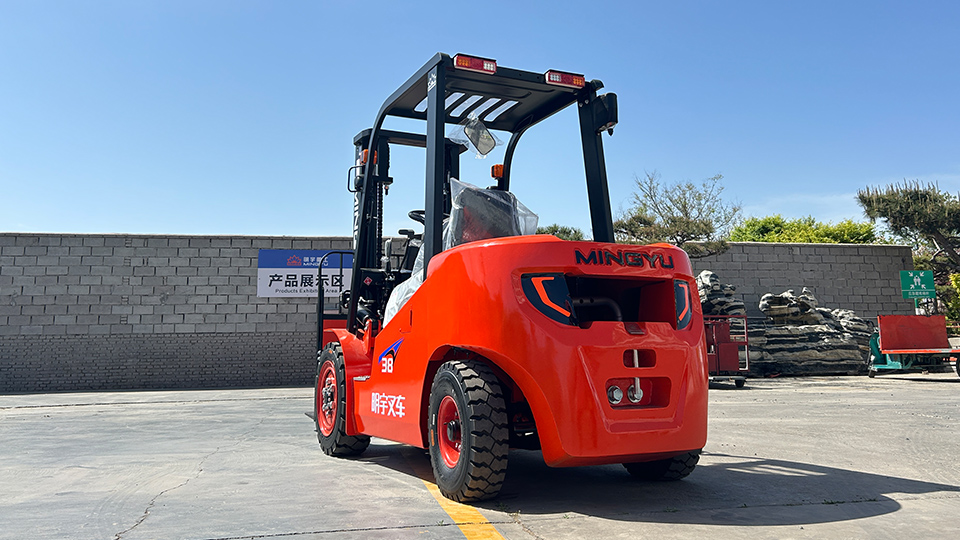
Hydrostatic Transmissions: As implemented by Linde and others, hydrostatic drives use variable displacement hydraulic pumps connected to hydraulic wheel motors. They eliminate torque converter slip losses and enable infinitely variable speed control without mechanical shifting. In high-cycle applications with frequent direction changes, hydrostatic drives can improve fuel efficiency by 10–20%.
Powershift Transmissions: These mechanically engaged transmissions use clutch packs to shift between fixed gear ratios. They are more efficient than torque converters during steady-speed travel but less smooth during direction changes. Powershift transmissions are most common in rough-terrain forklifts and applications requiring sustained higher-speed travel.
Tire Selection and Rolling Resistance
Tires are often overlooked as a fuel efficiency factor, yet they significantly influence the energy required to move the forklift.
Pneumatic Tires: Standard pneumatic tires offer shock absorption and traction but introduce rolling resistance through tread deformation. In outdoor applications, aggressive tread patterns further increase resistance. A pneumatic tire forklift may consume 5–10% more fuel for travel than an equivalent machine with cushion tires on smooth surfaces.
Solid Pneumatic Tires: These combine durability with moderate cushioning. They have lower rolling resistance than standard pneumatics but higher than cushion tires.
Cushion (Solid) Tires: Used on smooth indoor surfaces, cushion tires minimize rolling resistance and thus reduce fuel consumption for travel. However, they are unsuitable for rough terrain and offer no shock absorption.
Underinflation Impact: Even modest underinflation of pneumatic tires increases rolling resistance. A tire at 80% of recommended pressure can increase rolling resistance by 10–15%, directly increasing fuel consumption for travel operations.
Operational Variables Affecting Gallons per Hour
Beyond engineering specifications, operational variables exert profound influence on real-world fuel consumption. These factors can cause gallon-per-hour consumption to vary by 30–50% or more from manufacturer baseline figures.
Load Factor and Application Intensity
The intensity with which a forklift is used—the proportion of time spent at maximum rated capacity versus light loads—dramatically impacts fuel burn.
Light Load Operations: When handling loads at 25–50% of rated capacity, the engine operates well below maximum output, hydraulic pressures are moderate, and fuel consumption tends toward the lower end of the typical range. A 3-tonne forklift moving 1-tonne pallets will consume significantly less fuel than when handling 3-tonne steel coils.
Moderate Load Operations: At 50–75% of rated capacity, which represents typical warehouse and distribution operations, fuel consumption falls in the middle of the expected range. This is the baseline against which most manufacturer figures are calibrated.
Heavy Load Operations: Operating at 80–100% of rated capacity increases fuel consumption by 20–40% compared to light-load operations. The engine must generate higher hydraulic pressure, greater traction force, and maintain higher RPMs to prevent stalling under load.
Lift Height Impact: Raising loads to maximum mast height requires the hydraulic pump to work against gravity for extended periods. Operations requiring frequent full-height lifts consume 10–20% more fuel than those with lower average lift heights.
Duty Cycle Characteristics
The pattern of forklift usage throughout a shift significantly impacts hourly consumption.
High-Cycle, Short-Distance Operations: In applications with frequent pick-and-place cycles, short travel distances, and many direction changes, fuel consumption tends to be higher. Repeated acceleration events and torque converter inefficiency at low speeds drive consumption above baseline.
Long-Distance Travel Operations: Extended travel between distant locations allows the engine to operate in more efficient speed ranges and reduces the proportion of time spent in acceleration. However, higher average travel speeds increase aerodynamic and rolling resistance losses.
Idle Time: Extended idling is a major source of fuel waste. A diesel engine idling at 800–1,000 RPM consumes approximately 0.13 to 0.40 gallons per hour without producing any productive work. In operations with high idle-to-work ratios, effective fuel efficiency degrades significantly.
Operator Behavior and Technique
Operator skill and habits have a surprisingly large impact on fuel consumption.
Acceleration Patterns: Aggressive acceleration increases fuel consumption by 15–25% compared to smooth, progressive throttle application. Rapid acceleration forces the engine to operate in inefficient high-load, high-RPM regions.
Braking and Travel Planning: Frequent hard braking wastes the kinetic energy built up during acceleration, requiring additional fuel to re-accelerate. Anticipatory driving—coasting to stops, minimizing unnecessary travel, and planning efficient routes—can reduce fuel consumption substantially.
Throttle Control During Lifting: Jerky or excessive throttle application during lifting operations increases hydraulic system pressure and engine load unnecessarily. Smooth, controlled lifting at appropriate engine speeds minimizes fuel use.
Gear and Speed Selection: Operating at excessively high travel speeds increases rolling resistance and aerodynamic drag. Conversely, "lugging" the engine at too low an RPM in too high a gear increases mechanical stress and reduces efficiency.
Environmental and Site Conditions
The physical environment in which the forklift operates affects fuel efficiency in multiple ways.
Temperature Extremes: Cold weather increases fuel consumption through higher oil viscosity, reduced combustion efficiency, and extended warm-up periods. In sub-zero conditions, fuel consumption can increase by 15–30%. Hot weather can also reduce efficiency if cooling systems are inadequate and the engine operates at elevated temperatures.
Altitude: Reduced air density at higher elevations decreases oxygen availability for combustion. Naturally aspirated engines can suffer 10–20% efficiency losses at 6,500+ feet elevation. Turbocharged engines partially compensate but may still experience 5–10% reductions.
Surface Conditions: Rough, uneven, or soft surfaces increase rolling resistance and require more power for traction. Operating on gravel, mud, or sand can increase fuel consumption by 20–50% compared to smooth concrete.
Grades and Inclines: Even modest inclines significantly increase fuel consumption. A 5% grade can increase fuel use by 15–25% for loaded travel, with steeper grades imposing proportionally greater penalties.
Comparative Gallon-per-Hour Analysis: Diesel vs. Alternative Power Sources
Contextualizing diesel forklift consumption requires comparison with alternative power sources.
Diesel vs. LPG (Propane) Forklifts
LPG forklifts are the primary indoor alternative, though they also serve outdoor applications.
Energy Density: Diesel contains approximately 137,380 BTU per US gallon; LPG contains approximately 91,500 BTU per gallon. Diesel has 50% more energy per gallon.
Engine Efficiency: Diesel engines achieve 35–45% thermal efficiency; LPG spark-ignition engines achieve 25–35%.
Real-World Consumption: An LPG forklift performing equivalent work to a diesel unit consuming 0.8 gallons per hour would require approximately 1.1 to 1.2 gallons per hour of LPG, reflecting both lower energy density and lower thermal efficiency.
Diesel vs. Electric Forklifts
Electric forklifts are the fastest-growing segment, driven by lower operating costs.
Energy Cost Comparison: At typical commercial electricity rates of $0.10–$0.15 per kWh, an electric forklift costs approximately $0.75–$1.50 per hour to operate. At diesel prices of $3.50–$4.50 per gallon, a diesel forklift consuming 0.8 gallons per hour costs $2.80–$3.60 per hour in fuel alone. This 2–3x cost advantage for electricity is the primary driver of electric forklift adoption.
Runtime and Refueling: Diesel forklifts can operate 8–12+ hours on a single tank, with refueling taking 5–10 minutes. Electric forklifts typically require 4–8 hours of charging for equivalent runtime, though lithium-ion batteries and opportunity charging are narrowing this gap.
Strategies for Minimizing Gallons per Hour
Implementing fuel efficiency optimization strategies yields substantial cost savings.
Equipment Right-Sizing: Match forklift capacity to actual application requirements. Oversized machines waste fuel through unnecessary engine displacement and hydraulic capacity.
Operator Training Programs: Comprehensive training covering smooth acceleration, anticipatory driving, efficient lifting, and proper gear selection can reduce consumption by 15–25%.
Idle Reduction Policies: Establish idle-time limits and implement auto-shutdown systems. Eliminating unnecessary idling can reduce effective consumption by 10–20%.
Preventive Maintenance Excellence: Maintain air filters, fuel injectors, tire pressure, and hydraulic systems according to manufacturer schedules. Poor maintenance can increase consumption by 10–20%.
Route and Task Optimization: Plan efficient pick paths, minimize travel distances, and eliminate unnecessary trips. Even small reductions compound into significant savings.
Conclusion
The answer to "How many gallons of diesel does a forklift use per hour?" is not a single number but a range shaped by capacity, technology, operation, and environment. For the most common 3-tonne industrial diesel forklift operating under typical conditions, 0.7 to 1.0 US gallons per hour represents a reasonable expectation. Light-duty compact models may consume as little as 0.4 gallons per hour, while extra heavy-duty specialized machines can exceed 3.5 gallons per hour.
What distinguishes efficient operations from wasteful ones is the comprehensive management of engineering selection, operational discipline, and maintenance excellence. Common-rail injection, turbocharging, and hydrostatic drives offer meaningful efficiency gains. Smooth operator technique, minimized idle time, and optimized travel routes reduce consumption significantly. Rigorous maintenance preserves designed-in efficiency.
For North American fleet managers, mastering diesel forklift fuel consumption in gallons per hour is not merely an operational metric—it is a financial imperative. With diesel prices subject to volatility and environmental regulations tightening, the ability to minimize gallons burned per productive hour directly impacts competitiveness and sustainability. As electrification advances, diesel forklifts will remain essential for heavy-duty outdoor applications where their unique capabilities cannot be matched. In these applications, fuel efficiency mastery is not optional; it is a competitive necessity.
Name: selena
Mobile:+86-13176910558
Tel:+86-0535-2090977
Whatsapp:8613181602336
Email:vip@mingyuforklift.com
Add:Xiaqiu Town, Laizhou, Yantai City, Shandong Province, China
