
vip@mingyuforklift.com
+86-0535-2090977

The humble forklift is an indispensable piece of machinery in modern logistics, warehousing, and manufacturing.1 Its primary function—to lift, move, and place heavy loads—is essential to supply chain efficiency.2 However, the answer to the seemingly simple question, "How much weight can a forklift lift?" is far more complex than a single number.3 It is governed by a meticulous interplay of physics, engineering design, operational factors, and stringent safety regulations.4
This technical article will delve into the core principles that dictate a forklift’s load capacity, exploring the concepts of counterbalancing, the stability triangle, the load moment, and the crucial role of the data plate. Understanding these technical elements is not merely academic; it is foundational for safe, efficient, and compliant material handling operations.5
I. The Fundamental Principle: Counterbalance Mechanics
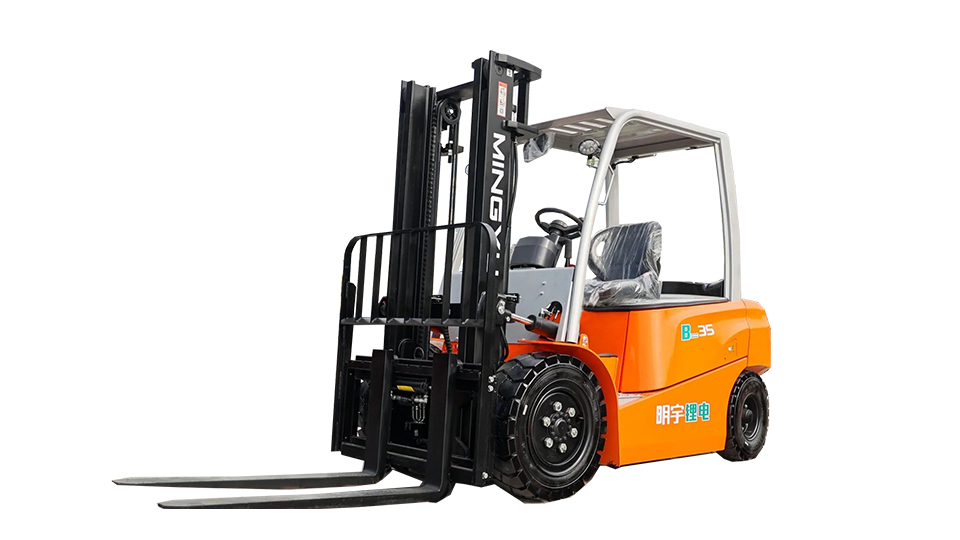
The operational capability of the most common type of industrial truck, the counterbalanced forklift, is based on the principle of a seesaw, or a Class 1 lever.
The Fulcrum and the Counterweight
The front axle, specifically the center point of the drive wheels, acts as the fulcrum (the pivot point) of this lever system.6 The load, situated on the forks, exerts a downward force on one side of this fulcrum, attempting to tilt the entire truck forward (an overturning moment).7
To resist this overturning force, the forklift is deliberately designed with its own weight concentrated at the rear in the form of a heavy counterweight—a massive block of steel or, in the case of electric models, the battery itself. This counterweight generates a counter-acting moment (a restoring moment) around the fulcrum, ensuring the machine's stability.
The basic equilibrium equation that governs the maximum lifting capacity is derived from balancing these two opposing moments:
$$\text{Load Moment} \le \text{Counterweight Moment}$$
$$\text{Load Weight} \times \text{Load Distance (Load Center)} \le \text{Counterweight} \times \text{Counterweight Distance (from fulcrum)}$$
This equation technically demonstrates that the safe capacity of the forklift is a function of both the load's weight and its distance from the fulcrum.8 This leads directly to the single most critical factor in determining safe lift capacity: the Load Center.
II. The Critical Concept of Load Center (LC)
The load center is the horizontal distance from the vertical face of the forks to the load's center of gravity (CG).9
A. The Standard Load Center
For most forklifts, especially those handling standard palletized goods, the rated capacity is based on a standard load center (LC), typically 24 inches (600 mm).10 This standard is derived from the common dimensions of a 48-inch long pallet, where the load's center of gravity is assumed to be at the midpoint, or 24 inches.11
B. The Inverse Relationship: LC and Capacity
The inverse relationship between the Load Center and the safe lifting capacity is the most critical technical principle for operators to grasp:
As the load center (distance) increases, the safe lifting capacity decreases.12
As the load center (distance) decreases, the safe lifting capacity increases.13
The reason is simple: a longer Load Center increases the Load Moment (Load Weight 14$\times$ Load Distance), which is the overturning force.15 To maintain equilibrium, the maximum allowable Load Weight must be reduced to keep the Load Moment below the forklift’s maximum stabilizing capacity (Counterweight Moment).
C. Calculating Derated Capacity
When a load’s actual center of gravity exceeds the standard rated load center (e.g., a 60-inch-long load results in a 30-inch LC), the forklift’s maximum safe capacity must be derated (reduced).16
The practical calculation for determining the revised capacity ($\text{New Capacity}$) based on a change in load center is:
$$\text{New Capacity} = \frac{\text{Rated Capacity} \times \text{Rated Load Center}}{\text{Actual Load Center}}$$
For example, a forklift rated for 5,000 lbs at a 24-inch LC lifting a load with a 30-inch LC would have a revised capacity of:
$$\text{New Capacity} = \frac{5,000 \text{ lbs} \times 24 \text{ in}}{30 \text{ in}} = 4,000 \text{ lbs}$$
In this scenario, extending the load center by just 6 inches reduces the safe lifting capacity by a significant 1,000 lbs (20%). This calculation underscores the critical necessity of knowing the actual center of gravity for all non-standard loads.
III. The Three-Dimensional Stability Envelope: The Stability Triangle
While the counterbalancing principle addresses longitudinal (forward/backward) stability, the overall safety of a forklift is defined by its ability to maintain stability laterally (side-to-side) and dynamically (during motion).17 This comprehensive stability is encapsulated by the Stability Triangle.18
A. Defining the Stability Triangle
The Stability Triangle is an imaginary, three-dimensional envelope formed by the vehicle’s suspension points:19
The two front wheels (at the center of the drive axle).20
The center pivot point of the steer axle (the single-point connection in the center of the rear axle).
For safe operation, the Combined Center of Gravity (CCG)—the composite CG of the forklift and its load—must always remain within the boundaries of this stability triangle.21 If the CCG shifts outside this envelope, a tip-over is imminent.
B. Factors Affecting the Combined Center of Gravity (CCG)
Several operational factors cause the CCG to shift, which reduces the effective safe lifting capacity, even if the static load weight is within the rated limits:22
Lift Height: Raising the load vertically also raises the CCG. This shift is both upward and forward, significantly decreasing stability.23 A load that is safe at 4 inches off the ground may cause a forward tip-over at 15 feet.
Mast Tilt: Tilting the mast forward moves the load’s CG and thus the CCG forward, dangerously close to or outside the front fulcrum.24 Tilting the mast backward (to cradle the load against the carriage) shifts the CCG rearward, increasing stability—a required procedure when traveling with a load.25
Dynamic Forces (Speed, Turns, Braking): Rapid acceleration, sudden braking, or sharp turns create inertial and centrifugal forces that dynamically shift the CCG.26 A sharp turn can shift the CCG laterally, potentially pushing it outside the side perimeter of the stability triangle and causing a lateral (sideways) tip-over.27
IV. The Forklift Data Plate: The Technical Mandate
The Capacity Data Plate (or Nameplate) is the authoritative, legally mandated document that defines the specific operational limits of an individual forklift.28 It is the final engineering statement on how much the machine can lift safely.
A. Key Information on the Data Plate
The plate, required by regulatory bodies like OSHA and ANSI/ITSDF, typically includes:
|
Parameter |
Technical Significance |
|
Rated Capacity |
The maximum gross weight the truck can lift. |
|
Rated Load Center |
The distance from the fork face at which the Rated Capacity applies (e.g., 5,000 lbs at 24 inches). |
|
Max. Lift Height |
The maximum elevation the load can be safely raised. |
|
Derated Capacities |
Often includes a load chart showing reduced capacities at greater lift heights or extended load centers. |
|
Attachment Information |
Specifies the weight and effective thickness of the original factory-installed attachment. |
B. The Impact of Attachments (Derating)
Any modification or addition to a forklift, particularly the addition of an attachment (e.g., side shifters, drum clamps, carpet poles), reduces the effective lifting capacity.29 This derating occurs for two primary reasons:
Increased Load Center: Attachments add physical bulk (effective thickness) between the fork face and the load, pushing the load's center of gravity further away from the fulcrum.30
Increased Tare Weight: The weight of the attachment itself must be subtracted from the forklift's base lifting capacity, as it consumes part of the available lifting capacity.31
OSHA regulations require that a forklift modified with an attachment must have a new data plate showing the revised, derated capacity, ensuring the operator is aware of the new, lower safe operating limit.32
V. Range of Forklift Capacities by Type
The lifting capacity varies dramatically based on the forklift's design, intended application, and power source.33 The range extends from a few thousand pounds to tens of thousands of pounds.
|
Forklift Type |
Typical Rated Capacity Range |
Primary Application |
|
Class 1 & 2: Electric Counterbalanced / Narrow Aisle |
2,500 lbs to 12,000 lbs |
Indoor, smooth surfaces, high-stacking warehousing. |
|
Class 4 & 5: Internal Combustion (IC) Cushion/Pneumatic Tire |
3,000 lbs to 35,000 lbs |
General warehousing (cushion) and yard/outdoor operations (pneumatic). |
|
Class 7: Rough Terrain Forklifts |
6,000 lbs to 35,000 lbs |
Construction sites, lumberyards, uneven ground. |
|
Container Handlers / Heavy Capacity Trucks |
Up to 80,000 lbs or more |
Port operations, shipping terminals, intermodal transport. |
|
Telehandlers (Telescopic Handlers) |
4,000 lbs to 50,000 lbs |
Construction and agriculture; capacity decreases significantly with boom extension and angle. |
The capacity listed here is the rated capacity at the standard load center. The actual, safe working capacity is always subject to the real-time operational factors of load size, lift height, and dynamic forces.34
VI. Advanced Considerations: Capacity Retention and Mast Design
For forklifts designed for high-reach applications, such as narrow aisle and high-mast counterbalanced trucks, the concept of capacity retention becomes critical.
A. Capacity Retention at Height
As the mast extends, the weight of the mast stages, carriage, and forks themselves shifts the truck's center of gravity forward. Consequently, the maximum weight the forklift can safely lift decreases as the load height increases.35
Modern high-mast trucks often feature a capacity chart (sometimes integrated into the data plate) that plots the maximum safe load against the maximum fork height.36 A truck with a 5,000-lb rated capacity at 24 inches and a low lift height might only be rated for 3,500 lbs when the forks are extended to 20 feet.
B. Load Sensing and Electronic Safety Systems
Modern, high-specification forklifts are increasingly equipped with sophisticated Load Sensing Systems (LSS) or Load Moment Indicators (LMI). These electronic systems use sensors to continuously monitor the load weight, lift height, and mast angle.
When the combination of these factors approaches the stability limit (i.e., the Load Moment approaches the Maximum Counterweight Moment), the LMI provides an audible and visual warning to the operator. In more advanced systems, the LSS can automatically limit hydraulic functions (such as preventing further upward movement or forward tilt) to physically prevent an operator from exceeding the safe lifting envelope. These systems transform stability management from a purely human calculation to an electronically assisted, dynamic process.
VII. Conclusion: The Engineering of Safety
The question of "How much weight can a forklift lift?" does not have a simple, universal answer. It is a technical problem solved by a delicate balance of mechanical engineering and physical law.
The maximum safe lifting capacity is defined by the Load Moment, which must be perpetually offset by the Counterweight Moment. This relationship is codified for every individual machine on the Capacity Data Plate, with the Load Center serving as the key variable that dictates the effective capacity.37 Any deviation from the standard (such as an increased load center, greater lift height, or added attachments) requires a technical understanding and application of derating principles to maintain a safe Combined Center of Gravity within the Stability Triangle.38
For every operator, fleet manager, and safety professional, the technical article on the forklift’s capacity serves as a stark reminder: the power of the machine is not limitless, but rather precisely calculated. Adherence to the principles of counterbalancing and the limits prescribed on the data plate is the fundamental requirement for maximizing operational efficiency while ensuring the highest level of workplace safety.
Name: selena
Mobile:+86-13176910558
Tel:+86-0535-2090977
Whatsapp:8613181602336
Email:vip@mingyuforklift.com
Add:Xiaqiu Town, Laizhou, Yantai City, Shandong Province, China