
vip@mingyuforklift.com
+86-0535-2090977

Introduction
The decision between leasing and purchasing material handling equipment represents one of the most consequential capital allocation choices in warehouse operations, manufacturing facilities, and logistics networks. While the sticker price often dominates initial procurement discussions, the true financial picture emerges only through analysis of total cost of ownership (TCO)—a metric that captures acquisition costs, maintenance expenditures, energy consumption, administrative overhead, and residual value across the equipment's operational lifespan. A 2024 study conducted by the Technical University of Munich (TUM) in collaboration with CHG-MERIDIAN demonstrated that how you acquire intralogistics equipment is one of the most significant variables in the total cost equation, with findings that challenge conventional assumptions about leasing economics .
This article examines the maintenance responsibility structures and cost implications of leased versus owned forklift fleets, drawing on current industry data, academic research, and operational best practices to provide a framework for strategic decision-making.
Understanding the Acquisition Landscape
The Ownership Model
Purchasing a forklift—whether through outright cash payment or financed acquisition—transfers full asset control to the operator. The forklift becomes a balance sheet asset, subject to depreciation schedules, and the owner assumes complete responsibility for operational management, maintenance scheduling, repair execution, and eventual disposal or resale. This model appeals to organizations with stable, predictable demand patterns, sufficient capital reserves, and established maintenance infrastructure.
The primary advantage of ownership lies in unrestricted operational flexibility. Owned equipment faces no usage hour limitations, no geographic restrictions, and no contractual constraints on modifications or attachments. For operations running 24/7 schedules or requiring highly customized configurations, ownership eliminates the friction of lease compliance monitoring and equipment return protocols .
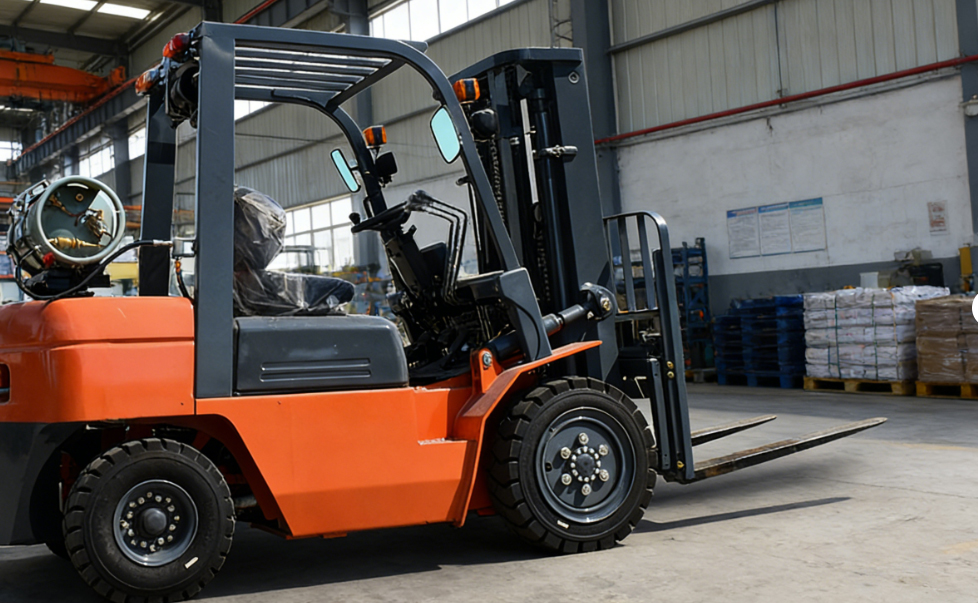
However, ownership introduces significant financial exposure. The owner absorbs 100% of depreciation risk, bears all maintenance cost variability, and must manage the complex logistics of battery replacement, parts procurement, and technician scheduling. For electric forklifts, battery replacement—typically required around year seven—represents a substantial unplanned cost spike that can disrupt capital planning cycles .
The Leasing Model
Forklift leasing operates on fundamentally different economic principles. Rather than purchasing an asset, the operator acquires the right to use equipment for a fixed term—typically 1 to 5 years—in exchange for periodic payments. The leasing provider retains ownership and, critically, assumes the residual value risk associated with equipment depreciation.
Leasing arrangements generally fall into two categories: operating leases (true leases) and finance leases (capital leases). Operating leases treat the equipment as a rental, with payments fully deductible as operating expenses and no asset recognition on the balance sheet. Finance leases function more like purchase financing, with the lessee effectively assuming ownership risks and rewards. For material handling equipment, operating leases with full-service maintenance provisions represent the dominant market structure .
The leasing model's core value proposition centers on capital efficiency and risk transfer. Organizations avoid large upfront expenditures, convert capital expenses to predictable operating expenses, and transfer depreciation risk, technology obsolescence risk, and maintenance cost variability to the lessor. This structure proves particularly valuable for growing businesses, seasonal operations, and organizations prioritizing balance sheet flexibility.
Maintenance Responsibility Structures
Owned Equipment: Full Operational Burden
Under ownership, maintenance responsibility constitutes a comprehensive operational obligation encompassing preventive maintenance, corrective maintenance, emergency repairs, parts management, and regulatory compliance. The owner must establish or contract for:
Preventive Maintenance Programs: Scheduled servicing based on manufacturer recommendations and operational intensity, including hydraulic system inspections, brake testing, tire replacement, lubrication, and electrical system diagnostics. For electric forklifts, this extends to battery watering (for lead-acid systems), equalizing charges, and thermal management monitoring.
Corrective Maintenance Capability: Responsive repair infrastructure capable of addressing mechanical failures, hydraulic leaks, mast malfunctions, and electrical faults. Downtime costs in high-throughput operations can exceed $1,000 per hour, making repair response time a critical performance metric.
Parts Inventory Management: Strategic stocking of high-wear components (tires, filters, hoses, seals) and critical spare parts to minimize procurement lead times. This requires capital allocation to inventory, warehouse space, and inventory management systems.
Regulatory Compliance: Ensuring equipment meets OSHA, ANSI, and local safety standards through mandatory inspections, operator training documentation, and equipment certification. Non-compliance exposes organizations to significant liability and operational shutdown risk.
Technical Expertise: Maintaining qualified technicians or service contracts. For specialized equipment—particularly electric forklifts with lithium battery systems and advanced control electronics—technical competency requirements have increased substantially. The 2026 market data indicates electric forklifts now represent 67.73% of all forklift shipments, reflecting the industry's shift toward electrification and the corresponding evolution of maintenance skill requirements .
The financial trajectory of owned equipment maintenance follows a predictable pattern: relatively low costs in years 1-3 (often covered by manufacturer warranty), moderate escalation in years 4-6 as wear components require replacement, and accelerating cost growth beyond year 7 as major systems approach end-of-life. This compounding cost curve represents the primary financial risk of extended ownership.
Leased Equipment: Structured Responsibility Transfer
Leasing fundamentally restructures maintenance responsibility through contractual allocation. The specific division of responsibilities varies by lease type:
Full-Service Leases: The lessor assumes comprehensive maintenance responsibility, including all preventive servicing, repairs, parts replacement, and emergency response. The lessee's obligation is limited to proper operation, routine cleaning, and damage reporting. This model provides maximum cost predictability through fixed monthly payments that encompass both equipment use and maintenance.
Service-and-Repair Leases: The lessor provides scheduled maintenance and covers normal wear, while the lessee assumes responsibility for operator-induced damage, abuse, and certain categories of repairs. This hybrid model offers moderate cost predictability with some shared risk.
Net Leases: The lessee assumes maintenance responsibility similar to ownership, with lease payments covering only equipment use. These arrangements are less common in material handling but may appear in specialized applications.
The Full-Service model delivers the most significant operational and financial advantages. According to the TUM study, pairing leasing with a Full-Service model for a 1.6-ton electric forklift in double-shift operation produced total 8-year costs of approximately $163,800, compared to approximately $174,300 for a purchased vehicle under a Service-and-Repair model. The Full-Service lease eliminated the year-seven battery replacement cost through a fleet exchange at the four-year midpoint, effectively resetting the maintenance cost curve .
Quantitative Cost Analysis
Total Cost of Ownership Framework
A rigorous TCO analysis requires modeling all cost categories across the equipment lifecycle:
Acquisition/Lease Costs: Purchase price or cumulative lease payments
Maintenance and Repair: Scheduled servicing, parts, labor, and emergency repairs
Energy/Battery: Electricity, fuel, or battery replacement costs
Administrative Overhead: Fleet management labor, procurement, vendor management
Capital Costs: Financing charges or opportunity cost of capital
Residual Value/Disposal: Recovery value or disposal costs at end of life
For a representative 2-ton lithium battery electric forklift operating 2,000 hours annually over a 5-year lifecycle, the cost structures reveal significant divergence between ownership and leasing models.
Ownership Cost Profile
Using current market data, a 2-ton lithium battery electric forklift carries an acquisition cost of approximately $28,000–$35,000. Over a 5-year operational life:
Initial Investment: $32,000 (including transportation and commissioning)
Energy Costs: $12,000 (based on 3 kWh/hour consumption at $0.12/kWh)
Maintenance: $12,000 (escalating from $1,500/year to $3,500/year)
Battery Replacement: $6,000 (partial replacement in year 5)
Administrative Overhead: $8,000 (fleet management allocation)
Residual Value Recovery: ($11,000) (35% residual at 5 years)
5-Year TCO (Ownership): $59,000
This calculation excludes financing costs and opportunity cost of capital, which would add approximately $4,000–$6,000 for financed purchases .
Leasing Cost Profile
For the same equipment under a Full-Service lease:
Lease Payments: $45,000 ($750/month × 60 months)
Energy Costs: $12,000 (lessee responsibility)
Administrative Overhead: $2,000 (minimal fleet management)
Residual Value: $0 (lessor retains asset)
5-Year TCO (Leasing): $59,000
At first glance, the totals appear equivalent. However, this equivalence masks critical differences in risk profile, cash flow timing, and operational flexibility. The leasing model converts a $32,000 upfront capital outlay into manageable monthly payments, eliminates the $6,000 battery replacement risk, and removes residual value uncertainty. For organizations with capital constraints or high opportunity costs for deployed capital, the leasing structure delivers superior economic value despite equivalent nominal costs.
The Optimal Usage Cycle Effect
The TUM research introduced a critical refinement to TCO analysis: the concept of optimal usage cycles. Every forklift exhibits an inflection point in its maintenance cost curve where marginal operating costs exceed replacement economics. Before this point, maintenance costs remain manageable; after it, costs compound through cascading failures, parts obsolescence, and energy efficiency degradation.
Leasing enables operators to exit the equipment relationship before reaching this inflection point. The lessor recovers residual value through secondary market sales or refurbishment, while the lessee re-enters a new lease at the start of a fresh, low-maintenance cycle. This mechanism explains why leasing consistently outperforms ownership in high-utilization scenarios: the ability to optimize replacement timing captures value that ownership cannot replicate.
The study found that electric forklifts showed consistent leasing savings across all scenarios analyzed, while diesel forklift savings depended more heavily on usage intensity and cycle length. For 1.6-ton electric forklifts in double-shift operation, leasing with Full-Service coverage produced approximately 6% TCO savings over 8 years compared to purchase with Service-and-Repair .
Comparative Analysis by Powertrain Type
The powertrain selection significantly impacts the lease-versus-buy calculus:
表格
Powertrain Upfront Cost 5-Year Operating Cost Maintenance Complexity Lease Advantage
Electric (Lithium) High ($28,000–$35,000) Very Low ($12,000) Low Strong
Electric (Lead-Acid) Medium ($20,000–$28,000) Low ($15,000) Medium Moderate
Diesel Low ($18,000–$22,000) High ($45,000) High Variable
LPG Medium ($20,000–$25,000) Medium ($30,000) Medium Moderate
Electric forklifts demonstrate the strongest lease advantage due to their high upfront costs, low operating costs, and battery replacement risk transfer. The 5-year TCO for electric models reaches $44,000–$51,000 compared to $78,000+ for diesel—a 40% savings that amplifies the value of leasing's cost predictability .
Strategic Decision Framework
When Leasing Optimizes Value
Organizations should prioritize leasing under the following conditions:
Capital-Constrained Growth: Startups, rapidly expanding operations, and businesses with high-return alternative uses for capital benefit from leasing's minimal upfront requirements. Preserving liquidity for inventory, marketing, or technology investments often generates higher returns than equipment ownership.
Variable or Uncertain Demand: Seasonal operations, project-based workflows, and businesses testing new markets require operational flexibility that ownership cannot provide. Leasing enables fleet scaling without asset impairment risk.
High-Utilization, High-Intensity Operations: Double-shift and triple-shift operations accelerate equipment wear, making the optimal usage cycle effect most pronounced. Leasing captures maximum value when equipment is replaced before the maintenance cost inflection point.
Limited Maintenance Infrastructure: Organizations without dedicated maintenance teams, parts inventory systems, or technical expertise benefit from Full-Service leasing's comprehensive responsibility transfer.
Technology Sensitivity: Rapidly evolving battery technology, telematics systems, and automation interfaces create obsolescence risk. Leasing enables technology refresh without stranded asset exposure.
Tax Optimization Priorities: Lease payments are typically fully deductible as operating expenses in the period incurred, providing immediate tax benefits compared to depreciation schedules for purchased equipment .
When Ownership Optimizes Value
Ownership proves superior under contrasting conditions:
Long-Term Stable Demand: Operations with predictable, consistent utilization exceeding 2,000 hours annually for 5+ years can amortize acquisition costs effectively. The break-even point for ownership versus leasing typically occurs between 18 and 24 months of continuous use .
High Customization Requirements: Specialized attachments, modified mast configurations, and proprietary control integrations are difficult to accommodate within standard lease structures. Ownership enables unrestricted customization.
Strong Maintenance Capabilities: Organizations with established maintenance departments, vendor relationships, and parts inventory systems can execute maintenance more cost-effectively than lessor-provided services, particularly for simple equipment types.
Favorable Financing: Access to low-cost capital or tax-advantaged financing can narrow or reverse the cost gap between ownership and leasing.
Residual Value Capture: In markets with strong used equipment demand, ownership enables residual value recovery that leasing transfers to the lessor.
Emerging Models and Future Considerations
The material handling industry continues evolving toward service-based models that blur traditional ownership boundaries. Power-as-a-Service arrangements convert battery capital expenses to consumption-based operating costs at $0.08–$0.12 per kWh. Rent-to-own programs blend lease flexibility with eventual ownership. Automated Guided Vehicle (AGV) fleets introduce entirely new economics, with TUM research showing AGV automation reducing 10-year TCO by approximately 50% compared to manual forklift fleets—primarily through labor cost elimination rather than equipment cost savings .
These developments reinforce a fundamental principle: the lease-versus-buy decision should not be treated as a one-time procurement choice but as an ongoing strategic optimization. Fleet composition, utilization patterns, technology trajectories, and capital market conditions all influence the optimal structure, and the best organizations continuously reevaluate their approach.
Conclusion
The maintenance responsibility and cost comparison between leased and owned forklifts reveals no universal superiority—only contextual optimization. Leasing transfers maintenance burden, depreciation risk, and technology obsolescence exposure to the lessor in exchange for higher nominal costs and operational constraints. Ownership delivers maximum flexibility and potential long-term savings while requiring capital commitment, maintenance infrastructure, and risk absorption.
The decisive factor is alignment between the acquisition structure and operational reality. High-utilization electric fleets in growth-phase operations generally realize superior economics through Full-Service leasing, particularly when matched to optimal usage cycles. Stable, long-term operations with strong maintenance capabilities and low capital costs may find ownership more advantageous.
Ultimately, the TCO framework provides the analytical discipline necessary for sound decision-making, but the decision itself remains strategic—reflecting organizational priorities around capital allocation, risk tolerance, operational flexibility, and competitive positioning in an increasingly dynamic material handling landscape.
Name: selena
Mobile:+86-13176910558
Tel:+86-0535-2090977
Whatsapp:8613181602336
Email:vip@mingyuforklift.com
Add:Xiaqiu Town, Laizhou, Yantai City, Shandong Province, China