
vip@mingyuforklift.com
+86-0535-2090977

For businesses operating high-volume, strenuous material handling processes—such as lumberyards, ports, steel mills, and large distribution centers—the diesel forklift is often the non-negotiable workhorse. Unlike their electric counterparts, Internal Combustion (IC) diesel models are designed for maximum power, high torque output, and continuous operation in demanding outdoor and dusty environments.
However, the capital investment and the cost of ownership over a 10-to-15-year lifecycle are substantial, making reliability the single most critical factor. Reliability, in this context, is measured not just by raw power, but by uptime, the longevity of core components, the cost and availability of replacement parts, and the robustness of the structural and electronic systems under severe duty.
This technical article provides an in-depth evaluation of the brands consistently ranked as the most reliable suppliers of heavy-duty diesel forklifts (typically Class IV and V, with capacities ranging from $15,000 \text{ lbs}$ upwards).
I. Defining Heavy-Duty Diesel Forklift Reliability
The assessment of reliability in the heavy-duty sector must go beyond anecdotal evidence and focus on measurable engineering and logistical factors:
Drivetrain Durability: Resistance to premature wear in the engine, hydrostatic or torque converter transmission, and drive axle under continuous high-load, stop-and-go cycles.
Structural Integrity: Robustness of the chassis, mast, and counterweight against twisting, fatigue, and shock loading.
Component Sourcing: Use of industrial-grade engines and transmissions from reputable and easily serviceable manufacturers (e.g., Cummins, Deutz, or proprietary OEM industrial units).
Dealer Network and Parts Availability: The speed and cost-effectiveness of sourcing Original Equipment Manufacturer (OEM) parts are paramount to reducing downtime.
Technology for Uptime: Inclusion of modern diagnostics, telematics, and operator assist systems that prevent abuse and flag maintenance issues early.
II. The Tier 1 Global Leaders in Diesel Reliability
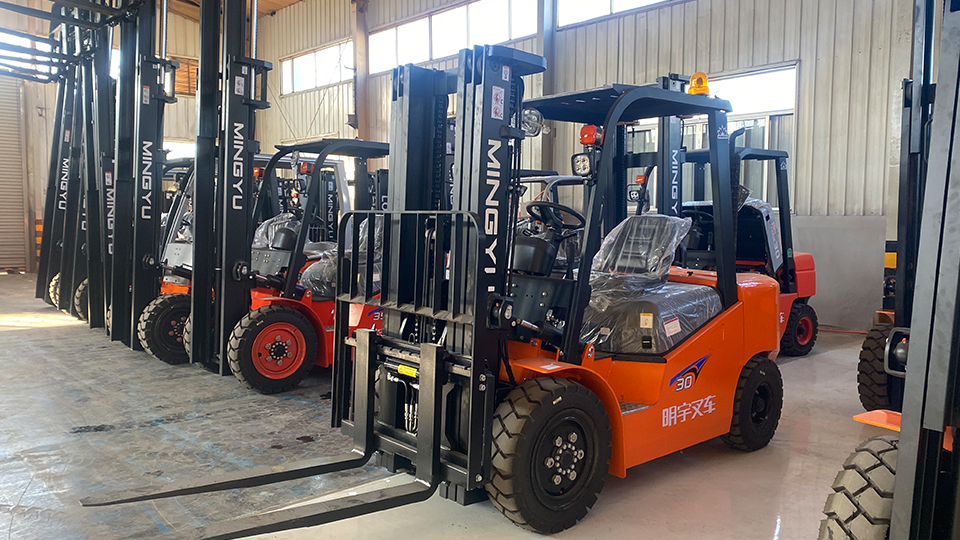
Based on global market share, consistent engineering quality, and fleet manager testimonials, three brands consistently dominate the conversation for high-capacity and reliable diesel operation.
A. �� Toyota Material Handling (Toyota)
Toyota has been the global leader in the material handling industry for over two decades, setting the benchmark for quality, durability, and reliability (QDR). Their reputation extends seamlessly into the heavy-duty diesel market.
1. Technical Edge: Engine and SAS
Proprietary Engines: Unlike some competitors who integrate third-party engines, Toyota designs and builds many of its own industrial engines specifically for fork trucks. These engines are rigorously tested for the intermittent, high-load duty cycle typical of forklift work, focusing on longevity and fuel efficiency.
System of Active Stability (SAS): While not exclusively a diesel feature, Toyota’s patented SAS is a major safety and reliability factor. By electronically monitoring the lift truck’s operation and automatically engaging safety features (like limiting mast angle or speed), it actively prevents instability. This reduces the risk of tip-overs, which can cause catastrophic structural and component damage, thus enhancing long-term reliability.
Heavy-Duty Models: The Toyota High-Capacity IC Pneumatic line, often used in lumber and steel, is renowned for its low cost of ownership (TCO) stemming from high uptime and reduced maintenance frequency.
2. Service and Support
Toyota’s massive, globally distributed dealer network is a key competitive advantage. Excellent parts availability (often 97%+ in-stock rates) ensures minimal downtime, a crucial metric for evaluating true reliability.
B. �� Hyster-Yale Materials Handling (Hyster and Yale)
Hyster and Yale, operating under the same parent company, have a long-standing, well-earned reputation for building rugged, durable machines designed to "take a beating" in demanding environments such as ports, intermodal facilities, and heavy manufacturing.
1. Technical Edge: Rugged Power
Focus on Power: Hyster's heavy-duty diesel lines, such as the H-Series and Big Truck lines, are frequently praised for their raw, dependable power and use of powerful, industrial-grade engines and robust torque converter transmissions engineered for maximum duty cycle. The company's heritage in the logging industry translates to over-engineered frames and mast assemblies.
Cooling Systems: Recognizing the stress of heavy lifting, Hyster often features superior cooling systems designed to protect the engine and transmission from thermal degradation, a common failure point in heavy-duty IC forklifts. For example, some models incorporate enhanced cooling for hydraulic fluid and the transmission.
Durability Rating: Fleet managers often cite Hyster as the benchmark for sheer durability and structural integrity in extremely tough, high-abuse outdoor applications, making them a consistent choice where rough terrain or continuous heavy loads are the norm.
2. Service and Support
While their parts are known for quality and durability, Hyster-Yale maintains a strong dealer network that provides excellent service support, particularly for their larger, high-capacity trucks.
C. �� Caterpillar (CAT Lift Trucks)
Caterpillar (CAT) leverages its global reputation in heavy construction and earth-moving machinery, translating its expertise in robust engineering and durable engines into its lift truck division.
1. Technical Edge: Component Integration
Durability by Association: CAT Lift Trucks benefits from the perception and reality of Caterpillar's industrial-grade components. Their diesel forklifts are built with strong, reliable frames and powertrain components that can handle rough, uneven surfaces (e.g., construction yards or lumber mills).
Serviceability: A significant advantage is CAT's vast, global dealer network (often overlapping with heavy equipment dealers). This means parts are typically easy to source, and technicians are widely available and well-versed in complex diesel engine diagnostics and repair, which contributes directly to high uptime figures.
High-Capacity Models: CAT offers reliable diesel models that balance powerful performance with fuel-efficient operation, utilizing technology honed in their larger construction equipment.
III. Strong Contenders in the Heavy-Duty Diesel Sector
While Toyota, Hyster, and CAT lead in overall reputation, several other manufacturers offer highly reliable, specialized, or region-specific solutions for heavy-duty diesel applications.
A. Komatsu
Komatsu, like CAT, is a Japanese multinational known globally for construction and mining equipment. Their diesel forklifts benefit from this DNA, focusing on precision engineering and rugged construction.
Key Strength: Komatsu trucks are known for their operator comfort, ease of use, and integration of durable components, providing a great balance of power, fuel efficiency, and long-term durability.
Reliability Niche: They are highly valued in outdoor, industrial, and lumber applications where stable performance over long operational hours is critical.
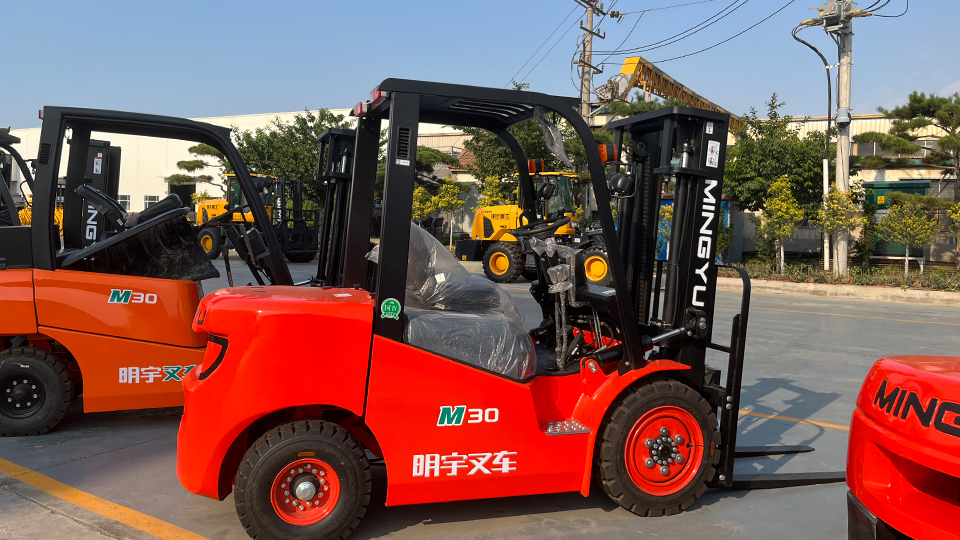
B. Kalmar (Cargotec Corporation)
Kalmar is a global leader, particularly in the extreme end of heavy-duty material handling, specializing in machinery for ports, terminals, and heavy industries (steel, paper).
Key Strength: Kalmar’s focus is on massive capacity (loaded container handlers, reach stackers, and specialized heavy forklifts up to $350,000 \text{ lbs}$). Their reliability is demonstrated in their ability to handle continuous, punishing applications in harsh marine and industrial environments. Their systems often feature the most advanced diagnostics and safety systems required for operating $40 \text{-foot}$ loads.
Ideal Use: Where standard $30,000 \text{-pound}$ forklifts are too small, Kalmar is a Tier 1 supplier for the largest, most demanding industrial applications.
C. Doosan
Doosan has established itself as a reliable player, often providing a blend of quality and affordability in the heavy-duty sector.
Key Strength: Doosan focuses on continuous improvement in technology, including advanced features and ergonomic designs, and offers models that can handle substantial capacity (up to $55,000 \text{ lbs}$).
Value Proposition: They often provide an excellent value proposition, delivering durable, high-capacity diesel performance without the absolute premium price point of some global competitors.
IV. Technical Factors Influencing Diesel Reliability
The choice of brand is only half the battle. True long-term reliability in heavy-duty diesel forklifts is determined by the synergy of brand engineering, operator conduct, and fleet management practices.
A. The Engine Component Choice
Reliability in diesel trucks is intrinsically linked to the engine manufacturer. The leading forklift brands generally partner with or incorporate their own industrial engines:
|
Engine Type |
Brand Association |
Reliability Impact |
|
Proprietary |
Toyota, Komatsu |
Engines are engineered specifically for the fork truck duty cycle (e.g., high torque at low RPMs), often resulting in greater internal component longevity. |
|
Industrial Standard |
Hyster (Cummins/Perkins), CAT, Doosan |
Utilizes globally recognized, over-the-road or industrial engines known for parts availability, serviceability, and inherent robustness. |
B. Transmission Technology: Hydrostatic vs. Torque Converter
Heavy-duty diesel forklifts primarily use two types of transmissions, each impacting reliability differently:
Torque Converter Transmission: Common in heavy-duty forklifts, these transmissions are robust and durable, relying on a fluid coupling and geared system. Reliability is high provided the transmission fluid and filters are changed exactly according to the severe-duty schedule to prevent overheating and internal clutch pack wear.
Hydrostatic Transmission (HST): Often featured in European brands like Linde (KION Group) and some specialized models. HST uses high-pressure hydraulic fluid to transmit power. While HST offers extremely precise control (inching) and simplifies the drivetrain (fewer moving parts), its reliability is highly dependent on the cleanliness of the hydraulic fluid and proper maintenance of high-pressure seals and pumps.
C. Advanced Diagnostics and Telematics
Modern reliability is actively managed by embedded technology. Top-tier brands integrate telematics systems that monitor parameters such as:
Impact Sensing: Logs severe impacts, indicating potential damage to the mast or frame, allowing for immediate inspection.
Over-Temp Monitoring: Continuously tracks engine and transmission temperature, preventing component meltdown due to overheating before the operator is aware.
Error Code Reporting: Transmits real-time engine control module (ECM) fault codes directly to the fleet manager for proactive scheduling of diagnostics and parts ordering. This is critical for minimizing unexpected downtime.
V. Strategic Procurement and Total Cost of Ownership (TCO)
While initial purchase price ($P$) is important, the true cost of reliability is found in the TCO, calculated over the lifespan of the machine:
$$\text{TCO} = P + \sum (\text{Maintenance Costs} + \text{Fuel} + \text{Downtime Cost}) - \text{Residual Value}$$
The Downtime Cost ($\text{DTC}$) is the primary differentiator for the most reliable brands. If a forklift with a purchase price of $\$80,000$ saves $100$ hours of unexpected downtime annually (with a DTC estimated at $\$150/\text{hour}$), the savings are $\$15,000$ per year, quickly justifying a higher initial purchase price over a competitor.
|
Reliability Factor |
Impact on TCO |
Brand Strength Examples |
|
Uptime (Downtime Reduction) |
Massive Savings. Direct reduction in DTC. |
Toyota (SAS, proprietary engine), Kalmar (advanced diagnostics). |
|
Parts Availability/Cost |
Reduces repair labor time and part expenses. |
Toyota, CAT (vast global networks). |
|
Fuel Efficiency |
Lower operating expense. |
Komatsu (engine design focus), modern Hyster engines. |
|
Residual Value |
Higher asset recovery at end of lease/life. |
Toyota (brand reputation holds high value). |
VI. Conclusion: Selecting the Right Heavy-Duty Champion
Choosing the most reliable heavy-duty diesel forklift brand is a sophisticated technical decision that must align the demands of the application with the engineering strength of the manufacturer.
For the vast majority of operations requiring maximum reliability, efficiency, and safety in general warehousing and heavy industrial use, Toyota remains the undisputed global benchmark due to its commitment to quality, its SAS safety features, and its dominant support network.
For applications defined by extreme ruggedness, continuous high-capacity use, and punishing environments (like ports or lumber operations), Hyster and Kalmar offer purpose-built, over-engineered solutions that excel in pure durability. CAT and Komatsu provide excellent alternatives with strong engineering and service backing from their heavy machinery heritage.
Ultimately, the technical analysis confirms that reliability is not a feature but an integrated system of superior engineering, preventative maintenance support, and advanced diagnostics—all areas where the top-tier global manufacturers consistently outperform.
Choosing the right brand and adhering to a strict preventative maintenance schedule ensures the diesel workhorse remains a profitable and dependable asset for the fleet.
Name: selena
Mobile:+86-13176910558
Tel:+86-0535-2090977
Whatsapp:8613181602336
Email:vip@mingyuforklift.com
Add:Xiaqiu Town, Laizhou, Yantai City, Shandong Province, China