
vip@mingyuforklift.com
+86-0535-2090977

Executive Summary
The center of gravity (CG) represents the fundamental pivot point around which all forklift stability dynamics revolve. In an unloaded configuration, the center of gravity of a typical sit-down counterbalance forklift is located near the center of the vehicle, positioned below the operator's seat and slightly rearward of the longitudinal midpoint . This positioning is not arbitrary—it results from deliberate engineering design involving rear ballast weighting that counteracts the natural forward bias created by the mast and fork assembly. Understanding this baseline CG location is essential for operators, safety professionals, and engineers, as it establishes the reference point from which all load-induced stability shifts are calculated.
1. Fundamental Concepts: Defining Center of Gravity in Industrial Trucks
1.1 The Physics of Gravitational Concentration
The center of gravity is defined by OSHA as "the point on an object at which all of the object's weight is concentrated" . For symmetrical objects, this point coincides with the geometric center; for asymmetrical objects, it shifts toward the concentration of mass. In the context of material handling equipment, the CG represents the three-dimensional coordinate where the entire mass of the forklift could theoretically be suspended in perfect equilibrium.
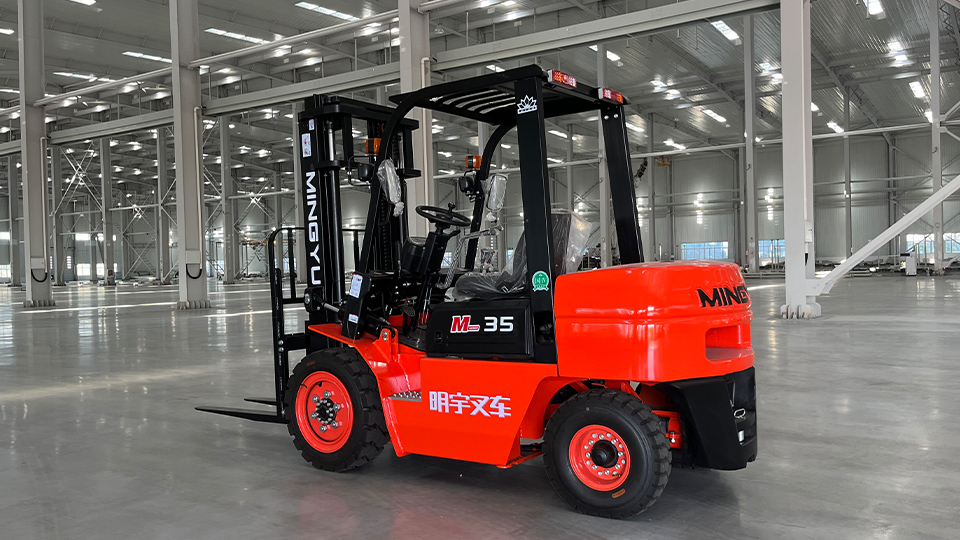
Every forklift possesses two distinct centers of gravity throughout its operational lifecycle: the unloaded vehicle center of gravity and the combined center of gravity (incorporating both vehicle and load mass). The unloaded CG serves as the static baseline; the combined CG becomes the dynamic variable that operators must manage to maintain stability .
1.2 Forklift Design Asymmetry
Unlike passenger vehicles, which generally exhibit symmetrical weight distribution, forklifts are inherently asymmetrical machines. The mast assembly, carriage, and forks constitute significant forward-projecting mass, while the engine (in internal combustion models) or battery pack (in electric models) provides rearward ballast . This asymmetry necessitates careful CG positioning to prevent forward tip-over during unloaded operation.
Table 1: Typical Unloaded Forklift CG Specifications by Configuration
|
Forklift Type |
Approximate Unloaded Weight |
CG Longitudinal Position |
CG Vertical Height |
Rear Ballast Contribution |
|
Electric Counterbalance (3,000 lb capacity) |
6,000–8,000 lbs |
12–16 inches behind front axle |
10–12 inches above ground |
Battery pack (2,000–3,000 lbs) |
|
IC Cushion Tire (5,000 lb capacity) |
8,500–11,000 lbs |
14–18 inches behind front axle |
12–15 inches above ground |
Cast iron counterweight (3,000–4,500 lbs) |
|
IC Pneumatic Tire (6,000 lb capacity) |
10,000–13,000 lbs |
16–20 inches behind front axle |
14–18 inches above ground |
Engine + counterweight (4,000–6,000 lbs) |
|
Reach Truck (3,500 lb capacity) |
7,000–9,000 lbs |
10–14 inches behind front axle |
8–10 inches above ground |
Battery + chassis ballast (2,500–3,500 lbs) |
Sources: OSHA technical documentation, manufacturer specifications
2. The Stability Triangle: Geometric Framework for CG Positioning
2.1 Three-Point Suspension Architecture
Counterbalance forklifts utilize a three-point suspension system that creates the geometric foundation for stability analysis. Despite having four wheels, the vehicle is effectively supported at:
Point A: The center pivot of the rear steer axle (single point)
Points B and C: The centers of the two front drive wheels
Connecting these three points forms the stability triangle—an imaginary pyramid that defines the boundaries of safe operation . The unloaded forklift's center of gravity must remain within this triangular prism; any excursion beyond these boundaries results in tip-over instability.
2.2 CG Position Relative to the Stability Triangle
In an unloaded configuration, the center of gravity is positioned centrally within the stability triangle, providing maximum stability margin in all directions . Specifically:
Longitudinally: The CG sits approximately midway between the front axle (line B-C) and the rear pivot point (Point A), though slightly rearward of the true geometric center due to ballast weighting
Laterally: The CG is centered between the front wheels, assuming symmetrical weight distribution
Vertically: The CG is maintained as low as practicable, typically 10–15 inches above ground level for standard counterbalance configurations
This central positioning provides symmetrical stability margins—the forklift is equally resistant to forward, rearward, and lateral tip-over when unloaded. However, this symmetry creates a critical operational paradox: unloaded forklifts are actually less stable laterally than loaded forklifts with lowered loads, as the CG sits higher relative to the stability triangle base .
3. Engineering Design: Ballast and CG Optimization
3.1 The Counterweight Engineering Solution
The rearward positioning of the unloaded CG is achieved through strategic ballast placement. In electric forklifts, the battery pack serves dual functions as power source and counterweight, typically weighing 2,000–4,000 pounds and occupying the rear chassis compartment . Internal combustion models employ cast iron counterweights bolted to the rear frame, engineered to precise specifications to balance the mast assembly's moment arm.
This ballast design creates a moment equilibrium around the front axle. The mast and forks generate a forward-tipping moment (weight × distance from front axle); the rear ballast generates an opposing rearward moment. The unloaded CG represents the resultant vector of these competing forces—positioned rearward of center to ensure that even with maximum rated load at maximum elevation, the combined CG remains within the stability triangle .
3.2 Battery-Powered vs. Internal Combustion Variations
Electric forklifts exhibit lower vertical CG positions than their IC counterparts due to battery mass placement beneath the operator compartment floor. This configuration enhances stability by reducing the moment arm during lateral accelerations (turning). IC engines, mounted higher in the chassis, necessitate heavier counterweights positioned lower to achieve equivalent stability characteristics .
Table 2: CG Position Variations by Power Source
|
Design Parameter |
Electric Forklift |
Internal Combustion Forklift |
|
Primary Ballast Location |
Underfloor battery compartment |
Rear-mounted cast iron block |
|
Typical CG Height |
10–12 inches |
12–16 inches |
|
Ballast as % of Total Weight |
35–45% |
30–40% |
|
Lateral Stability Characteristic |
Superior (lower CG) |
Adequate (higher CG) |
|
Rearward CG Bias |
Moderate (battery centered) |
Pronounced (counterweight rear) |
4. Dynamic CG Shifts During Operational Modes
4.1 Mast Tilt Effects
The unloaded CG is not a fixed coordinate—it moves in response to mast positioning. When the mast tilts forward or backward, the CG shifts correspondingly:
Forward tilt: CG moves forward toward the front axle, reducing rearward stability margin
Backward tilt: CG moves rearward toward the steer axle, reducing forward stability margin but increasing resistance to forward tip-over
These movements remain within safe boundaries during normal operation but become critical when combined with other destabilizing factors (grades, acceleration, turning).
4.2 Fork Elevation Dynamics
Raising or lowering the forks without load induces vertical CG displacement. As forks elevate, the mast carriage mass rises, slightly elevating the overall vehicle CG. While unloaded fork elevation presents minimal tip-over risk, it reduces the resistance to lateral tip-over during turning maneuvers—a factor contributing to the recommendation that forks be kept lowered during travel .
5. Comparative Analysis: Loaded vs. Unloaded Stability Profiles
5.1 The Unloaded Stability Paradox
Counterintuitively, unloaded forklifts exhibit reduced lateral stability compared to properly loaded forklifts with lowered loads. This phenomenon occurs because:
The unloaded CG sits higher relative to the wheelbase than a loaded CG with forks lowered
Without load mass on the forks, the CG remains closer to the lateral edges of the stability triangle during turns
The rear ballast creates a pendulum effect, increasing lateral momentum during directional changes
OSHA data indicates that tip-overs occur disproportionately during unloaded operation, particularly during high-speed turns or abrupt directional changes .
5.2 Load-Induced CG Migration
When a load is engaged, the combined center of gravity shifts forward and upward from the unloaded position. The magnitude of this shift depends on:
Load weight: Heavier loads generate greater forward CG displacement
Load center distance: Horizontal distance from fork face to load CG (standardized at 24 inches for rated capacity calculations)
Load elevation: Height above ground affects both vertical and horizontal CG position due to mast geometry
At maximum rated load and maximum elevation, the combined CG approaches—but must not exceed—the front axle line (the forward boundary of the stability triangle) .
6. Measurement and Calculation Methodologies
6.1 Determining CG Experimentally
Manufacturers establish unloaded CG positions through weighing procedures:
Reaction Method: Weighing individual wheel loads and calculating moments around reference axes
Tilt Table Testing: Gradually inclining the forklift until tip-over occurs, then calculating CG height from the tip angle
Suspension Method: Lifting the forklift at specific points and measuring equilibrium positions
These measurements are documented on the forklift data plate, which specifies load capacities at various load centers and elevations based on the known unloaded CG position .
6.2 Mathematical Modeling
The unloaded CG coordinates can be calculated using static equilibrium equations:
Longitudinal Position (X_cg): Xcg=∑mi∑(mi⋅xi)
Where mi represents component masses (chassis, mast, counterweight, battery) and xi represents their longitudinal positions relative to the front axle.
Vertical Position (Y_cg): Ycg=∑mi∑(mi⋅yi)
Where yi represents vertical positions relative to ground level.
These calculations confirm that the unloaded CG is positioned to ensure the combined CG remains within the stability triangle under all rated load conditions .
7. Operational Implications and Safety Protocols
7.1 Pre-Operational Stability Assessment
Operators must understand that the unloaded CG position establishes baseline stability parameters:
Maximum permissible grade: Determined by the longitudinal CG position and stability triangle geometry
Maximum turning speed: Limited by lateral CG position and centrifugal force effects
Braking deceleration: Affected by forward CG bias during mast tilt
7.2 Stability Maintenance Practices
To preserve the safety margins inherent in the unloaded CG design:
Maintain proper tire inflation: Underinflation effectively widens the stability triangle base but alters CG height calculations
Avoid unauthorized modifications: Addition of attachments (sideshifters, clamps) shifts the unloaded CG forward, requiring derated capacity calculations
Monitor ballast integrity: Battery replacement with non-OEM specifications or counterweight damage alters designed CG position
Respect load center ratings: Exceeding 24-inch load centers moves the combined CG forward of designed limits
8. Advanced Considerations: Specialized Configurations
8.1 Stand-Up and Narrow-Aisle Variants
Stand-up forklifts and order pickers exhibit different unloaded CG characteristics due to operator positioning and chassis geometry. In these configurations, the CG is typically more forward and higher than sit-down models, necessitating enhanced stability systems and reduced speed capabilities .
8.2 Rough Terrain and All-Terrain Forklifts
Pneumatic-tire forklifts designed for outdoor operation feature wider stability triangles and lower CG heights to accommodate uneven surfaces. The unloaded CG is positioned more rearward to counteract the forward bias created by large-diameter front tires .
Conclusion
The center of gravity of an unloaded forklift is strategically positioned below the operator's seat, slightly rearward of the vehicle's longitudinal center, and within the geometric center of the stability triangle . This location results from deliberate engineering balancing of mast mass against rear ballast, creating the reference point from which all operational stability calculations derive.
Understanding this baseline CG position is not merely academic—it directly informs safe operating practices, load capacity determinations, and risk assessments. The central positioning provides balanced stability in all directions when unloaded, though operators must remain cognizant that lateral stability is actually reduced compared to loaded operation with lowered forks .
As material handling technology evolves toward automation and electrification, the fundamental physics of CG management remain constant. Whether operating conventional counterbalance trucks or autonomous guided vehicles, maintaining the center of gravity within the stability triangle—whether unloaded or loaded—remains the paramount safety imperative in forklift operations.
Name: selena
Mobile:+86-13176910558
Tel:+86-0535-2090977
Whatsapp:8613181602336
Email:vip@mingyuforklift.com
Add:Xiaqiu Town, Laizhou, Yantai City, Shandong Province, China
