
vip@mingyuforklift.com
+86-0535-2090977

Introduction
The construction and maintenance industries have long relied on two primary methods for providing workers access to elevated areas: traditional scaffolding systems and aerial work platforms (AWPs). While scaffolding has served as the foundation of elevated work for centuries, the emergence of powered access equipment in the mid-20th century introduced a paradigm shift in how industries approach height-based operations. This comprehensive technical analysis examines the comparative advantages of aerial work platforms versus traditional scaffolding across critical dimensions including safety, efficiency, cost-effectiveness, flexibility, and environmental impact, providing decision-makers with quantitative and qualitative data to optimize their access strategy selection.
Safety Performance Analysis
Fall Protection and Structural Integrity
Aerial work platforms incorporate engineered fall protection as primary design features rather than aftermarket additions. Guardrail systems on modern AWPs typically measure 1.1 meters in height with integrated mid-rails and toe boards, satisfying regulatory requirements without necessitating personal fall arrest equipment under normal operating conditions. Load moment indicators, tilt sensors, and automatic pothole protection systems provide real-time stability monitoring that scaffolding cannot match.
Traditional scaffolding, while structurally robust when properly erected, relies heavily on assembly quality and continuous inspection. The Health and Safety Executive (HSE) reports that scaffolding-related incidents account for approximately 15% of fatal construction accidents, with common causes including incomplete guardrails, improper base preparation, and overloading. Independent studies indicate that AWPs demonstrate incident rates 75% lower than scaffolding for equivalent working heights, attributed to integrated safety systems and reduced human error factors during setup.
Weather and Environmental Considerations
AWPs equipped with anemometers automatically restrict operation when wind speeds exceed manufacturer specifications (typically 12.5 m/s for standard models, reduced to 7.5 m/s for high-reach equipment). This engineered limitation prevents operation in unsafe conditions. Scaffolding lacks such automated protection, requiring manual judgment that may be compromised by production pressures. Additionally, scaffolding platforms become hazardous in ice conditions, whereas AWPs can be equipped with heated platforms and enclosed cabs for cold-weather operations.
Productivity and Time Efficiency
Setup and Dismantling Protocols
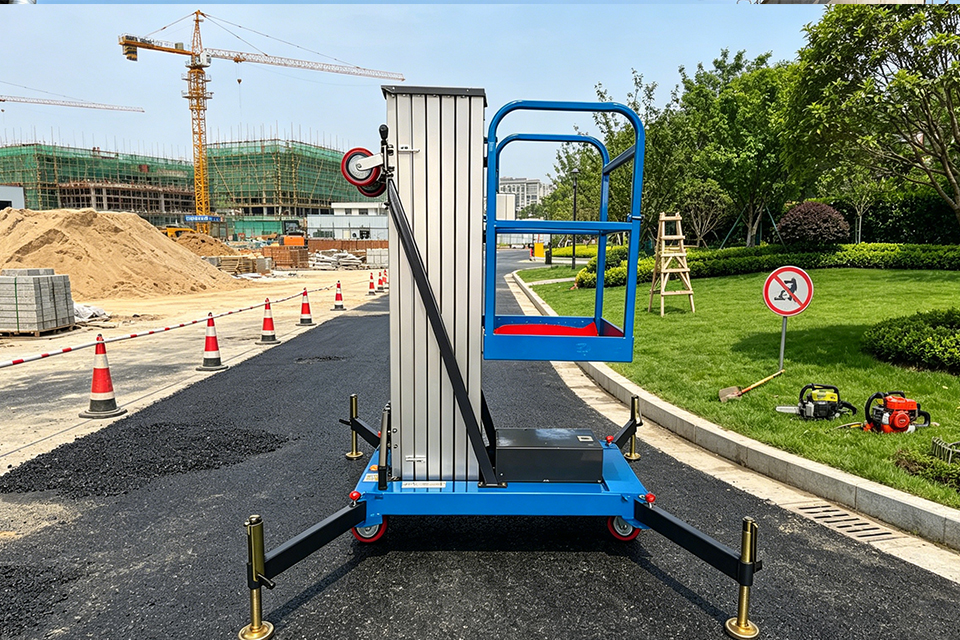
The temporal advantages of AWPs become immediately apparent when comparing deployment times. A 12-meter electric scissor lift requires approximately 15 minutes from delivery to operational status, including outrigger deployment on uneven surfaces. Conversely, tube-and-fitting scaffolding to equivalent height demands 4-6 hours for experienced erection teams, with system scaffolding reducing this to 2-3 hours.
For projects requiring frequent relocation, the productivity differential compounds significantly. AWPs enable positional changes within minutes, whereas scaffolding dismantling and re-erection cycles consume entire shifts. Analysis of facade maintenance projects indicates that AWPs reduce total project duration by 40-60% compared to scaffolding alternatives, primarily through elimination of repetitive assembly operations.
Labor Resource Optimization
Scaffolding erection requires specialized competence—typically 50-70% of scaffolding costs derive from labor. AWP operation, following standardized IPAF certification, enables general construction personnel to perform elevated work without dedicated scaffolding crews. This reallocation of specialized labor resources generates compound efficiency gains across project portfolios.
Furthermore, AWPs reduce the physical demands on workers. Scaffolding assembly involves manual handling of components weighing 20-50 kg, repetitive lifting, and working in awkward postures. AWP operators utilize hydraulic controls with minimal physical exertion, reducing musculoskeletal disorder incidence and associated workers' compensation claims.
Economic Analysis and Cost Modeling
Capital and Operational Expenditure
Initial cost comparisons favor scaffolding for long-term, continuous applications. A basic tube-and-fitting scaffolding system serving 20 linear meters at 10 meters height costs approximately $15,000-$25,000 for purchase, with indefinite service life given proper maintenance. Equivalent AWP capability (two 12-meter scissor lifts) requires capital investment of $60,000-$80,000, with 10-15 year operational lifespans and battery replacement cycles.
However, total cost of ownership analysis reveals more nuanced economics. Scaffolding incurs hidden costs including storage (typically 20-30% of equipment value annually), transportation, inspection, and maintenance. AWP rental models convert capital expenditure to operational costs, with daily rates for 12-meter scissor lifts ranging $150-$300 depending on market conditions. For projects under three months duration, rental AWPs consistently demonstrate cost advantages over scaffolding purchase or rental.
Indirect Cost Factors
Scaffolding-related indirect costs extend beyond direct financial metrics. The structural footprint of scaffolding systems reduces site circulation space, potentially compromising other trades' productivity. Weather delays disproportionately impact scaffolding-dependent schedules, as incomplete structures cannot guarantee worker safety during precipitation or high winds.
Insurance premiums increasingly reflect access method selection. Underwriters recognize AWP safety advantages, with liability coverage for powered access operations typically 15-25% lower than equivalent scaffolding coverage. This differential, applied across large construction portfolios, generates substantial annual savings.
Flexibility and Application Versatility
Adaptability to Complex Geometries
Modern articulating and telescopic boom lifts navigate architectural complexities that challenge scaffolding design. Up-and-over capability enables access to atriums, courtyards, and obstructed facades without ground-level support beneath the work area. Jib attachments provide 120-135 degree platform rotation, achieving positioning precision of ±5 cm in confined spaces.
Scaffolding excels in linear applications—building perimeters, bridge superstructures, and industrial tank farms—where repetitive bay configurations maximize efficiency. However, irregular geometries demand custom scaffolding designs with extended engineering and procurement timelines. The modular adaptability of AWPs reduces response time from specification to operation from weeks to days.
Multi-Level and Intermittent Access
Industrial maintenance scenarios frequently require intermittent access to multiple elevations. AWPs facilitate rapid vertical repositioning without structural modification. Spider lifts and compact crawlers access confined areas with setup footprints as small as 3×3 meters, operating on structural slabs with limited load capacity (0.5 kg/cm² ground pressure) where scaffolding would require extensive load distribution engineering.
Conversely, scaffolding provides simultaneous multi-level access advantageous for sequential construction operations—masonry, cladding, and glazing progressing systematically across building elevations. This parallel work capability, when fully utilized, can offset scaffolding's setup time disadvantages.
Environmental and Sustainability Considerations
Emissions and Energy Consumption
The electrification of aerial work platforms has progressed rapidly, with lithium-ion battery systems now powering equipment to 20-meter working heights. Zero-emission operation enables indoor use without ventilation requirements and supports corporate sustainability commitments. Even diesel-powered AWPs utilize efficient modern engines (Stage V/Tier 4 Final compliant) with particulate filtration, consuming 2-4 liters per hour depending on application intensity.
Scaffolding generates minimal direct emissions but carries embodied carbon in steel or aluminum manufacturing. Transport emissions favor AWPs for mobile applications—single delivery versus multiple truckloads of scaffolding components. Lifecycle assessments indicate that for projects with frequent relocation requirements, AWPs demonstrate 30-40% lower carbon footprints than scaffolding alternatives.
Material Efficiency and Waste
AWP rental models maximize asset utilization across multiple projects, with professional fleet management ensuring optimal maintenance and end-of-life recycling. Scaffolding ownership often results in underutilized inventory, component loss, and eventual scrap generation. The circular economy advantages of shared AWP assets align with evolving construction sustainability standards.
Regulatory Compliance and Documentation
Inspection and Certification Requirements
Scaffolding demands comprehensive documentation including design calculations, assembly drawings, and weekly inspection records by competent persons. The regulatory burden increases with scaffold complexity—temporary roofs, loading bays, and independent scaffolds require engineered designs and enhanced inspection protocols.
AWPs streamline compliance through standardized pre-use inspections (typically 10-15 minutes) and periodic thorough examinations. Digital fleet management systems automate maintenance scheduling and documentation, reducing administrative overhead. The uniformity of AWP safety standards across jurisdictions simplifies multinational project execution compared to scaffolding code variations.
Training and Competency Frameworks
IPAF certification provides globally recognized operator competency validation, with standardized training modules adaptable across equipment categories. Scaffolding erection competence requires nationally specific qualifications with limited international reciprocity. The scalability of AWP training—typically 1-3 days for initial certification versus weeks for scaffolding erection competence—accelerates workforce development.
Risk Management and Liability Considerations
Third-Party Exposure
Scaffolding installations create extended liability exposures through public interface. Falling objects from scaffolding platforms, collapse risks during adverse weather, and unauthorized access by untrained personnel generate significant third-party liability. Enclosed AWP platforms with interlocked gates eliminate falling object hazards, while machine guarding and key-controlled operation prevent unauthorized use.
Weather-Related Risk Transfer
AWP rental agreements typically include weather-related downtime provisions, transferring utilization risk to equipment providers. Scaffolding contracts place weather protection responsibility on contractors, with inadequate protection generating accelerated corrosion, safety compromises, and premature dismantling requirements.
Hybrid Approaches and Emerging Integration
Complementary Application Strategies
Sophisticated project planning increasingly utilizes hybrid access strategies. Scaffolding establishes baseline perimeter access for extended duration trades, while AWPs provide specialized access for intermittent high-value operations—HVAC commissioning, glazing replacement, or signage installation. This optimization requires detailed activity sequencing and cost modeling but yields superior project outcomes.
Technological Convergence
Innovation blurs traditional distinctions. Self-climbing scaffolding systems incorporate powered elevation, while AWPs adopt scaffolding-style platform extensions and material handling capabilities. Mast climbing work platforms (MCWPs) represent explicit hybridization—scaffolding-style platforms with powered vertical movement, occupying intermediate positions in the access equipment spectrum.
Conclusion
The comparative analysis of aerial work platforms versus traditional scaffolding reveals no universal superiority—rather, distinct advantages across application-specific criteria. AWPs demonstrate decisive superiority in safety performance, setup efficiency, and application flexibility for intermittent or complex access requirements. Scaffolding maintains economic advantages for long-duration, linear applications with stable specifications and continuous multi-level utilization.
The trajectory of industry evolution favors AWPs through electrification, autonomous capabilities, and safety system integration. Regulatory trends emphasizing fall prevention and carbon reduction align with AWP technological development. However, scaffolding's fundamental reliability, load capacity, and independence from power sources ensure continued relevance in construction methodology.
Optimal access strategy selection requires quantitative analysis of project parameters—duration, complexity, mobility requirements, and safety risk profiles—against the comparative advantages detailed herein. As construction productivity pressures intensify and safety standards elevate, the informed integration of both access methodologies, deployed according to their respective strengths, represents best practice for sophisticated construction and maintenance operations.
The future of elevated work access lies not in the displacement of scaffolding by powered platforms, but in the intelligent optimization of both technologies within comprehensive access strategies that prioritize worker safety, operational efficiency, and economic performance in equal measure.
Name: selena
Mobile:+86-13176910558
Tel:+86-0535-2090977
Whatsapp:8613181602336
Email:vip@mingyuforklift.com
Add:Xiaqiu Town, Laizhou, Yantai City, Shandong Province, China
