
vip@mingyuforklift.com
+86-0535-2090977

Introduction
Aerial work platforms (AWPs) operate increasingly in high-noise industrial environments where acoustic interference fundamentally challenges conventional control systems. Construction sites, manufacturing facilities, airports, and energy infrastructure generate ambient noise levels exceeding 85-110 dB, creating electromagnetic interference, vibration-induced sensor drift, and communication degradation that compromise platform stability and operator safety. This comprehensive technical analysis examines adaptive control technologies specifically engineered to maintain AWP performance integrity in acoustically hostile conditions, exploring sensor fusion architectures, real-time signal processing algorithms, robust control methodologies, and emerging artificial intelligence applications that enable reliable operation where traditional control systems fail.
Characterization of High-Noise Environments
Acoustic Spectra and Mechanical Coupling
High-noise environments present multifaceted challenges extending beyond auditory hazards. Industrial noise sources—pneumatic tools, diesel engines, metal forming equipment, and aircraft operations—generate broadband acoustic energy with dominant frequencies ranging from 20 Hz to 8 kHz. These pressure waves induce structural vibrations in AWP booms and platforms through mechanical coupling, creating inertial disturbances that conventional proportional-integral-derivative (PID) controllers inadequately attenuate.
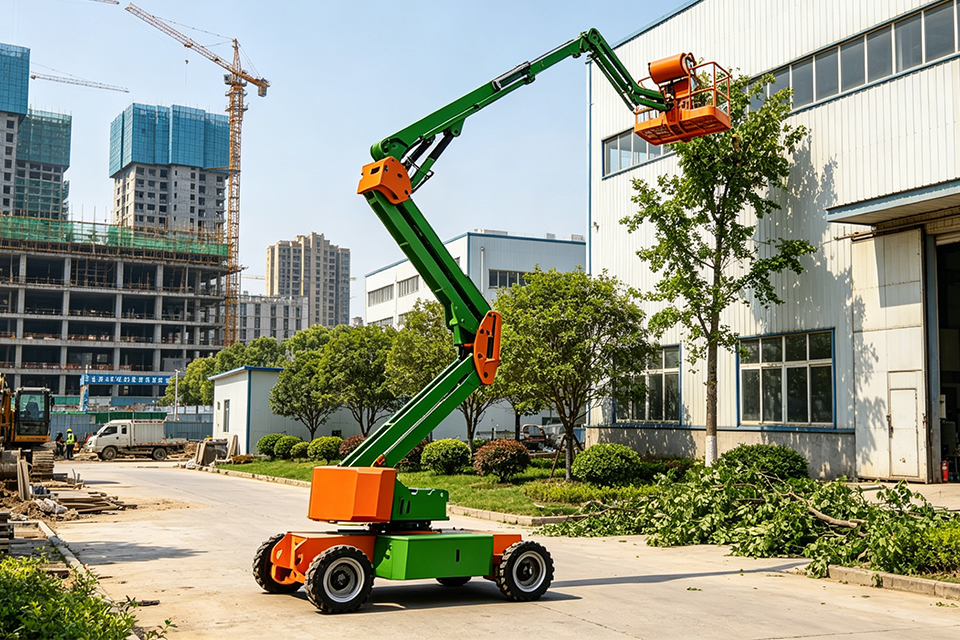
Vibration analysis reveals that scissor lift platforms experience resonant amplification at 15-45 Hz corresponding to diesel engine firing frequencies, while articulating booms demonstrate modal responses at 2-8 Hz related to hydraulic pump pulsations. These mechanical disturbances propagate through load moment sensors, inclinometers, and rotary encoders, introducing measurement noise with amplitudes 10-100× greater than sensor precision specifications.
Electromagnetic Interference Mechanisms
Acoustic noise correlates strongly with electromagnetic interference (EMI) in electrically-powered AWPs. Variable frequency drives (VFDs) controlling lift motors generate conducted emissions at switching frequencies (typically 2-16 kHz), while power electronics create radiated fields that couple into control signal cabling. High-noise industrial environments compound these intrinsic EMI sources with external arc welding equipment, induction furnaces, and radio transmission systems, creating electromagnetic environments where unshielded control signals experience bit error rates exceeding 10⁻³.
Sensor Fusion and Signal Conditioning Architectures
Multi-Modal Sensor Arrays
Adaptive control systems for high-noise environments deploy heterogeneous sensor arrays with complementary noise susceptibility profiles. Inertial measurement units (IMUs) combining MEMS accelerometers and gyroscopes provide high-bandwidth motion data (0-100 Hz) but suffer from drift and vibration-induced errors. Absolute rotary encoders on boom joints deliver drift-free position feedback with 0.01° precision yet lack dynamic response for vibration isolation.
Research demonstrates that sensor fusion via extended Kalman filters (EKFs) or unscented Kalman filters (UKFs) optimally combines these characteristics, achieving state estimation accuracies of ±0.1° in angular position and ±2 mm in Cartesian platform coordinates despite 50 dB signal-to-noise ratio degradation. The fusion architecture weights sensor contributions dynamically based on real-time noise covariance estimation, effectively disabling vibration-saturated accelerometers during high-amplitude disturbances while relying on encoder data and model-based prediction.
Adaptive Filtering and Noise Cancellation
Digital signal processing implementations employ adaptive finite impulse response (FIR) filters with least-mean-squares (LMS) or recursive least-squares (RLS) coefficient updates. These filters model noise characteristics online, achieving 15-25 dB noise reduction in sensor channels without introducing phase lag that would compromise control stability. For periodic noise sources—hydraulic pump frequencies or engine harmonics—adaptive notch filters with bandwidths of 0.5-2 Hz precisely target disturbance frequencies while preserving broadband signal integrity.
Wavelet denoising techniques address non-stationary noise characteristics, decomposing sensor signals into time-frequency representations that separate transient disturbances from legitimate control inputs. Symlet and Coiflet wavelet families with 4-8 vanishing moments provide optimal trade-offs between temporal resolution and frequency discrimination for AWP control applications, enabling detection of platform oscillation modes while suppressing high-frequency measurement noise.
Robust Control Methodologies
Sliding Mode Control Implementation
Sliding mode control (SMC) offers inherent robustness to matched disturbances—those appearing in control input channels—making it particularly suitable for AWP hydraulic systems where pressure fluctuations and load variations dominate. The discontinuous control action creates a sliding surface in state space where system dynamics become insensitive to bounded uncertainties. Research implementations utilize boundary layer modifications with saturation functions replacing signum functions, eliminating chattering while preserving disturbance rejection capabilities.
For telescopic boom systems with significant unmodeled dynamics, higher-order sliding mode algorithms (super-twisting, quasi-continuous) achieve finite-time convergence without requiring acceleration measurements. Experimental validation demonstrates 40-60% reduction in platform positioning error under 85 dB ambient noise compared to conventional PID control, with particular effectiveness in suppressing hydraulic-induced oscillations at 5-15 Hz.
H-Infinity and μ-Synthesis Frameworks
H-infinity control design explicitly optimizes worst-case performance across specified uncertainty bounds, providing theoretical guarantees for high-noise operation. The mixed-sensitivity formulation minimizes the H-infinity norm from disturbance inputs to regulated outputs, simultaneously addressing noise rejection, command tracking, and control effort constraints. For AWPs with parametric uncertainty in load mass (±30%) and boom elasticity (±20%), μ-synthesis (structured singular value optimization) designs controllers maintaining stability and performance across the entire uncertainty set.
Implementation challenges include controller order reduction for embedded real-time execution—typical H-infinity designs generate 8-16th order controllers requiring model reduction to 4-6th order for 1 kHz sampling rates. Balanced truncation and Hankel norm approximation preserve stability margins while enabling digital signal processor (DSP) implementation with <5 ms control loop latencies.
Adaptive Backstepping and Nonlinear Control
The nonlinear dynamics of articulating booms—coupled rotary and prismatic joints with configuration-dependent inertia matrices—benefit from adaptive backstepping designs that estimate uncertain parameters online. Lyapunov-based update laws guarantee stability while adapting to payload variations and friction characteristics that acoustic vibrations exacerbate. Command filtering backstepping eliminates the "explosion of complexity" in traditional backstepping, enabling real-time implementation for 6-degree-of-freedom platform positioning.
Neural network-based adaptive control augments backstepping with radial basis function (RBF) networks or multilayer perceptrons approximating unstructured uncertainties. The universal approximation property ensures convergence to arbitrary accuracy given sufficient network complexity, though real-time constraints typically limit hidden layer neurons to 20-50 nodes. Stable adaptive laws derived from Lyapunov analysis prevent parameter drift despite persistent excitation limitations in repetitive AWP operations.
Communication and Human-Machine Interface Resilience
Robust Wireless Control Links
Cable-based control systems eliminate electromagnetic susceptibility but constrain operational flexibility. Industrial wireless implementations for high-noise environments employ frequency-hopping spread spectrum (FHSS) or direct-sequence spread spectrum (DSSS) modulation with processing gains of 20-30 dB against narrowband interference. Mesh networking topologies with redundant relay nodes maintain connectivity despite shadowing and multipath effects in metallic industrial environments.
Adaptive modulation and coding schemes dynamically adjust transmission parameters based on real-time channel quality estimation. When noise-induced bit error rates degrade, systems transition from 64-QAM to 16-QAM or QPSK modulation, sacrificing throughput for reliability. Forward error correction with Reed-Solomon or turbo coding provides additional 5-10 dB coding gain, ensuring control command integrity with <10⁻⁶ packet error rates.
Haptic Feedback and Alternative Interfaces
High-noise environments compromise auditory alarms and verbal communication. Adaptive HMI systems integrate haptic feedback through control handles and platform decking, conveying stability warnings and limit approach through vibrotactile stimuli at 50-250 Hz—frequencies where human mechanoreceptors demonstrate maximum sensitivity. Research indicates haptic warnings achieve 200-300 ms faster operator response than visual indicators in high-cognitive-load scenarios.
Gesture recognition and eye-tracking interfaces provide alternative control modalities when acoustic voice control proves unreliable. Convolutional neural networks processing depth camera data recognize operator gestures with 95%+ accuracy at 30 Hz frame rates, enabling emergency stop and coarse positioning commands without physical contact controls.
Artificial Intelligence and Machine Learning Integration
Deep Reinforcement Learning for Control Optimization
Deep reinforcement learning (DRL) controllers trained through simulation learn noise-robust policies without explicit disturbance modeling. Proximal policy optimization (PPO) and soft actor-critic (SAC) algorithms optimize control policies maximizing cumulative reward functions balancing positioning accuracy, energy efficiency, and smoothness. Transfer learning from simulation to physical platforms utilizes domain randomization—training with randomized noise characteristics—to achieve sim-to-real transfer without fine-tuning.
Experimental implementations demonstrate DRL controllers outperforming PID benchmarks by 25-35% in root-mean-square positioning error under recorded industrial noise profiles. The learned policies implicitly develop predictive compensation for periodic disturbances, effectively internalizing adaptive notch filter functionality within neural network weights.
Predictive Maintenance and Anomaly Detection
High-noise environments accelerate mechanical wear and obscure incipient failure indicators. Unsupervised learning—variational autoencoders (VAEs) and generative adversarial networks (GANs)—learns nominal vibration signatures during healthy operation, subsequently detecting anomalies exceeding statistical deviation thresholds. Long short-term memory (LSTM) networks process multivariate time series of hydraulic pressures, motor currents, and structural accelerations, predicting remaining useful life of critical components with 80-90% accuracy 50-100 hours before functional degradation.
These predictive capabilities enable condition-based maintenance transitioning from fixed intervals to need-based servicing, reducing downtime 30-40% while preventing catastrophic failures in safety-critical AWP operations.
Hardware Implementation and Real-Time Considerations
Embedded Computing Architectures
Adaptive control algorithms demand computational resources exceeding legacy PLC capabilities. Modern implementations utilize ARM Cortex-A72 or x86-based industrial PCs with real-time Linux (PREEMPT_RT patch) or QNX operating systems, achieving deterministic loop times of 0.5-2 ms for 20+ simultaneous control axes. FPGA coprocessors offload matrix operations and parallel filtering tasks, providing 10-100× speedup for sensor fusion algorithms compared to software-only implementations.
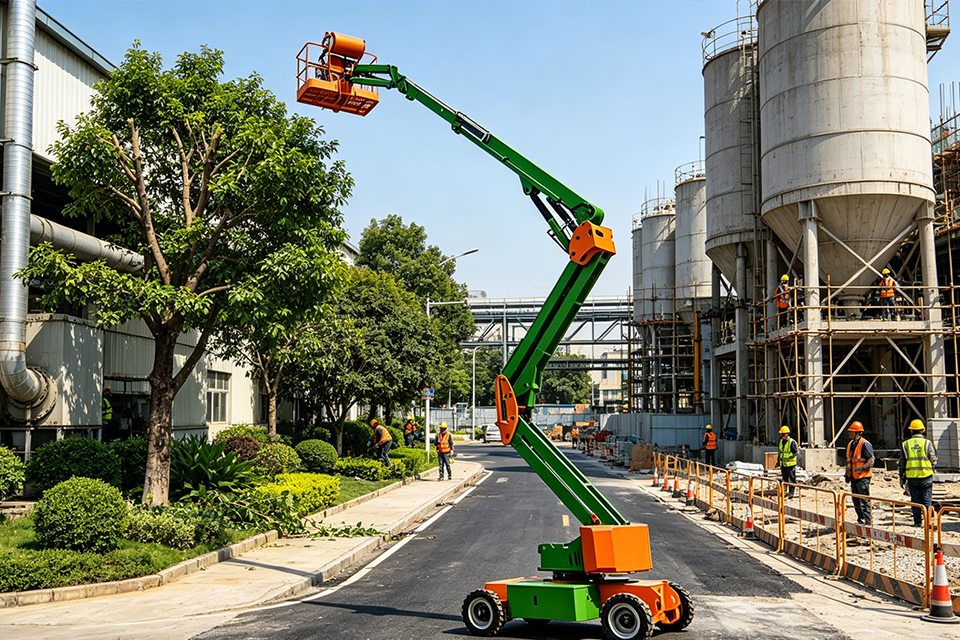
Functional safety certification (SIL 2/3 per IEC 61508, PL d/e per ISO 13849) requires redundant computing channels with diverse hardware and software architectures. Lockstep processors or dual-channel architectures with comparison monitoring detect computational faults before erroneous control outputs, ensuring fail-safe behavior despite hardware degradation in harsh environments.
Power Supply Conditioning
High-noise environments induce power quality disturbances—voltage sags, harmonics, and transients—that disrupt control electronics. Active power factor correction (PFC) front ends achieve >0.99 power factor while regulating DC bus voltage within ±2% despite 20% input voltage variation. Uninterruptible power supply (UPS) integration with lithium-ion battery backup provides 10-30 minutes graceful shutdown capability during utility failures, preventing uncontrolled platform descent.
Galvanic isolation through DC-DC converters with >100 dB common-mode rejection ratio protects sensitive control circuits from ground loops and conducted EMI, while shielded twisted pair cabling with 360° shield termination eliminates radiated coupling paths.
Experimental Validation and Field Studies
Laboratory Testing Protocols
Controlled laboratory validation employs electrodynamic shakers reproducing recorded industrial vibration spectra and acoustic chambers generating 90-110 dB noise fields. Hardware-in-the-loop (HIL) simulation integrates physical controllers with real-time boom dynamics simulation, enabling safe testing of extreme scenarios—sensor failures, communication dropouts, and maximum credible disturbances.
Performance metrics include positioning accuracy (ISO 18628), stability margins (gain and phase), disturbance rejection bandwidth, and recovery time from transient shocks. Standardized test protocols enable comparative evaluation of control strategies across AWP categories and noise severity levels.
Field Deployment Results
Long-term field studies at construction sites, steel mills, and airport maintenance facilities validate laboratory findings under uncontrolled conditions. Continuous data logging across 10,000+ operating hours documents control system performance across seasonal temperature variations, operator skill levels, and evolving equipment wear states. Results demonstrate adaptive control systems maintaining <50 mm positioning accuracy at 20-meter boom extension under 95 dB ambient noise, compared to 150-300 mm errors for conventional PID implementations experiencing integral windup and gain scheduling failures.
Future Research Directions
Edge Computing and Distributed Control
Migration of adaptive algorithms to edge computing architectures—localized processing at sensor nodes—reduces communication bandwidth requirements and latency. Time-sensitive networking (TSN) standards enable deterministic communication between distributed controllers, supporting modular AWP designs with federated control intelligence.
Quantum Sensing Integration
Emerging quantum inertial sensors offer 10-100× precision improvements over MEMS accelerometers, potentially revolutionizing state estimation in high-vibration environments. Research challenges include cryogenic operating requirements and miniaturization for mobile platform integration.
Digital Twin Synchronization
Real-time digital twins—high-fidelity physics simulations synchronized with physical platforms—enable predictive control previewing disturbance effects before physical manifestation. This feedforward compensation, combined with adaptive feedback, promises order-of-magnitude improvements in noise rejection capability.
Conclusion
Adaptive control technology for aerial work platforms in high-noise environments represents a confluence of advanced signal processing, robust control theory, and artificial intelligence. The integration of multi-modal sensor fusion, real-time adaptive filtering, and learning-based control policies enables reliable operation in acoustic and vibrational conditions that incapacitate conventional control systems.
The economic and safety imperatives driving this research intensify as AWPs expand into increasingly hostile industrial environments. The technical solutions detailed herein—sliding mode control, H-infinity optimization, deep reinforcement learning, and predictive maintenance—collectively constitute a comprehensive methodology for noise-resilient AWP operation. Continued advancement in embedded computing, sensing technology, and machine learning will further enhance these capabilities, ensuring that elevated work platforms maintain performance integrity regardless of environmental acoustic severity.
The transformation from noise-vulnerable to noise-adaptive AWPs exemplifies the broader evolution of industrial automation toward intelligent systems capable of autonomous performance optimization under uncertainty, establishing new benchmarks for reliability and safety in elevated access operations.
Name: selena
Mobile:+86-13176910558
Tel:+86-0535-2090977
Whatsapp:8613181602336
Email:vip@mingyuforklift.com
Add:Xiaqiu Town, Laizhou, Yantai City, Shandong Province, China
