
vip@mingyuforklift.com
+86-0535-2090977

In the logistics and warehousing industry, stackers are essential equipment for material handling, and their stable operation directly affects work efficiency and operational safety. For beginners who have just come into contact with stacker operation and maintenance, mastering scientific daily maintenance and upkeep regulations is not only the key to extending the service life of the equipment but also an important guarantee for avoiding safety accidents and reducing maintenance costs. Many beginners often ignore daily maintenance due to lack of experience, leading to frequent equipment failures such as unsmooth lifting, steering jams, and sudden power failures. This technical article will systematically sort out the daily maintenance and upkeep regulations for stackers, starting from the basic concepts of daily maintenance, and elaborating on pre-operation inspection, in-operation attention points, post-operation finishing, key component maintenance, common mistakes to avoid, and emergency handling methods. It is designed to provide a comprehensive and easy-to-understand guide for beginners, helping them quickly grasp the core points of stacker daily maintenance.
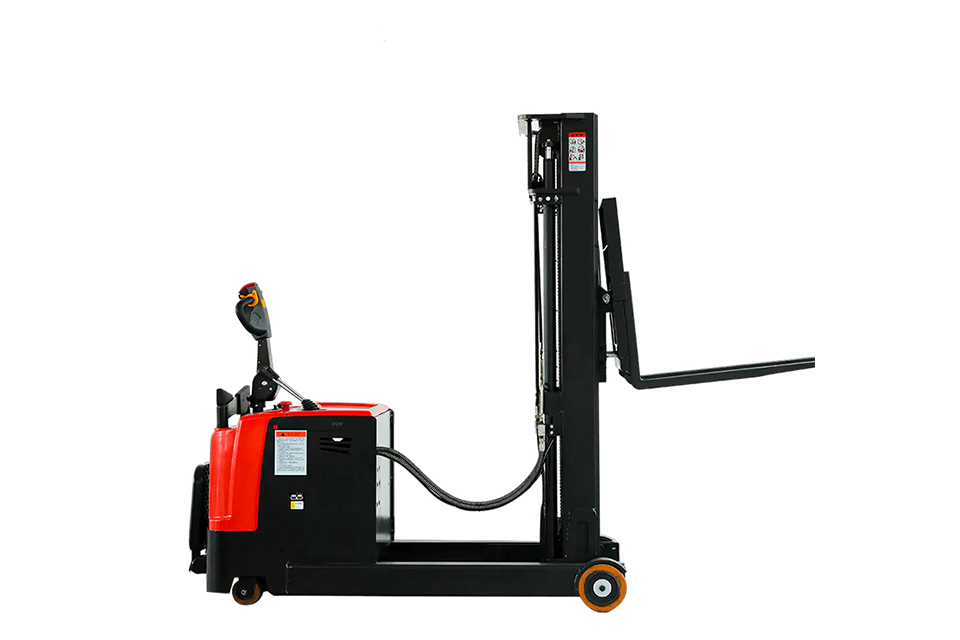
1. The Importance of Stacker Daily Maintenance for Beginners
For beginners, it is crucial to first understand why daily maintenance of stackers is necessary. Unlike professional maintenance personnel, beginners have limited knowledge of stacker structure and performance, and it is easier to overlook potential equipment problems during operation. Daily maintenance, as the most basic and frequent maintenance work, has three core values:
First, it ensures operational safety. Stackers, whether manual or electric, have certain risks during operation. For example, if the hydraulic system leaks, it may cause the fork to drop suddenly; if the brake fails, it may lead to equipment collision. Daily maintenance can promptly detect these potential safety hazards and eliminate them in the bud, protecting the personal safety of operators and the safety of goods. Second, it reduces failure rates and improves work efficiency. Regular daily maintenance can slow down the wear of components, avoid sudden equipment failures, ensure the continuous and stable operation of the stacker, and thus improve the efficiency of material handling. Third, it reduces maintenance costs and extends equipment service life. Minor faults that are not handled in time will gradually develop into major faults, requiring expensive component replacement and overhaul. Daily maintenance only requires simple operations such as inspection, cleaning, and lubrication, which can effectively reduce the frequency of major maintenance and extend the service life of the stacker.
It should be emphasized that daily maintenance is not a "formality" but a mandatory regulation that every stacker operator (including beginners) must abide by. Only by forming a good habit of daily maintenance can we maximize the value of the stacker and ensure the smooth progress of logistics operations.
2. Pre-Operation Inspection: The First Line of Defense for Safe Operation
Pre-operation inspection is the first step of stacker daily maintenance, which needs to be completed by the operator before using the stacker every day. The purpose is to check whether the equipment is in normal working condition and eliminate potential faults before operation. For beginners, pre-operation inspection should follow the principle of "from outside to inside, from simple to complex", and focus on the following aspects:
2.1 Appearance and Basic Structure Inspection
Check the overall appearance of the stacker for obvious damage, such as cracks on the frame, deformation of the fork, or damage to the protective cover. If any abnormality is found, stop using the equipment immediately and report it to the superior.
Check whether the fasteners (bolts, nuts) of each part are loose, especially the connecting parts of the fork, frame, and steering mechanism. Use a wrench to tighten loose fasteners if necessary.
Check the wheels (load wheels and steering wheels) for wear, cracks, or deformation. At the same time, check whether the wheel axles are loose and whether the wheels rotate flexibly. If the wheel wear is severe or the rotation is inflexible, it needs to be replaced or maintained in time.
2.2 Hydraulic System Inspection (Common to Manual and Electric Stackers)
Check the hydraulic oil level. Open the oil tank cover and observe whether the oil level is between the upper and lower scale lines specified on the oil tank. If the oil level is too low, it will cause insufficient lifting force or difficulty in lifting, and it is necessary to add hydraulic oil that meets the specifications in time.
Check for oil leakage in the hydraulic system. Carefully observe the hydraulic pipelines, joints, hydraulic cylinders, and hydraulic pumps for oil stains or oil seepage. If oil leakage is found, first check whether the joint is loose; if it is loose, tighten it; if the seal ring is damaged, report it to the maintenance personnel for replacement.
Test the hydraulic system performance. For manual stackers, operate the lifting handle to check whether the fork can lift and lower smoothly, and whether there is jamming or slow movement. For electric stackers, start the power supply and test the lifting and lowering functions to ensure that the hydraulic system works normally.
2.3 Electrical System Inspection (Electric Stackers Only)
Check the battery status. Observe the battery power indicator to ensure that the battery has sufficient power. At the same time, check the battery terminals for oxidation, corrosion, or loose connections. If there is oxidation, clean it with a wire brush dipped in baking soda solution; if it is loose, tighten it.
Check the wiring harness and connectors. Check whether the wiring harness is worn, aged, or damaged, and whether the connectors are plugged in firmly. If the wiring harness is damaged or the connector is loose, it needs to be repaired or replaced in time.
Check the safety devices. Test the emergency stop switch to ensure that the equipment can stop immediately when the switch is pressed. At the same time, check whether the warning lights, horns, and other safety devices work normally.
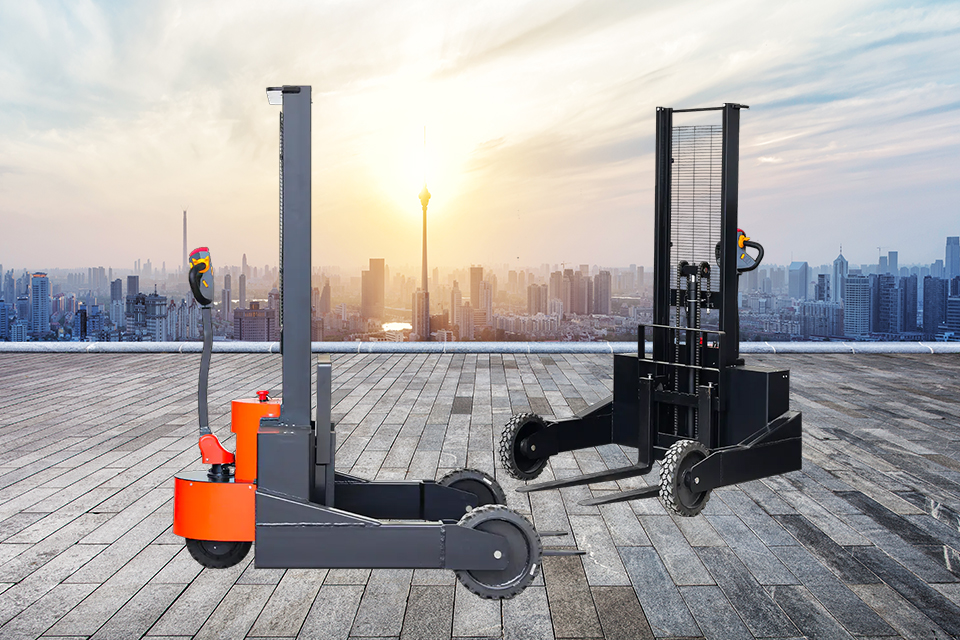
2.4 Brake System Inspection
Check the parking brake. Pull the parking brake lever to see if it can be locked firmly, and whether the release is flexible. For electric stackers, also check the service brake to ensure that the braking effect is good.
Check the brake pads (if applicable) for wear. If the brake pad wear exceeds the limit, it needs to be replaced in time.
3. In-Operation Attention Points: Avoiding Equipment Damage Caused by Improper Operation
In addition to pre-operation inspection, correct operation during use is also an important part of daily maintenance. For beginners, improper operation is one of the main causes of stacker damage. Therefore, during the operation of the stacker, the following points must be noted:
3.1 Load-Bearing Specifications
Strictly abide by the rated load of the stacker, and never overload. Overloading will cause excessive pressure on the hydraulic system, frame, and wheels, leading to component damage or even equipment deformation.
Ensure that the goods are placed stably and evenly on the fork. The center of gravity of the goods should be as close to the fork root as possible to avoid the goods tilting or falling during lifting and moving, which will affect the stability of the equipment.
3.2 Operation Speed and Route
Control the operation speed. Especially when turning, starting, or stopping, the speed should be slow to avoid inertial force causing damage to the goods or the equipment itself. For electric stackers, do not switch between forward and reverse gears suddenly, which will increase the load on the motor and controller.
Choose a flat and smooth operation route. Avoid operating on uneven ground, potholes, or slippery surfaces, which will cause excessive vibration of the equipment and accelerate the wear of components such as wheels and bearings.
3.3 Hydraulic and Electrical System Usage
When using the hydraulic system, avoid frequent and rapid operation of the lifting and lowering lever, which will cause excessive pressure fluctuations in the hydraulic system and affect the service life of the hydraulic pump and valves.
For electric stackers, avoid over-discharging the battery. When the battery power indicator shows low power, stop using it in time and charge it. At the same time, do not charge the battery in a high-temperature or low-temperature environment, which will affect the battery life.
3.4 Real-Time Observation During Operation
During the operation, always pay attention to the working status of the equipment. If abnormal phenomena such as abnormal noise, vibration, or odor are found, stop the equipment immediately, turn off the power (for electric stackers), and check the cause. Do not continue to operate with faults to avoid expanding the damage.
4. Post-Operation Finishing: Laying the Foundation for the Next Use
Post-operation finishing is the last step of stacker daily maintenance, which needs to be completed by the operator after using the stacker every day. The main purpose is to clean the equipment, restore it to the standby state, and record the operation and maintenance situation. Specific work contents include:
4.1 Equipment Cleaning
Use a clean cloth to wipe the surface of the stacker, removing dust, debris, and oil stains. Pay special attention to cleaning the fork, wheels, and hydraulic system components to avoid the accumulation of debris affecting the normal operation of the equipment.
For the battery of electric stackers, clean the surface of the battery to avoid the accumulation of dust and debris causing short circuits. At the same time, check whether the battery has electrolyte leakage.
4.2 Equipment Reset
Lower the fork to the lowest position to reduce the load on the hydraulic system and the fork.
Pull the parking brake firmly to ensure that the equipment is locked stably.
For electric stackers, turn off the main power switch and unplug the charging plug (if not charging). If the battery power is low, connect the charger for charging in time, and ensure that the charging environment is safe and ventilated.
4.3 Maintenance Record
Fill in the stacker operation and maintenance record form, recording the date, operation time, pre-operation inspection results, in-operation status, post-operation finishing situation, and any abnormal phenomena found. This is not only convenient for the follow-up tracking and maintenance of the equipment but also provides a basis for the analysis of equipment faults.
5. Key Component Daily Maintenance: Focus on Core Parts
In addition to the above three links, beginners also need to focus on the daily maintenance of key components of the stacker. These components are the core of the equipment's operation, and their performance directly determines the overall working status of the stacker. The following are the daily maintenance points for key components:
5.1 Hydraulic System Components
Hydraulic oil: Check the oil level and oil quality every day. If the oil is discolored, turbid, or contains impurities, it needs to be replaced in time. At the same time, ensure that the oil tank cover is sealed tightly to avoid dust and debris entering the oil tank.
Hydraulic pump and valves: During pre-operation and post-operation inspections, check for abnormal noise or vibration of the hydraulic pump. For the one-way valve, relief valve, and other valves, ensure that their operation is flexible and there is no jamming.
5.2 Electrical System Components (Electric Stackers Only)
Battery: In addition to checking the power and terminals, avoid short-circuiting the battery. Do not place metal objects on the battery to prevent sparks caused by short-circuiting. For lead-acid batteries, check the electrolyte level regularly (once a week) and add distilled water if necessary.
Motor and controller: Keep the motor and controller clean and dry. Avoid water or oil stains entering the motor and controller, which will cause short circuits or component damage. During operation, pay attention to whether the motor has abnormal noise or overheating.
5.3 Mechanical Components
Wheels and bearings: Clean the wheels every day to remove debris stuck on the wheels. Check the rotation flexibility of the bearings. If the rotation is inflexible, apply an appropriate amount of lubricating grease to the bearings (once a week).
Fork and frame: Check for cracks or deformation every day. For the fork, ensure that the fork surface is flat and there is no wear or deformation. For the frame, check the welding seams for cracks and perform anti-rust treatment on the corroded parts (once a month).
Chains (if applicable): Check the tension and wear of the chain every day. If the chain is too loose, adjust the tensioning device; if the chain is severely worn, replace it in time. Apply chain oil to the chain regularly (once a week) to reduce friction.
6. Common Mistakes in Stacker Daily Maintenance for Beginners to Avoid
Due to lack of experience, beginners often make some mistakes in stacker daily maintenance, which not only fails to achieve the purpose of maintenance but also may cause damage to the equipment. The following are common mistakes that need to be avoided:
6.1 Ignoring Pre-Operation Inspection
Some beginners are eager to start work and skip pre-operation inspection, thinking that "the equipment was normal yesterday, and it will be normal today". This is a very dangerous behavior. Even if the equipment was normal the previous day, it may have problems such as loose fasteners or oil leakage due to vibration during operation. Ignoring pre-operation inspection may lead to equipment failure during operation and cause safety accidents.
6.2 Using Inferior Maintenance Materials
In order to save costs, some enterprises or individuals use inferior hydraulic oil, lubricating grease, or spare parts for maintenance. These inferior materials have poor performance and will accelerate the wear of components, reduce the service life of the equipment, and even cause faults such as hydraulic system blockage and electrical system short circuits. Beginners must use maintenance materials and spare parts that meet the manufacturer's specifications.
6.3 Improper Lubrication
Lubrication is an important part of daily maintenance, but some beginners either forget to lubricate or apply too much lubricant. Too little lubrication will cause increased friction between components and accelerate wear; too much lubrication will cause dust and debris to adhere to the lubricated parts, forming dirt and affecting the normal operation of the components. Therefore, it is necessary to apply an appropriate amount of lubricant according to the manufacturer's recommendations.
6.4 Blindly Disassembling Components
When finding equipment abnormalities, some beginners try to disassemble the components without understanding the structure and working principle of the stacker. This may cause secondary damage to the equipment and even affect the safety performance of the equipment. When encountering equipment faults that cannot be solved, beginners should stop using the equipment immediately and report it to professional maintenance personnel.
6.5 Neglecting Post-Operation Finishing and Record-Keeping
Some beginners think that "as long as the work is done, it's okay", and neglect post-operation finishing and record-keeping. The accumulation of dust and debris will affect the heat dissipation and operation of the equipment; the lack of maintenance records makes it impossible to track the equipment's working status and fault history, which is not conducive to the long-term maintenance of the equipment.
7. Emergency Handling Methods for Common Faults During Daily Use
Even with strict daily maintenance, stackers may still have some minor faults during use. For beginners, it is necessary to master the emergency handling methods for common faults to avoid expanding the damage. The following are common faults and their emergency handling methods:
7.1 Fork Cannot Lift or Lifts Slowly
Possible causes: Low hydraulic oil level, clogged oil filter, loose hydraulic joints, or faulty hydraulic pump.
Emergency handling: First, stop the equipment and check the hydraulic oil level. If the oil level is too low, add hydraulic oil; if the oil level is normal, check for loose hydraulic joints and tighten them. If the problem is still not solved, it may be a clogged oil filter or a faulty hydraulic pump, and professional maintenance personnel should be notified.
7.2 Electric Stacker Cannot Start
Possible causes: Low battery power, loose battery terminals, pressed emergency stop switch, or faulty power switch.
Emergency handling: Check the battery power indicator. If the power is low, charge the battery; check the battery terminals for looseness or oxidation and handle them accordingly; check whether the emergency stop switch is pressed and reset it; check whether the power switch is faulty and replace it if necessary.
7.3 Abnormal Noise During Equipment Operation
Possible causes: Lack of lubrication of components, loose fasteners, wear of wheels or bearings, or faulty motor.
Emergency handling: Stop the equipment immediately and check for loose fasteners. If loose, tighten them; check whether the lubricated parts are short of lubricant and add an appropriate amount of lubricant; check the wheels and bearings for wear. If the problem is still not solved, it may be a motor fault, and professional maintenance personnel should be notified.
7.4 Hydraulic System Oil Leakage
Possible causes: Loose hydraulic joints or damaged seal rings.
Emergency handling: Stop the equipment immediately and turn off the power (for electric stackers). Check the leaking part. If the joint is loose, tighten it with a wrench; if the seal ring is damaged, replace the seal ring (if you have the ability and relevant spare parts) or notify professional maintenance personnel. Before the fault is solved, do not use the equipment.
8. Conclusion
Stacker daily maintenance and upkeep regulations are the basic guarantee for the safe and efficient operation of stackers, and they are also the essential knowledge that every beginner must master. From pre-operation inspection to in-operation attention points, and then to post-operation finishing, every link is crucial. By adhering to scientific daily maintenance methods, focusing on the maintenance of key components, avoiding common mistakes, and mastering emergency handling methods for common faults, beginners can gradually improve their ability to operate and maintain stackers, ensure the stable operation of equipment, reduce failure rates, and extend the service life of equipment.
It should be emphasized that daily maintenance is a long-term and persistent work. Beginners should form a good habit of daily maintenance, strictly abide by relevant regulations, and not take chances. At the same time, they should continuously learn professional knowledge about stacker maintenance, accumulate practical experience, and gradually grow into professional stacker operators and maintenance personnel. Only in this way can we better play the role of stackers in logistics and warehousing operations and contribute to the improvement of the overall efficiency of the enterprise.
Name: selena
Mobile:+86-13176910558
Tel:+86-0535-2090977
Whatsapp:8613181602336
Email:vip@mingyuforklift.com
Add:Xiaqiu Town, Laizhou, Yantai City, Shandong Province, China