
vip@mingyuforklift.com
+86-0535-2090977

Introduction
The proliferation of all-wheel-drive (AWD) aerial work platforms represents a significant evolution in mobile elevating work platform (MEWP) technology, addressing the growing demand for equipment capable of operating in challenging terrain conditions where traditional two-wheel-drive systems face severe limitations. Construction sites, industrial facilities, and maintenance applications increasingly require AWPs that can traverse muddy ground, loose gravel, snow-covered surfaces, and significant gradients while maintaining precise positioning stability and operational safety. The dynamic behavior of these sophisticated machines, characterized by complex interactions between multiple drive axles, articulated steering systems, and variable payload configurations, presents formidable challenges for control system designers seeking to optimize traction, minimize energy consumption, and ensure safe operation across diverse environmental conditions.
The dynamic modeling of AWD aerial work platforms requires sophisticated multibody mechanics formulations that capture the coupled behavior of chassis suspension, drive train dynamics, tire-ground interaction, and the elevated superstructure comprising boom mechanisms and work platforms. Unlike conventional vehicles, AWPs exhibit significant variations in center of mass position as booms extend, retract, and articulate, creating dynamic coupling between drive performance and elevated work operations. Furthermore, the requirement for precise positioning at elevation demands drive control strategies that eliminate unwanted chassis motion while providing responsive maneuverability during transit. These competing requirements necessitate control architectures that can adapt to rapidly changing operational modes and environmental conditions.
Anti-interference control strategies have emerged as critical enabling technologies for AWD AWPs, addressing the fundamental challenge of maintaining stability and trajectory tracking when external disturbances act on the system. These disturbances include terrain irregularities that induce wheel vertical motion and chassis pitch, wind gusts that create lateral forces on elevated platforms, and sudden load changes during material handling operations. Traditional control approaches that treat drive systems as independent entities prove inadequate for AWD configurations, where wheel slip at one axle can propagate through the drive train and compromise overall vehicle stability. Advanced anti-interference strategies employ coordinated control of multiple drive motors, differential braking, and active suspension interventions to reject disturbances while preserving operator command response.
This article presents a comprehensive technical analysis of dynamic modeling methodologies and anti-interference control strategies for AWD aerial work platforms. We examine the theoretical foundations of multibody dynamic modeling, explore tire-ground interaction physics under varying conditions, and develop control architectures that integrate drive control with stability management. The analysis encompasses both theoretical formulations and practical implementation considerations, providing a foundation for the design of next-generation AWD platforms that achieve superior performance in demanding operational environments.
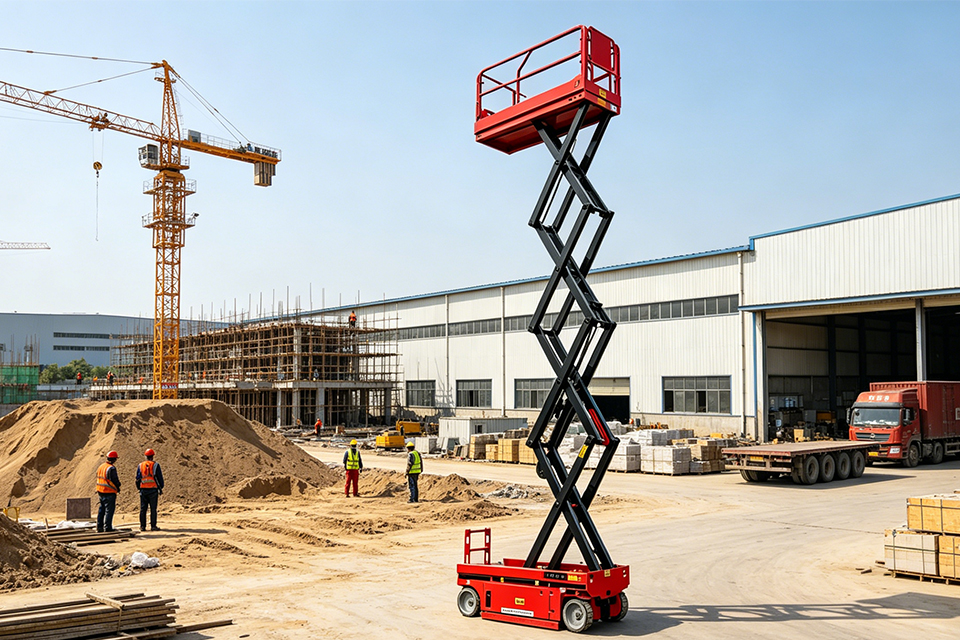
Multibody Dynamic Modeling Framework
The dynamic modeling of AWD aerial work platforms begins with the establishment of comprehensive multibody system representations that capture the essential kinematic and dynamic characteristics governing vehicle behavior. The chassis constitutes the primary reference body, with coordinate systems defined according to ISO 8855 conventions where the x-axis points forward, y-axis to the left, and z-axis upward. Drive axles, steering linkages, and suspension components attach to the chassis through kinematic joints that constrain relative motion while transmitting forces and moments. The elevated work platform, comprising boom sections, platform carrier, and any attached loads, connects to the chassis through a turntable bearing that enables continuous rotation in the horizontal plane.
The configuration space of AWD AWPs spans numerous degrees of freedom that must be carefully managed in model development. Chassis motion incorporates six degrees of freedom—three translational and three rotational—subject to constraints imposed by tire-ground contact. Drive axles typically include suspension travel, steering rotation, and wheel spin degrees of freedom, with AWD configurations featuring independent control of multiple drive motors. The boom system adds additional degrees of freedom corresponding to lift, extension, and articulation angles, while the platform carrier may include leveling and rotation capabilities. Comprehensive models may incorporate thirty or more degrees of freedom, requiring systematic reduction techniques to achieve computational efficiency suitable for real-time control implementation.
Tire-ground interaction modeling represents a critical aspect of AWD platform dynamics, as traction forces fundamentally limit achievable performance and stability. The Pacejka magic formula and its extensions provide phenomenological descriptions of tire force generation as functions of slip ratios, slip angles, normal loads, and surface conditions. For AWD applications, the combined slip formulation is essential, as drive and steering inputs simultaneously generate longitudinal and lateral force components that interact nonlinearly. Terrain characterization parameters—including friction coefficients, rolling resistance, and stiffness characteristics—vary significantly across operational environments, requiring adaptive model structures or parameter estimation techniques that identify surface conditions in real-time.
The equations of motion for AWD AWPs derive from Lagrangian mechanics or Newton-Euler formulations, yielding coupled differential equations that describe system dynamics under applied forces. For control system design, these nonlinear equations are typically linearized about operating points corresponding to specific platform configurations and velocity conditions, producing state-space representations suitable for controller synthesis. The linearized models capture essential dynamic modes including chassis heave and pitch, drive train oscillations, and boom flexibility, while higher-frequency dynamics associated with tire carcass deformation and hydraulic compliance may be treated as unmodeled dynamics addressed through robust control techniques.
Model validation against experimental data ensures that theoretical representations accurately capture physical behavior across operational envelopes. Instrumented prototypes equipped with accelerometers, gyroscopes, wheel speed sensors, and strain gauges provide measurement data for parameter identification and model verification. Dynamic maneuvers including step steer inputs, acceleration and braking events, and boom motion while stationary characterize system response and validate model predictions. The validation process iteratively refines model parameters and structure until simulation results achieve acceptable correspondence with measured behavior, establishing confidence in model-based control design.
Drive System Dynamics and Torque Distribution
The drive system architecture of AWD aerial work platforms fundamentally influences dynamic behavior and control system requirements. Electric drive configurations, increasingly prevalent in modern AWPs, employ independent motors at each driven wheel or axle, enabling precise torque control and rapid response to traction demands. Hydraulic drive systems, while less efficient, provide high power density and robustness in harsh environments, with variable displacement pumps and motors enabling continuous adjustment of drive torque. Hybrid configurations combine electric and hydraulic technologies, optimizing efficiency and performance across operational modes.
Torque distribution strategies determine how total drive demand is allocated among available drive axles, significantly influencing traction performance, energy consumption, and tire wear. Open-loop distribution based on static weight distribution provides baseline performance, allocating torque in proportion to normal loads calculated from platform geometry and payload mass. However, this approach fails to exploit dynamic weight transfer during acceleration or deceleration, and cannot respond to variations in surface conditions across the vehicle footprint. Advanced strategies employ feedback from wheel speed sensors to detect incipient slip, redistributing torque to axles with available traction margin and preventing wheel spin that compromises stability and efficiency.
The dynamics of torque transfer between axles in mechanical AWD systems introduce additional complexity that control strategies must address. Differential mechanisms allow speed variation between axles during turning but passively distribute torque according to internal friction characteristics. Limited-slip differentials and torque-vectoring differentials provide active intervention capabilities, but with bandwidth constraints that may limit disturbance rejection performance. Fully active torque distribution systems, utilizing independent motor control or clutch packs, achieve superior performance by enabling arbitrary torque allocation within powertrain limits, though at increased cost and complexity.
Longitudinal dynamics modeling captures the relationship between drive torque, vehicle acceleration, and resistive forces including aerodynamic drag, rolling resistance, and grade effects. For AWD AWPs operating at low speeds typical of construction sites, aerodynamic forces are negligible, but rolling resistance varies significantly with surface conditions and tire inflation pressure. Grade resistance becomes substantial on steep slopes, potentially consuming majority of available traction capacity and limiting acceleration capability. The coupling between longitudinal acceleration and chassis pitch affects load distribution across axles, creating dynamic interactions that torque distribution strategies must anticipate and compensate.
Lateral dynamics govern vehicle response to steering inputs and external side forces, with AWD influence manifesting primarily through torque-induced yaw moments. The distribution of drive torque between left and right sides of the vehicle creates direct yaw moment that can assist or oppose steering commands, enabling active yaw control that enhances maneuverability and stability. However, unintended yaw moments from asymmetric traction conditions or differential locking can degrade handling precision, requiring careful calibration of torque distribution algorithms. The interaction between lateral and longitudinal dynamics becomes particularly complex during combined steering and acceleration maneuvers, where tire force saturation at individual wheels can induce sudden changes in vehicle behavior.
Anti-Interference Control Architecture
Anti-interference control for AWD aerial work platforms addresses the fundamental challenge of maintaining desired motion trajectories when external disturbances act on the system. These disturbances arise from terrain unevenness, wind loading, payload variations, and interaction with the work environment, creating forces and moments that deviate the vehicle from operator-commanded paths. Effective anti-interference strategies require sensing of disturbance effects, estimation of disturbance characteristics, and coordinated control responses that reject disturbances while preserving responsive control authority.
The hierarchical control architecture commonly employed separates high-level motion planning from low-level torque execution, with intermediate layers handling disturbance estimation and compensation. The supervisory layer interprets operator commands and platform configuration data to generate desired chassis motion trajectories, considering stability constraints and obstacle avoidance. The disturbance estimation layer processes sensor data to identify external force and moment disturbances, utilizing observers or Kalman filters that compare expected and actual motion responses. The execution layer implements torque commands that achieve desired motion while compensating for estimated disturbances, subject to actuator constraints and safety limits.
Active disturbance rejection control (ADRC) has emerged as a powerful methodology for AWP applications, treating disturbances as extended state variables to be estimated and compensated in real-time. The extended state observer reconstructs disturbance effects from measurable outputs such as chassis acceleration and wheel speeds, enabling feedforward compensation that reduces the burden on feedback control loops. ADRC implementations achieve robust performance without precise system models, accommodating parameter variations associated with changing platform configurations and surface conditions. The tuning of observer bandwidths involves trade-offs between disturbance estimation speed and noise sensitivity, with typical implementations targeting disturbance rejection within hundreds of milliseconds.
Sliding mode control provides alternative robustness properties, utilizing discontinuous control actions that constrain system trajectories to designed sliding surfaces despite disturbances and uncertainties. The chattering phenomenon associated with ideal sliding mode implementations is mitigated through boundary layer techniques or higher-order sliding mode formulations that achieve continuous control signals. For AWD torque distribution, sliding mode approaches ensure that wheel slip ratios remain within desired bounds despite rapid variations in surface friction, maintaining traction without excessive tire wear or energy consumption.
Model predictive control (MPC) offers optimization-based disturbance rejection that explicitly considers system constraints and future trajectory predictions. At each control interval, MPC solves an optimization problem that determines control actions minimizing deviation from desired trajectories over a prediction horizon, subject to constraints on actuator limits, stability margins, and collision avoidance. The receding horizon implementation applies only the first control action, then repeats the optimization with updated state estimates. While computationally demanding, MPC formulations for AWD AWPs leverage problem structure and efficient algorithms to achieve real-time execution, with prediction horizons of several seconds enabling anticipation of terrain features and proactive disturbance compensation.
Terrain Adaptation and Traction Optimization
The operational effectiveness of AWD aerial work platforms depends critically on adaptation to varying terrain conditions that affect traction availability and ride quality. Terrain characterization systems identify surface types and conditions through analysis of wheel slip patterns, vibration signatures, and visual or spectral sensing, enabling control parameter adjustment that optimizes performance for specific environments. Machine learning classifiers trained on extensive terrain databases distinguish between surfaces such as firm soil, loose gravel, mud, snow, and ice, triggering appropriate control mode transitions that modify torque distribution, slip thresholds, and stability control intervention levels.
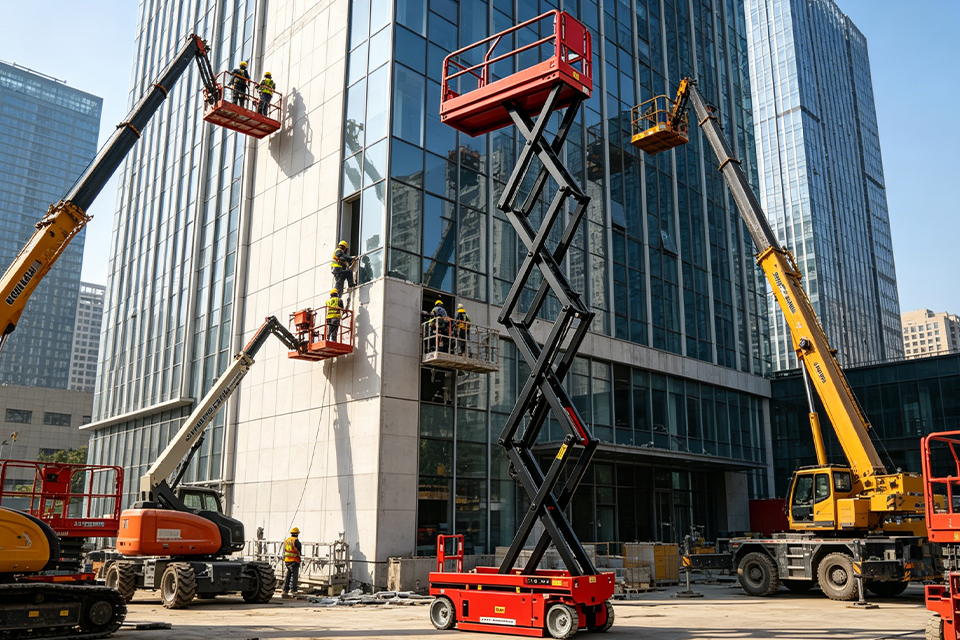
Traction control systems prevent wheel spin that wastes energy and degrades surface conditions, utilizing individual wheel speed feedback to detect slip and reduce drive torque at affected wheels. Contraction control implementations modulate motor current or hydraulic pressure to maintain slip ratios near values that maximize traction force, typically 10-20% for firm surfaces and lower values for loose terrain where excessive slip causes digging and traction loss. The integration of traction control with torque distribution ensures that available traction is fully utilized without exceeding limits that would induce instability.
Active suspension systems enhance terrain traversal capabilities by maintaining chassis stability and wheel-ground contact across uneven surfaces. Hydraulic or electromechanical actuators at suspension corners generate forces that counteract terrain-induced disturbances, reducing chassis pitch and roll that affect boom positioning precision and operator comfort. Skyhook control strategies specify desired chassis motion characteristics—typically low vertical acceleration and minimal angular rates—with suspension forces calculated to achieve these targets despite terrain inputs. The coordination of active suspension with drive control prevents dynamic weight transfer from compromising traction during acceleration or braking on uneven grades.
Gradient traversal presents particular challenges for AWD AWPs, as grade steepness affects both traction requirements and stability margins. Pitch angle estimation from inclinometers or accelerometer data enables gradient-adaptive control that modifies maximum acceleration limits, boom operating envelopes, and parking brake engagement thresholds. For extreme gradients, winch assistance or outrigger deployment may be required, with control systems managing transitions between mobile and stabilized configurations. The prevention of rollback on steep upgrades, particularly during stop-and-go operations, requires hill-hold functionality that maintains brake pressure or drive torque until sufficient forward propulsion is established.
Integrated Stability Management
The integration of drive control with overall platform stability management creates unified control architectures that address the coupled dynamics of AWD mobility and elevated work operations. Stability management systems continuously assess the vehicle's resistance to tip-over, considering factors including chassis inclination, boom extension, platform load, and dynamic effects from motion or wind. When stability margins approach safety thresholds, integrated systems can restrict drive commands that would further degrade stability, such as acceleration on slopes or turning with extended booms, while maintaining sufficient control authority for safety-critical maneuvers.
Load moment indicators (LMIs) provide the foundation for stability assessment, calculating overturning moments from platform load and geometry and comparing against stabilizing moments from vehicle weight and outrigger support. Advanced implementations incorporate dynamic augmentation that accounts for acceleration-induced load swing and wind effects, providing real-time stability margin estimates that drive control interventions. The integration of LMI data with drive control enables predictive stability management, where approaching stability limits trigger graduated responses from warning alerts through drive restriction to automatic platform lowering.
Outrigger systems extend the stability envelope for stationary work, creating support polygons that significantly increase resistance to overturning. Control integration ensures proper outrigger deployment and ground contact before elevated operation is permitted, with pressure sensors confirming adequate support at each pad. Automatic leveling systems adjust outrigger extension to achieve chassis horizontality on uneven terrain, with drive control disabled during elevated work to prevent unintended motion. The transition between mobile and deployed configurations requires coordinated sequencing of boom motion, outrigger operation, and drive system engagement that integrated control architectures manage seamlessly.
Emergency safety systems provide fail-safe responses to critical fault conditions, including loss of power, hydraulic failure, or control system malfunction. Accumulator systems maintain hydraulic pressure for essential functions during power loss, enabling controlled platform descent and brake engagement. Mechanical locks and brakes engage automatically when control system faults are detected, preventing uncommanded motion while preserving operator safety. The design of emergency systems considers failure modes of the primary control architecture, ensuring that no single point of failure compromises safety-critical functions.
Implementation Considerations and Validation
The practical implementation of advanced dynamic modeling and anti-interference control for AWD AWPs requires careful attention to computational resources, sensor requirements, and validation methodologies. Real-time execution of multibody dynamics and optimization-based control algorithms demands high-performance computing platforms, with modern implementations utilizing multicore processors, graphics processing units, or field-programmable gate arrays to achieve required computational throughput. Software architectures partition functions across processing elements according to latency requirements, with safety-critical control loops executing at kilohertz rates on dedicated processors while optimization and estimation tasks run asynchronously on general-purpose cores.
Sensor systems must provide accurate, reliable measurement of states required for control implementation, with redundancy and diagnostic coverage satisfying functional safety standards. Inertial measurement units combining accelerometers and gyroscopes provide chassis motion data, while wheel speed sensors, motor encoders, and hydraulic pressure transducers capture drive system states. GPS and inertial navigation systems enable position estimation for autonomous or semi-autonomous operation, with accuracy enhanced through differential corrections or sensor fusion with visual odometry. The calibration and alignment of sensor systems significantly affect control performance, requiring procedures that verify measurement accuracy across operational temperature ranges and vibration environments.
Hardware-in-the-loop (HIL) simulation provides essential validation capability, integrating actual control hardware with real-time simulation of vehicle dynamics and environmental interactions. HIL testing enables exhaustive evaluation of control algorithms across operational scenarios that would be impractical or dangerous to execute with physical prototypes, including extreme disturbances, component failures, and edge-case combinations of platform configuration and terrain conditions. The fidelity of HIL simulations must be sufficient to capture relevant dynamic phenomena, requiring validated multibody models and accurate representations of actuator dynamics and sensor characteristics.
Field testing with instrumented prototypes ultimately validates control system performance in actual operational environments, characterizing behavior across diverse terrain conditions and work scenarios. Data logging during field operations provides insight into control system behavior and identifies opportunities for algorithm refinement, while also documenting safety performance for regulatory certification. The iterative process of simulation, HIL testing, and field validation ensures that deployed control systems achieve designed performance while maintaining robustness to real-world variations and uncertainties.
Conclusion
The dynamic modeling and anti-interference control of all-wheel-drive aerial work platforms represent sophisticated engineering disciplines that integrate multibody mechanics, tire-ground interaction physics, and advanced control theory to achieve superior performance in challenging operational environments. The complex interactions between drive system dynamics, chassis motion, and elevated work operations demand comprehensive modeling approaches that capture essential physics while remaining tractable for real-time control implementation. Anti-interference control strategies that reject external disturbances while preserving responsive operator control enable AWD AWPs to operate safely and productively across terrain conditions that would defeat conventional drive systems.
The continued evolution of electric drive technology, computational capability, and sensing systems promises further advancement in AWD platform performance and safety. Machine learning techniques for terrain characterization and adaptive control offer potential to optimize performance without extensive manual calibration, while vehicle-to-vehicle and vehicle-to-infrastructure communication enables coordinated operation that enhances site-wide productivity and safety. The integration of autonomous navigation capabilities will expand AWP applications to environments where operator presence is impractical or hazardous, requiring control systems that maintain stability and precision without continuous human oversight.
As construction and industrial applications demand increasingly capable elevated work platforms, the engineering of dynamic modeling and anti-interference control will remain central to meeting performance requirements while ensuring operator safety. The methodologies and strategies presented in this analysis provide a foundation for continued innovation in this critical technology domain, supporting the development of next-generation AWD AWPs that expand the boundaries of where elevated work can be performed safely and efficiently.
Name: selena
Mobile:+86-13176910558
Tel:+86-0535-2090977
Whatsapp:8613181602336
Email:vip@mingyuforklift.com
Add:Xiaqiu Town, Laizhou, Yantai City, Shandong Province, China
