
vip@mingyuforklift.com
+86-0535-2090977

Introduction
Forklifts are the backbone of modern material handling operations, serving warehouses, manufacturing facilities, ports, and construction sites worldwide. For fleet managers, procurement officers, and operations supervisors, one of the most critical yet frequently misunderstood questions is: How much fuel does a forklift consume in one hour of use? The answer is far from straightforward. Fuel consumption varies dramatically depending on the power source, load capacity, operating environment, and operator behavior. This article provides a detailed technical analysis of hourly fuel consumption across diesel, LPG (liquefied petroleum gas), gasoline, and electric forklift systems, drawing on industry data and manufacturer specifications to give you actionable benchmarks for cost estimation and fleet optimization.
Understanding the Forklift Fuel Landscape
Before diving into specific consumption figures, it is essential to understand the four primary power categories that dominate the forklift market:
Diesel Forklifts: Powered by compression-ignition diesel engines, these are the workhorses of outdoor and heavy-duty applications.
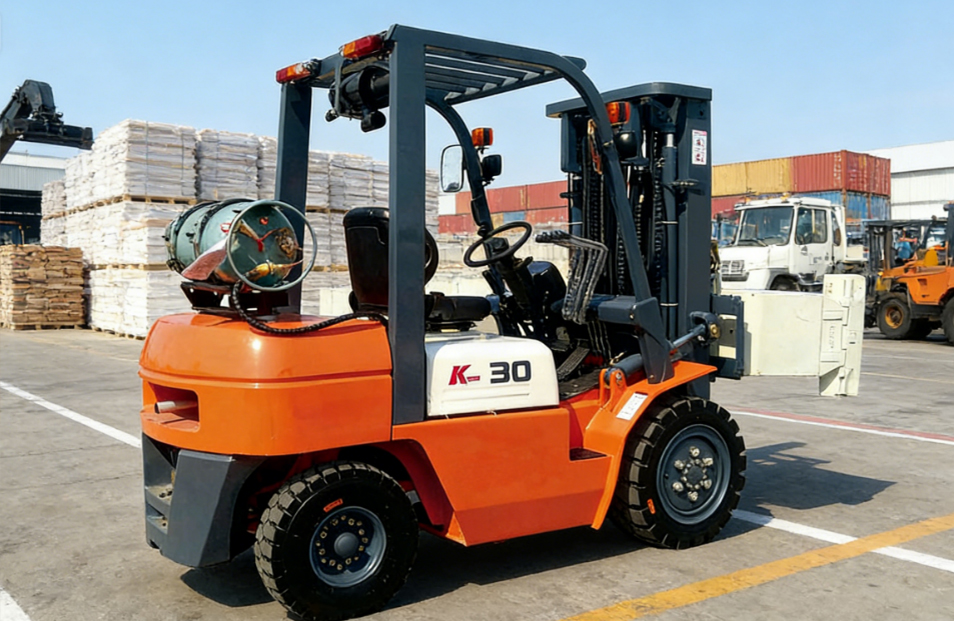
LPG (Propane) Forklifts: Use liquefied petroleum gas stored in exchangeable cylinders, offering a balance between indoor usability and IC engine power.
Gasoline Forklifts: Less common today but still used in specific light-duty outdoor applications.
Electric Forklifts: Battery-powered units that have seen explosive growth due to lower operating costs and zero direct emissions.
Each power source has distinct fuel consumption characteristics, and direct comparisons require careful attention to energy equivalence and measurement units.
Diesel Forklift Fuel Consumption
Typical Consumption Rates
Diesel forklifts remain the dominant choice for outdoor operations, rough terrain, and heavy-load applications. Their fuel consumption is generally the highest among internal combustion options, but this is offset by superior torque and durability.
According to industry data and manufacturer specifications, diesel forklift consumption follows a clear capacity-based progression:
Light-duty forklifts (under 2.5 tonnes): 2–3 litres per hour
Mid-range forklifts (3–5 tonnes): 3–4 litres per hour
Heavy-duty forklifts (6+ tonnes): 4–5+ litres per hour
More granular data from equipment suppliers indicates that a standard 3-ton diesel forklift typically consumes between 2.5 and 3.5 litres per hour under standard working conditions, while a 5-ton model can use 4.5 to 6.0 litres per hour . For very heavy-duty applications, consumption can exceed 6.5–8.0 litres per hour on 7-ton models .
Hyster, a globally recognized manufacturer, provides specific data for their XT series: these versatile units consume between 2.7 and 3.6 litres per hour depending on lift capacity and engine type . However, Hyster notes that these figures are derived from standardized test courses, and real-world variations of plus or minus at least 20% should be expected depending on duty cycle and operator habits .
In imperial units, most diesel forklifts fall within the 1 to 3 gallons per hour range, with compact units at the lower end (0.8–1.5 gallons/hour) and heavy-duty models consuming 2.5–4+ gallons per hour .
Factors Affecting Diesel Consumption
Several variables can significantly alter these baseline figures:
Load Weight: Operating at maximum rated capacity can increase fuel usage by 20–40% compared to handling lighter loads. The engine must work harder to generate the hydraulic pressure and traction force needed for heavy lifts .
Terrain and Environment: Rough terrain, inclines, and soft ground can increase consumption by 30–50% compared to smooth, level warehouse floors. Cold weather also impacts efficiency due to increased fuel density and higher energy demands for combustion .
Maintenance Status: Clogged air filters can increase consumption by 10–15%, while poorly maintained hydraulic systems force the engine to work harder during lifting operations. Underinflated tires create additional rolling resistance, further reducing efficiency .
Idle Time: Extended idling is a major source of fuel waste. A diesel engine burning fuel while stationary contributes nothing to productivity but adds directly to hourly consumption figures.
LPG (Propane) Forklift Fuel Consumption
Typical Consumption Rates
LPG forklifts are widely favored for indoor operations where diesel emissions are unacceptable, yet electric infrastructure is insufficient. They offer quick refueling via cylinder exchange and maintain consistent power output until the tank is nearly empty.
Consumption data for LPG forklifts is typically expressed in kilograms per hour or litres equivalent:
1.5–2.5 ton forklifts: 1.5–2.5 kg per hour
3–5 ton forklifts (most common): 2–4 kg per hour, or approximately 3.5–5.5 litres equivalent per hour
Heavy-duty industrial forklifts: 4–6+ kg per hour
In US customary units, this translates to roughly 0.7–1 gallon of LPG per hour for average operations, or approximately 2–3 kg per hour as a broad benchmark .
A study by the Electric Power Research Institute (EPRI) comparing 5,000 lb capacity forklifts found that propane-powered units consumed fuel at a rate equivalent to 1.38 gallons per hour when normalized for energy delivery to the wheels . Southwest Research Institute (SWRI) testing measured propane consumption averaging 0.19 gallons per kWh delivered to the wheels, though this figure varies with duty cycle intensity .
LPG vs. Diesel Comparison
When comparing LPG to diesel directly, LPG forklifts generally offer cleaner combustion with lower particulate matter and nitrogen oxide emissions, making them suitable for indoor use. However, diesel engines typically have higher thermal efficiency, meaning diesel forklifts may consume less fuel in terms of energy content per unit of work done . The trade-off is that LPG engines run smoother with less carbon buildup, potentially reducing long-term maintenance costs despite slightly higher fuel consumption rates .
Gasoline Forklift Fuel Consumption
Gasoline-powered forklifts are increasingly rare in modern fleets, largely supplanted by LPG and electric alternatives. However, they still appear in certain light-duty outdoor applications.
Based on energy equivalence calculations, gasoline forklifts consume approximately 0.26 gallons per kWh delivered to the wheels . Given the lower energy density of gasoline compared to diesel and the typically less efficient spark-ignition engines used in these applications, gasoline forklifts generally exhibit lower fuel efficiency than diesel equivalents while offering less torque for heavy loads .
For a typical light-duty gasoline forklift, hourly consumption might range from 1 to 2 gallons per hour, though precise data is scarce because manufacturers have largely shifted away from gasoline-only models in favor of LPG or dual-fuel configurations.
Electric Forklift Energy Consumption
While electric forklifts do not consume "fuel" in the traditional sense, understanding their energy consumption is crucial for total cost of ownership comparisons. Electric forklifts are powered by rechargeable battery packs, typically lead-acid or lithium-ion, and their "fuel" cost is the electricity used for charging.
Typical Energy Consumption
A standard 2.5-ton electric forklift operating for 25 hours per week might consume approximately 7.5 kWh per hour of operation, based on EPRI data . However, this is the energy delivered to the wheels. When accounting for charger efficiency (typically ~84%) and battery efficiency (~76%), the actual electricity drawn from the grid is approximately 1.56 times the wheel energy, meaning roughly 11.7 kWh per hour of operation must be purchased from the utility .
In practical terms, charging a typical electric forklift costs around $6 per night (assuming standard commercial electricity rates), compared to LPG costs of approximately $40 per exchange bottle every 5 hours of operation . Over a 5-year lifetime, this translates to total charging costs of roughly $7,800 for electric versus $52,000 for LPG fuel—a staggering difference that explains the rapid shift toward electrification .
Battery Capacity and Runtime
Electric forklift runtime depends on battery capacity. A 36-volt forklift might have a battery capacity of 30–38 kWh, of which only about 80% (24–30 kWh) is usable to prevent battery damage . At typical consumption rates, this provides roughly 4–6 hours of continuous operation before recharging is required, though modern lithium-ion batteries and opportunity charging systems are extending this significantly.
Comparative Analysis: Fuel Cost Per Hour
To contextualize these consumption figures, consider the following cost comparison for a standard 2.5–3 ton forklift operating under typical warehouse conditions:
Power Source Hourly Fuel/Energy Consumption Approximate Hourly Cost*
Diesel 2.5–3.5 L/hour $3.00–$4.20
LPG 2–3 kg/hour (~3.5–5.5 L eq.) $2.80–$4.40
Gasoline 1–2 gallons/hour $3.50–$7.00
Electric 7.5 kWh/hour (at wheels) $0.58–$1.20
*Costs are approximate and vary significantly by region and energy prices. Electric costs based on $0.077–$0.16/kWh; diesel and LPG based on 2025–2026 average commercial fuel prices.
The data reveals that electric forklifts offer the lowest hourly energy cost by a substantial margin, while diesel and LPG are relatively comparable, with diesel often having a slight edge in heavy-duty applications due to higher thermal efficiency .
Hydrogen Fuel Cell Forklifts: An Emerging Alternative
Hydrogen fuel cell forklifts represent a growing niche, particularly in large distribution centers seeking to eliminate battery change-out downtime. These units convert hydrogen into electricity through a chemical reaction, producing only water as a byproduct.
Energy equivalence data suggests that 1 kg of hydrogen delivers approximately 15 kWh of usable energy to the wheels, implying a fuel cell power-train efficiency of around 45% . This is significantly higher than the 15–20% efficiency typical of internal combustion engines under transient forklift duty cycles .
However, hydrogen forklifts currently face challenges related to fuel availability, storage infrastructure, and high hydrogen production costs. Compression energy required to store hydrogen at 3,000–5,000 psi adds approximately 7–9% to the total fuel-cycle energy use . While promising for specific high-throughput applications, hydrogen has not yet achieved the market penetration of electric or LPG systems.
Strategies for Optimizing Fuel Efficiency
Regardless of power source, several operational strategies can reduce hourly fuel consumption:
Operator Training: Aggressive acceleration, hard braking, and excessive idling can increase fuel consumption by 20% or more. Training operators to use smooth, planned movements is one of the most cost-effective efficiency measures .
Route Optimization: Minimizing travel distance, reducing lifting height when unnecessary, and planning efficient pick paths can significantly reduce energy use per task.
Preventive Maintenance: Regular air filter replacement, oil changes, hydraulic system checks, and tire pressure maintenance are essential. A poorly maintained forklift can consume 10–20% more fuel than a well-maintained equivalent .
Right-Sizing Equipment: Using a heavy-duty forklift for light tasks wastes fuel. Match the forklift capacity to the actual load requirements of the application.
Idle Reduction: Implementing auto-shutdown systems or strict idle-time policies can eliminate a major source of unnecessary fuel consumption.
Conclusion
So, how much fuel does a forklift go through in one hour? The answer depends fundamentally on what powers it and how it is used:
Diesel forklifts consume 2–5 litres per hour (0.5–1.3 gallons) for typical 2–5 ton models, with heavy-duty units exceeding this range.
LPG forklifts use approximately 2–4 kg per hour (0.7–1 gallon equivalent), making them slightly less energy-efficient than diesel but cleaner for indoor use.
Gasoline forklifts are increasingly obsolete but typically fall in the 1–2 gallon per hour range for light-duty models.
Electric forklifts consume roughly 7.5 kWh per hour at the wheels (11–12 kWh from the grid), translating to the lowest hourly operating cost.
These figures are not fixed constants but dynamic ranges shaped by load weight, terrain, maintenance quality, and operator skill. For fleet managers, the key takeaway is that fuel consumption must be measured and managed over time rather than assumed from manufacturer specifications. By tracking actual usage, implementing operator training, and maintaining equipment rigorously, organizations can reduce hourly fuel costs by 15–25%—savings that compound dramatically across a multi-unit fleet operating thousands of hours annually.
As the material handling industry continues its shift toward electrification, the definition of "fuel" is itself evolving. Yet whether measured in litres of diesel, kilograms of propane, or kilowatt-hours of electricity, understanding hourly consumption remains the foundation of efficient forklift fleet management.
Name: selena
Mobile:+86-13176910558
Tel:+86-0535-2090977
Whatsapp:8613181602336
Email:vip@mingyuforklift.com
Add:Xiaqiu Town, Laizhou, Yantai City, Shandong Province, China