
vip@mingyuforklift.com
+86-0535-2090977

Introduction
The selection of an aerial work platform represents one of the most critical equipment decisions in construction, maintenance, and industrial operations. With three dominant categories—scissor-type lifts, straight (telescopic) boom lifts, and articulating (knuckle) boom lifts—each offering distinct mechanical advantages and operational constraints, project managers must navigate complex trade-offs between height capability, horizontal reach, maneuverability, and load capacity.
This technical guide provides a decision framework for matching equipment type to specific operational requirements. Rather than advocating for universal solutions, we examine how each platform category excels in defined scenarios, enabling informed selection that optimizes both productivity and safety.
Understanding the Mechanical Distinctions
Scissor Lifts: Vertical Efficiency
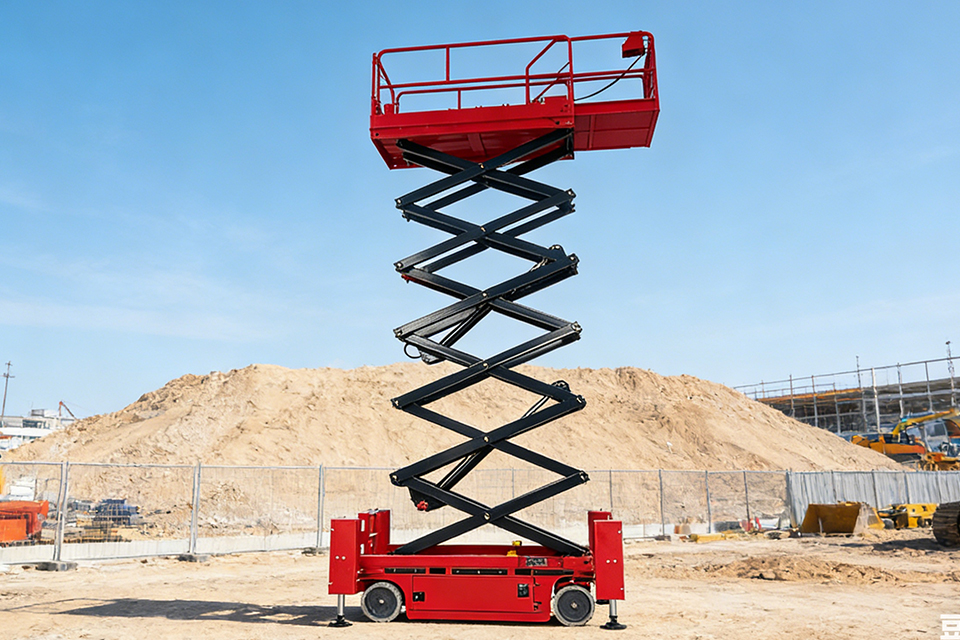
Scissor lifts operate through a pantograph mechanism—interlocking, crisscrossing metal supports that extend vertically to raise a rectangular platform. This design provides only vertical movement; the platform travels directly above the machine base, requiring positioning directly beneath the work area .
The mechanical simplicity of scissor systems translates to several operational advantages. Because the platform remains centered over the base throughout the elevation range, scissor lifts maintain exceptional stability. The direct vertical load path allows these machines to offer higher platform capacities than boom-type equipment of comparable size—typically 500 to 1,200 pounds depending on model class . Platform dimensions are generally spacious, accommodating multiple workers, material carts, and substantial tooling simultaneously.
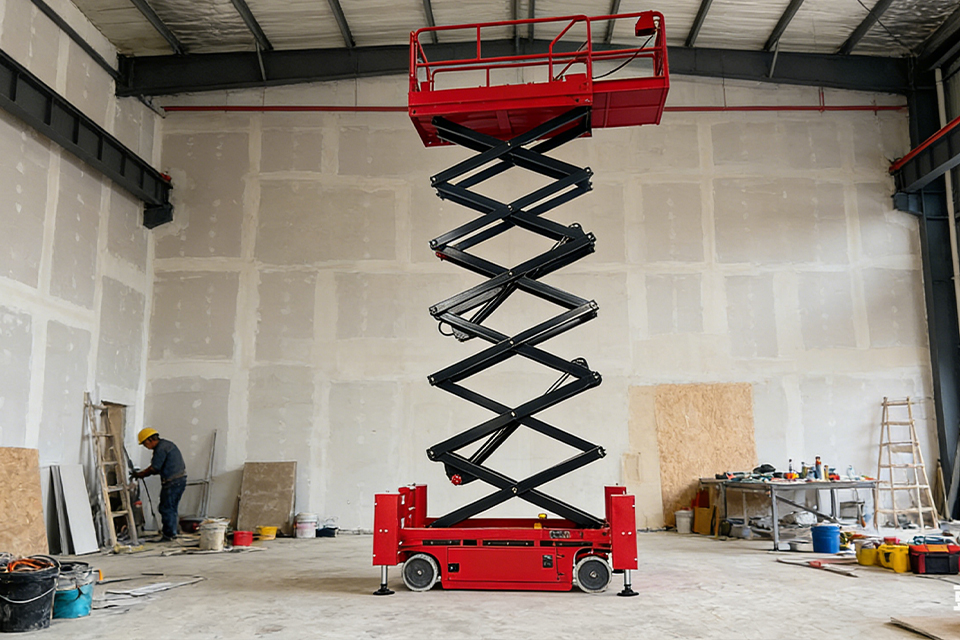
Scissor lifts are classified by power source and terrain capability: electric slab models for smooth indoor surfaces, diesel variants for outdoor firm ground, and rough-terrain (RT) versions with four-wheel drive and oscillating axles for challenging ground conditions . Working heights range from approximately 20 feet for compact indoor units to over 60 feet for large RT models, with specialized industrial units reaching 120+ feet .
Straight (Telescopic) Boom Lifts: Maximum Reach
Telescopic boom lifts, also called stick booms, feature a single straight arm composed of nested sections that extend telescopically. This design maximizes both vertical and horizontal reach, with some models achieving working heights exceeding 185 feet (56 meters) and horizontal outreach up to 75 feet .
The straight boom configuration provides inherent structural efficiency. Without the joints and pivot points of articulated designs, telescopic booms generally offer higher weight capacities at full extension and faster positioning times—operators extend the boom directly rather than articulating multiple joints . The design also delivers superior stability in windy conditions and on uneven terrain, as the load path remains consistent and predictable .
However, this mechanical efficiency comes with maneuverability constraints. The boom moves in a single plane; it cannot bend around obstacles or navigate through confined spaces. The platform position is always in line with the boom extension, requiring clear access paths from the machine base to the work area .
Articulating (Knuckle) Boom Lifts: Maneuverability Masters
Articulating boom lifts feature multiple hinged boom sections—typically two or three "knuckles"—that enable the arm to bend and maneuver around obstacles. This jointed configuration allows operators to position the platform with exceptional flexibility: up, over, and around structural elements, machinery, or architectural features .
The primary advantage lies in access capability. An articulating boom can extend vertically, then bend horizontally to reach around corners, over obstacles, or through narrow openings. This "up-and-over" capability proves invaluable in congested environments where straight-line access is impossible . The turntable base typically provides 360-degree continuous rotation, further enhancing positioning flexibility .
Trade-offs accompany this versatility. The multiple joints reduce maximum reach compared to telescopic designs—articulating booms typically top out around 120 feet versus 185+ feet for telescopic models . The complex boom structure also means lower weight capacities at full extension and slower positioning times as operators coordinate multiple joint movements .
Selection Criteria: A Comparative Framework
Working Height and Horizontal Outreach
For pure vertical access under 40 feet: Scissor lifts dominate. Their mechanical efficiency, high platform capacity, and lower operating costs make them the default choice for interior finishing, warehouse maintenance, and low-rise exterior work. When the machine can be positioned directly beneath the work area, scissors offer unmatched productivity .
For vertical access exceeding 40 feet with minimal horizontal offset: Telescopic booms excel. Their superior height capability and structural efficiency at extension make them ideal for high-rise construction, bridge work, and telecommunications infrastructure. The straight boom provides the fastest path to elevation when obstacles are absent .
For complex access requiring horizontal maneuvering: Articulating booms are essential. When work areas are blocked by building projections, machinery, or structural elements, the knuckle boom's ability to bend around obstacles becomes the determining factor. The trade-off in maximum height is justified by access capability impossible with other designs .
Terrain and Environmental Conditions
Indoor, smooth surfaces: Electric scissor lifts lead with zero emissions, minimal noise, and compact dimensions. Narrow models (30-inch width) navigate standard doorways and passenger elevators, enabling multi-story deployment without external lifts . For confined indoor spaces with obstacles, compact articulating booms provide maneuverability scissors cannot match .
Outdoor, firm, level ground: Diesel scissor lifts and both boom types operate effectively. Selection depends primarily on height and access requirements rather than terrain constraints.
Outdoor, rough or uneven terrain: Rough-terrain scissor lifts with four-wheel drive, oscillating axles, and high ground clearance handle slopes and soft ground that would immobilize slab models . Between boom types, articulating booms generally demonstrate superior terrain adaptability due to their jointed design, which accommodates ground irregularities better than rigid telescopic structures . However, large telescopic booms with outrigger systems provide exceptional stability on challenging surfaces when fully deployed .
Sensitive surfaces (marble, tile, computer floors): Atrium lifts (spider lifts)—a specialized articulating boom variant with tracked outriggers—distribute weight broadly, enabling operation on load-limited surfaces where conventional wheeled units would exceed floor ratings .
Load Capacity and Platform Configuration
Scissor lifts consistently offer the highest platform capacities within their height class, with RT models supporting 1,000–2,000+ pounds . This makes them preferred for multi-person crews with substantial equipment, material handling, or trade-specific tooling such as welding machines or glazing equipment.
Telescopic booms generally provide higher capacity than articulating booms at equivalent heights, particularly at full extension, due to their simpler structural load paths . Articulating booms experience capacity derating as joints extend, with maximum ratings typically 500–1,000 pounds depending on configuration .
Platform customization options—pipe racks, material trays, specialized tooling mounts—are available across all categories but are most commonly deployed on scissor lifts given their higher baseline capacities .
Operational Efficiency and Cost Considerations
Acquisition and rental costs: Scissor lifts represent the most economical category, with mechanical simplicity translating to lower purchase prices and rental rates. Telescopic booms command premium pricing due to their extended reach capabilities. Articulating booms fall between these extremes, with pricing varying significantly based on height and feature sets .
Operational speed: Telescopic booms achieve working position fastest in open environments—extend and elevate in a single motion. Articulating booms require sequential joint manipulation, slowing positioning in complex maneuvers but enabling access impossible with faster alternatives . Scissor lifts offer rapid vertical cycling but require frequent repositioning when horizontal work distribution exceeds platform dimensions.
Transport logistics: Scissor lifts under 3,000 pounds and compact articulating booms travel in standard trailers or pickup beds. Large RT scissors and heavy telescopic booms require specialized transport, adding mobilization costs and complexity .
Application Scenario Decision Matrix
Scenario 1: Warehouse Maintenance and Racking Operations
Recommended: Electric scissor lift
Warehouse environments demand vertical access for lighting maintenance, HVAC servicing, and inventory management. The smooth, level floors suit slab scissors perfectly. Narrow aisle models (30-inch width) navigate racking corridors, while high-capacity platforms accommodate maintenance crews with tooling . The zero-emission electric power supports continuous indoor operation without ventilation concerns. Scissor lifts provide the platform space for parts and equipment that vertical mast lifts cannot match, at lower cost than boom alternatives.
Scenario 2: High-Rise Exterior Construction
Recommended: Telescopic boom lift
High-rise construction, steel erection, and facade installation demand maximum height and outreach. Telescopic booms deliver working heights exceeding 150 feet with horizontal reach that keeps the machine base safely distant from the building footprint . The straight boom's structural efficiency supports the platform capacity needed for construction crews and material handling. In open construction sites without obstacle interference, the telescopic design's speed and stability optimize productivity.
Scenario 3: Industrial Facility Maintenance with Overhead Obstructions
Recommended: Articulating boom lift
Manufacturing plants, power generation facilities, and process industries present complex three-dimensional access challenges. Overhead piping, cable trays, ductwork, and structural steel obstruct direct vertical access. Articulating booms navigate through these congested environments, bending around obstacles to position platforms precisely where needed . The up-and-over capability accesses equipment nestled among overhead infrastructure impossible to reach with scissor or telescopic alternatives.
Scenario 4: Bridge Inspection and Highway Maintenance
Recommended: Telescopic boom lift
Bridge work demands exceptional horizontal outreach to position inspectors and crews over barriers, waterways, or traffic. Telescopic booms provide the straight-line reach necessary to extend from bridge decks to substructures, or from shoulders to overhead signage . The stability of the straight boom configuration proves critical when working over voids or active traffic lanes. Articulating booms lack the reach and direct access path for these applications.
Scenario 5: Retail and Commercial Interior Build-Out
Recommended: Compact electric scissor lift or small articulating boom
Tenant improvement projects in occupied buildings require navigating existing infrastructure, tight corridors, and sensitive finishes. For straightforward ceiling work (lighting, sprinkler, HVAC), narrow electric scissors provide efficient vertical access with minimal floor loading . When mechanical rooms, escalators, or architectural features obstruct direct positioning, compact articulating booms (30–40 foot class) provide the maneuverability to work around obstacles while maintaining indoor-appropriate dimensions and electric power.
Scenario 6: Tree Care and Landscaping
Recommended: Articulating boom lift or spider lift
Arboriculture and landscape maintenance demand positioning around dense canopies, building projections, and terrain variations. Articulating booms snake through branches and around structures to access specific limbs or building features . Spider lifts—tracked articulating booms with outrigger weight distribution—operate on lawns and sensitive landscaping without damage, accessing residential and commercial sites where wheeled units would be excluded .
Safety and Compliance Considerations
Equipment selection directly impacts safety protocol requirements. Under current ANSI and CSA standards, boom lifts (both telescopic and articulating) are classified as Group B MEWPs, requiring harness and lanyard use due to ejection hazards . Scissor lifts typically fall under Group A, where guardrail systems provide primary fall protection, though some jurisdictions mandate harnesses for all elevated platform work.
Ground conditions assessment is critical for all categories. Scissor lifts require level surfaces—rough-terrain models accommodate slopes through auto-leveling systems, but all scissors demand relatively stable ground . Boom lifts, particularly with outrigger deployment, tolerate more challenging terrain but require greater setup time and space .
Wind ratings vary significantly: large telescopic booms may have operational limits of 28–35 mph, while compact scissors and articulating booms may tolerate higher speeds due to reduced sail area . Selection must account for local weather patterns and seasonal conditions.
Conclusion
The choice between scissor-type, straight boom, and articulating boom aerial work platforms is not a matter of universal superiority but of operational fit. Scissor lifts dominate vertical access scenarios where direct positioning is possible, offering superior capacity and cost efficiency. Telescopic booms excel in open environments demanding maximum height and horizontal reach. Articulating booms prove indispensable when three-dimensional maneuvering around obstacles is required.
Effective selection demands rigorous analysis of working height, horizontal offset, terrain conditions, load requirements, and environmental constraints. The decision framework presented here enables project managers to align equipment capabilities with operational demands, optimizing both productivity and safety. As the industry continues evolving—with electric and hybrid power systems expanding application possibilities—understanding these fundamental mechanical distinctions remains essential for informed equipment procurement and deployment.
Name: selena
Mobile:+86-13176910558
Tel:+86-0535-2090977
Whatsapp:8613181602336
Email:vip@mingyuforklift.com
Add:Xiaqiu Town, Laizhou, Yantai City, Shandong Province, China
