
vip@mingyuforklift.com
+86-0535-2090977

Introduction
The material handling industry is undergoing a fundamental transformation. As of 2026, electric forklifts now represent approximately 67.73% of all new forklift shipments globally, and this share continues to grow rapidly . While the shift toward electrification is driven by multiple factors—including emissions regulations, indoor air quality requirements, and noise reduction—the single most compelling argument for fleet managers remains economic: the dramatic gap in fuel consumption and operating costs between diesel and electric powertrains.
This article provides a comprehensive technical analysis of the fuel consumption gap between diesel and electric forklifts. We examine energy consumption metrics, conversion efficiencies, real-world operating costs, and the broader implications for total cost of ownership (TCO). By quantifying the differences in energy use across typical operational scenarios, we aim to give procurement teams and operations managers the data they need to make informed fleet decisions.
Understanding Energy Consumption Metrics
Diesel Forklift Fuel Consumption
Diesel forklifts measure energy consumption in liters of fuel per operating hour. Industry data indicates that diesel forklifts typically consume between 2 and 5 liters per hour, depending on load capacity, duty cycle, and operating conditions . A 2-ton diesel forklift under typical warehouse operating conditions consumes approximately 2–2.5 liters per hour, while heavier-duty models or those operating under intensive load cycles may reach 3.5–5 liters per hour .
For a standard 2,000-hour annual operation, a diesel forklift consuming 3–4 liters per hour will use 6,000–8,000 liters of diesel annually . At volatile fuel prices— which reached $3.29 per liter in Australia by April 2026—this translates to annual fuel expenditures exceeding $13,000 for a single unit .
Electric Forklift Energy Consumption
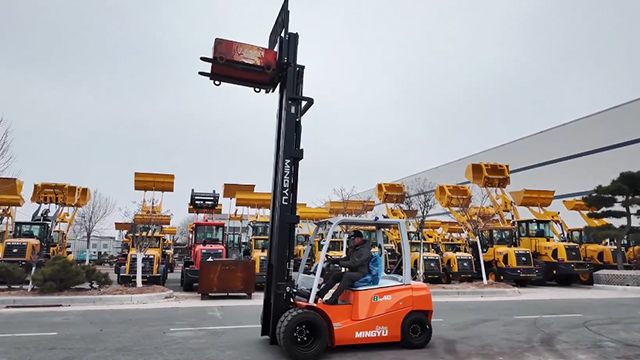
Electric forklifts measure energy consumption in kilowatt-hours (kWh) per operating hour. Typical consumption ranges from 3 to 12 kWh per hour, depending on battery voltage, capacity class, and operational intensity . A standard 2-ton lithium-ion electric forklift consumes approximately 3 kWh per hour under normal warehouse conditions . Larger 80V counterbalance forklifts handling heavy loads may consume 5.3–6 kWh per hour, while smaller pedestrian reach trucks use considerably less .
To understand total energy draw from the grid, charger efficiency must be accounted for. A typical 48V, 500Ah battery holds approximately 24 kWh of usable energy. Accounting for roughly 10% charger efficiency losses, each full charge cycle draws approximately 26–27 kWh from the grid . For a single-shift operation (250 working days, one charge per day), annual electricity consumption ranges from 6,500 to 6,750 kWh per year. Double-shift operations approximately double this figure to 13,000–13,500 kWh annually .
The Thermodynamic Efficiency Gap
The most significant technical factor underlying the consumption gap lies in the fundamental difference in energy conversion efficiency between internal combustion engines and electric drivetrains.
Diesel Engine Efficiency
Diesel internal combustion engines convert chemical energy in fuel into mechanical work with an efficiency of approximately 30–40% . The majority of the energy in diesel fuel—60–70%—is lost as waste heat through the exhaust system, cooling system, and friction. This thermodynamic limitation is inherent to the combustion process and cannot be overcome through incremental engineering improvements.
Electric Motor and Battery Efficiency
Electric forklifts, by contrast, achieve energy conversion rates exceeding 90% at the motor, with modern lithium-ion battery systems offering charge/discharge efficiencies of up to 95% . When accounting for charger losses and power electronics, the overall system efficiency from grid to wheel typically ranges from 80–85%. This represents more than double the effective energy utilization of diesel powertrains.
Furthermore, electric forklifts equipped with regenerative braking systems recover 8–12% of expended energy during deceleration and lowering operations . This energy recovery is particularly valuable in stop-and-go warehouse environments where frequent braking occurs. Diesel forklifts dissipate all braking energy as heat, with zero recovery potential.
Quantifying the Consumption Gap: A Comparative Analysis
To make a meaningful comparison between diesel and electric energy consumption, we must convert both to a common unit or compare operating costs directly.
Energy Content Equivalence
One liter of diesel fuel contains approximately 10.7 kWh of chemical energy. A diesel forklift consuming 3.5 liters per hour therefore processes approximately 37.45 kWh of primary energy per hour. With a 35% engine efficiency, the useful mechanical work output is approximately 13.1 kWh per hour.
An electric forklift consuming 3 kWh per hour from the battery requires approximately 3.3 kWh from the grid (accounting for charger losses). The useful mechanical work output is roughly 2.8 kWh per hour after motor and drivetrain losses.
At first glance, this suggests the diesel forklift delivers more work per hour. However, this comparison is misleading because it ignores the critical factor: the diesel forklift wastes 24.35 kWh per hour as heat, while the electric forklift wastes only 0.5 kWh. The electric forklift achieves the same material handling productivity with roughly one-fifth the primary energy input.
Cost-Per-Hour Comparison
The practical consumption gap becomes most visible when translated into operating costs. Using representative 2026 energy prices:
Diesel forklifts: At $1.20–$1.80 per liter (global average, with regional variation), a unit consuming 3–5 liters per hour costs $3.60–$9.00 per hour in fuel . In high-price markets like Australia ($3.29/L), costs exceed $8–$9 per hour .
Electric forklifts: At $0.10–$0.20 per kWh (industrial electricity rates), a unit consuming 3–12 kWh per hour costs $0.30–$2.40 per hour in electricity .
This represents an operating cost gap of approximately 70–90% in favor of electric forklifts . For a 2-ton class forklift operating 2,000 hours annually, the energy cost differential alone amounts to $9,000–$14,000 per year .
Battery Technology and Its Impact on Consumption
The type of battery technology significantly influences the effective energy consumption and operational efficiency of electric forklifts.
Lead-Acid vs. Lithium-Ion
Traditional lead-acid batteries convert only 75–80% of charge energy to usable power and suffer from voltage sag as they discharge, reducing forklift performance toward the end of a shift . They also require 8+ hours for a full charge and cannot be opportunity-charged without damaging battery life.
Lithium-ion batteries, now the dominant technology in new electric forklift sales, achieve up to 95% energy efficiency, maintain consistent voltage throughout the discharge cycle, and support opportunity charging during short breaks . A 30-minute lunch break can add 2–3 hours of runtime, effectively extending operational capacity without increasing energy consumption per hour .
The efficiency advantage of lithium-ion over lead-acid translates to 20–30% lower energy costs and eliminates the need for battery replacement during the typical forklift service life .
Real-World Operational Scenarios
Single-Shift Warehouse Operation
Consider a 2-ton counterbalance forklift in a standard warehouse environment, operating one shift per day (8 hours), 250 days per year (2,000 hours annually):
表格
Cost Component Diesel Forklift Lithium-Ion Electric
Energy consumption per hour 3.5 liters diesel 3 kWh
Annual energy consumption 7,000 liters 6,750 kWh
Unit energy cost $1.50/liter $0.15/kWh
Annual energy cost $10,500 $1,013
Annual maintenance $3,000–$5,000 $500–$1,500
Total annual operating cost $13,500–$15,500 $1,513–$2,513
Sources:
In this scenario, the electric forklift reduces annual energy and maintenance costs by approximately 85–90%. The savings of $11,000–$14,000 per year typically offset the higher upfront purchase price within 4–9 months .
Multi-Shift High-Intensity Operation
For operations running 3,000 hours annually (e.g., two-shift or continuous operations), the consumption gap widens further. A diesel forklift at 3.5 liters per hour consumes 10,500 liters annually, costing $15,750 at $1.50/liter. The equivalent electric forklift at 3 kWh per hour draws 9,000 kWh annually, costing $1,350 at $0.15/kWh. The annual energy savings reach $14,400 per unit, with payback periods shortening to under one year even for premium lithium-ion models .
Regional Variations
The consumption gap varies significantly by geography due to energy pricing differences:
India: Diesel at ₹93–95 per liter ($1.10–$1.15/L) versus electricity at ₹7.5 per kWh ($0.09/kWh). A diesel forklift costs ₹200–285 per hour in fuel; electric costs ₹60–130 per hour—a 50%+ reduction .
China: Industrial electricity at 1 RMB/kWh ($0.14/kWh) versus diesel at 7 RMB/liter ($0.97/L). Annual energy costs are 6,000 RMB for electric versus 49,000 RMB for diesel—a gap where electric costs only 12.2% of diesel .
Australia: With diesel at $3.29/L (April 2026), a single 2-ton diesel forklift costs over $13,000 annually in fuel alone, compared to $2,000–$4,000 for electric .
Beyond Fuel: Hidden Energy Costs
The fuel consumption gap extends beyond direct energy costs to encompass several secondary factors that amplify the economic advantage of electric forklifts.
Maintenance Energy Burden
Diesel forklifts require engine oil, filters, coolant, and exhaust system components that must be manufactured, transported, and disposed of—each carrying an embodied energy cost. Electric forklifts eliminate oil changes and reduce scheduled maintenance intervals from every 250–500 hours to primarily tire and hydraulic system checks . The maintenance cost gap adds $2,000–$3,500 annually per unit .
Infrastructure and Ventilation
Diesel operation in indoor environments necessitates ventilation systems to manage exhaust fumes, adding HVAC energy costs. Cold storage facilities operating diesel forklifts incur additional refrigeration loads to offset engine heat, estimated at up to $12,000 annually per facility . Electric forklifts generate minimal waste heat and zero emissions, eliminating these secondary energy burdens.
Downtime and Productivity
Unplanned downtime represents an indirect energy cost in the form of lost productivity. Electric forklifts experience approximately 40% less unplanned downtime annually due to simplified drivetrains with 70% fewer moving parts . While difficult to quantify in kWh, this reliability gap translates to more productive operating hours per energy dollar invested.
Total Cost of Ownership: The 5-Year View
When evaluating the fuel consumption gap, fleet managers must look beyond hourly costs to the total cost of ownership over the equipment lifecycle.
A standardized 5-year TCO model for a 2-ton forklift operating 2,000 hours annually reveals:
表格
Cost Category Electric (Li-Ion) Diesel
Acquisition $55,000 $38,000
Energy/Fuel (5 yr) $10,000 $45,000
Maintenance (5 yr) $6,000 $18,000
Battery replacement $0 —
Infrastructure $8,000 $4,000
Total 5-Year TCO $79,000 $105,000
Sources:
The electric forklift delivers a $26,000 (25%) savings over five years despite a $17,000 higher purchase price. At 1,500 hours annually, the savings are approximately $10,188 over five years, with payback on the premium occurring around year three .
For fleet-scale deployments, the economics become even more compelling. A 10-unit electric fleet over five years costs approximately $720,000 compared to $1,265,000 for an equivalent diesel fleet—a 43% reduction driven by $420,000 in energy savings and 60% lower maintenance expenditures .
When Diesel Still Makes Sense
Despite the overwhelming consumption gap favoring electric power, diesel forklifts retain advantages in specific applications:
Remote outdoor operations without grid access or charging infrastructure
Extreme terrain requiring high continuous torque and ground clearance
24/7 continuous duty cycles where charging downtime is unacceptable
Extreme climates where battery performance degrades significantly (though heated battery compartments mitigate this for lithium-ion)
For these niche applications, the fuel consumption gap is offset by operational necessity. However, as fast-charging infrastructure expands and battery technology improves, the domain where diesel remains competitive continues to shrink .
Conclusion
The fuel consumption gap between diesel and electric forklifts is substantial, systematic, and widening. Electric forklifts consume approximately 3–6 kWh of electricity per operating hour, while equivalent diesel models consume 2–5 liters of fuel per hour. When converted to common energy units and accounting for conversion efficiencies, electric systems deliver the same material handling productivity with roughly one-fifth the primary energy input.
In economic terms, this translates to hourly operating costs of $0.30–$2.40 for electric versus $3.60–$9.00 for diesel—a 70–90% cost reduction. Over a standard 2,000-hour annual operation, the energy and maintenance savings per unit range from $11,000 to $18,000, typically recovering any purchase price premium within the first year of operation.
The convergence of high diesel prices, declining electricity costs (particularly with valley-rate charging strategies), and advancing lithium-ion battery technology has made the electric forklift not merely an environmentally preferable option, but the economically dominant choice for the vast majority of material handling applications. For fleet managers evaluating equipment procurement in 2026, the fuel consumption data points decisively toward electrification as the standard for indoor and increasingly outdoor operations.
Name: selena
Mobile:+86-13176910558
Tel:+86-0535-2090977
Whatsapp:8613181602336
Email:vip@mingyuforklift.com
Add:Xiaqiu Town, Laizhou, Yantai City, Shandong Province, China