
vip@mingyuforklift.com
+86-0535-2090977

I. Technical Overview: How the System Functions
To troubleshoot effectively, one must understand the closed-loop nature of the forklift's hydraulic architecture. The system generally consists of:
Hydraulic Reservoir: Stores the fluid and allows heat to dissipate.2
Hydraulic Pump: Usually a gear or vane pump that creates flow.3
Control Valve (Spool Valve): Directs fluid to specific cylinders (Lift, Tilt, Side-shift).4
Cylinders: Convert fluid pressure into linear motion.5
Relief Valve: A safety mechanism that "dumps" fluid back to the tank if pressure exceeds safe limits.6
II. Malfunction 1: Weak or Sluggish Lifting Power7
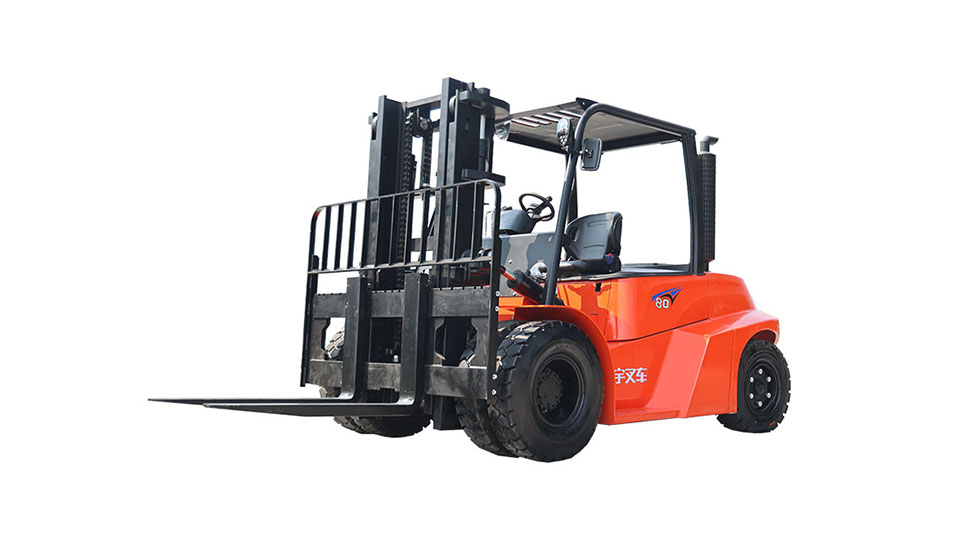
When a forklift struggles to raise a load within its rated capacity, or the mast moves at a glacial pace, the issue is typically a loss of flow or loss of pressure.
1. Root Causes
Contaminated Fluid: Aeration (air in the oil) or water contamination can make the fluid "spongy" and compressible. Since air compresses under load, the force isn't transmitted to the piston.
Worn Hydraulic Pump: Over time, internal clearances between gears or vanes increase. This causes "internal bypass," where the pump spins but fluid slips backward instead of being pushed into the lines.
Malfunctioning Relief Valve: If the relief valve spring weakens or debris gets stuck in the seat, the valve may stay partially open, bleeding off the pressure required for heavy lifting.
Clogged Filters/Strainers: A restricted suction strainer starves the pump of oil, causing cavitation—the formation and collapse of vapor bubbles that physically erode the metal surfaces of the pump.
2. Troubleshooting & Diagnostic Steps
Pressure Testing: Use a hydraulic pressure gauge at the test port.8 If the pressure at the pump is within spec but the lift is weak, the problem is likely in the control valve or cylinder.
Temperature Check: Use an infrared thermometer to check the control valve and cylinders. "Hot spots" often indicate internal leaks where high-pressure oil is escaping through a small gap, generating friction heat.9
Visual Fluid Inspection: Draw a sample. If it is milky, water is present.10 If it is foamy, air is entering the system (likely through a leak on the suction side of the pump).11
III. Malfunction 2: Hydraulic Oil Leaks
Leaks are categorized into two types: External (visible puddles) and Internal (invisible "drifting").12
1. External Leaks: The Visible Danger
External leaks are often caused by:
Hose Fatigue: Constant flexing and high heat cause rubber hoses to crack or "balloon."13
Loose Fittings: Vibrations from daily operation can loosen JIC or O-ring boss fittings.14
Worn Rod Seals: If you see oil "weeping" down the chrome shaft of the lift cylinder, the U-cup or wiper seal has failed.
2. Internal Leaks: The "Ghost" Failure
If the forks slowly lower on their own while the control lever is in neutral, you are experiencing cylinder drift.15
Causes: This usually indicates a failed piston seal inside the cylinder or a worn spool in the control valve. Fluid is "bypassing" the seal from the high-pressure side to the low-pressure side, allowing the load to drop.
IV. Comprehensive Maintenance Strategies
A proactive maintenance stance is the only way to ensure the 10,000+ hour lifespan typical of industrial forklifts.
1. Fluid & Filter Management
Scheduled Changes: Replace hydraulic oil every 2,000 operating hours (or as per manufacturer specs).
Filtration: Never skip a filter change.16 Modern high-efficiency filters can trap particles as small as 5–10 microns.
Breather Care: Ensure the reservoir breather cap is clean.17 A clogged breather creates a vacuum that can cause pump cavitation.
2. Component Protection
Cylinder Care: Keep the chrome rods of the lift cylinders clean. Dried mud or grit can act like sandpaper, shredding the rod seals the moment the cylinder retracts.
Seal Replacement: Don't just replace one seal. If you have a cylinder disassembled, use a complete seal kit to replace all O-rings, back-up rings, and wipers.
3. Operator Daily Checks
Operators should perform a "walk-around" inspection before every shift:
Check for "wet" spots around hose connections.18
Listen for a high-pitched "whining" or "screeching" (indicates air in the system or a pump under stress).
Verify the fluid level on the dipstick when the mast is fully lowered.
V. Troubleshooting Summary Table
|
Symptom |
Potential Culprit |
Recommended Action |
|
Forks "Drift" Down |
Failed Piston Seal / Worn Valve Spool |
Rebuild cylinder or replace control valve. |
|
Whining Noise |
Air in system / Clogged suction strainer |
Bleed system; clean/replace suction filter. |
|
Hot Hydraulic Oil |
Internal leakage / Clogged oil cooler |
Check for internal bypass; clean cooler fins. |
|
No Lift Power |
Blown Relief Valve / Pump failure |
Replace relief valve or test pump flow rate. |
Conclusion
Forklift hydraulic malfunctions are rarely isolated events; they are the result of cumulative environmental stress and fluid degradation. By mastering the diagnostic signs of weak lifting power and addressing leaks at the first sign of "weeping," fleet managers can prevent expensive downtime and ensure a safer workplace.19
Name: selena
Mobile:+86-13176910558
Tel:+86-0535-2090977
Whatsapp:8613181602336
Email:vip@mingyuforklift.com
Add:Xiaqiu Town, Laizhou, Yantai City, Shandong Province, China