
vip@mingyuforklift.com
+86-0535-2090977

Introduction: Clarifying a Common Misconception
When operators first encounter a forklift with multiple floor pedals, they often assume the configuration serves a differential braking function similar to agricultural tractors or military vehicles—where independent left and right brakes enable pivot turns. This assumption, while logical, mischaracterizes the primary purpose of dual pedal arrangements on most material handling equipment. In standard forklifts, the two pedals are not dual brake pedals for steering; rather, they consist of a service brake pedal and an inching pedal (also called an inching brake or clutch pedal) . Understanding the distinct functions of these pedals—and how they interact with modern forklift engineering—is essential to comprehending how narrow aisle forklifts achieve their remarkable maneuverability.
The inching pedal represents one of the most sophisticated yet underappreciated control mechanisms in material handling. Its design allows operators to execute millimeter-precise movements in confined warehouse environments where traditional braking and acceleration would prove too coarse. When combined with rear-wheel steering, three-wheel configurations, and electronic differential systems, the inching pedal transforms from a simple transmission disengagement device into a critical enabler of tight-space productivity.
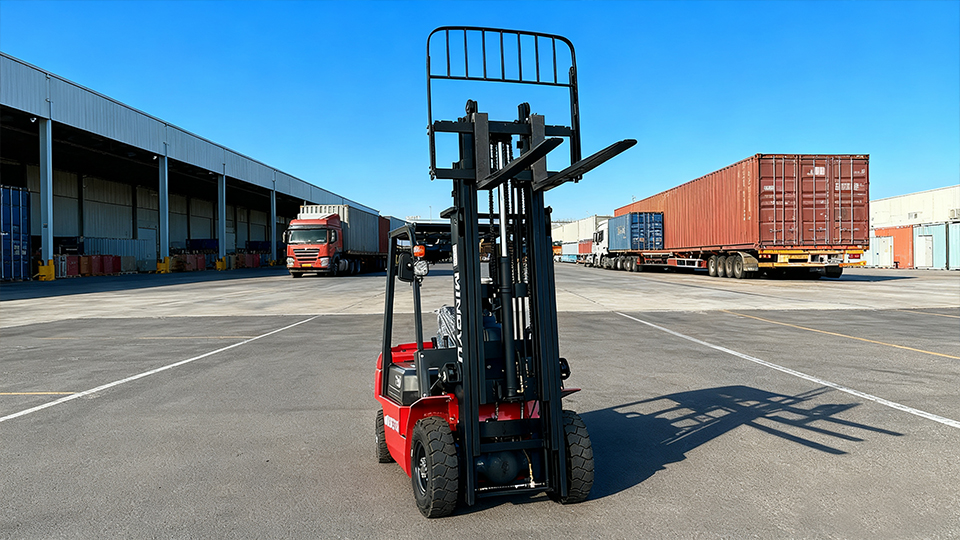
The Service Brake Pedal: Primary Deceleration Control
The service brake pedal functions as the main braking mechanism, analogous to the brake pedal in conventional automobiles. Located in the center or right position of the operator compartment floorboard, this pedal activates the hydraulic braking system to slow or stop the forklift . On internal combustion forklifts, the service brake typically operates through a hydraulic circuit connected to drum or disc brakes at the drive wheels. Electric forklifts may utilize regenerative braking systems where the drive motor acts as a generator to decelerate the vehicle while recovering energy .
The service brake provides full stopping power and is the pedal operators use for routine deceleration, emergency stops, and holding position on inclines. Importantly, pressing the service brake does not disengage the transmission on most designs—the engine or electric motor remains coupled to the drivetrain, meaning the forklift cannot simultaneously brake and deliver maximum hydraulic power for lifting operations .
The Inching Pedal: Precision Control Through Transmission Management
The inching pedal—typically positioned to the left of the service brake—serves a fundamentally different purpose than additional braking capacity. This pedal operates as a transmission disengagement mechanism combined with partial braking capability, creating a "clutch-like" function that enables precise speed control without requiring the operator to shift into neutral .
Mechanical Operation
When an operator depresses the inching pedal, the initial travel activates a linkage rod connected to the transmission control valve (on powershift transmissions) or a hydraulic spool valve . This action feathers the fluid flow to the clutch packs, progressively disengaging the drive circuit. As the pedal travels further, it begins applying the service brakes, creating a blended control where the operator can simultaneously manage transmission engagement and deceleration .
According to technical documentation for the Clark GPX series, the inching system incorporates dedicated master cylinders and hydraulic circuits separate from the main braking system, allowing precise calibration of the pedal's dual functions . The GPX25E service manual specifies that the left-hand pedal is intended for inching use while the right-hand pedal provides normal braking control—a configuration that ensures operators cannot accidentally compromise braking capability while using the inching function .
Operational Benefits for Narrow Aisle Maneuvering
The inching pedal's primary advantage emerges during low-speed precision operations. When positioning forks into pallet openings or aligning with rack beams in narrow aisles, operators need speeds measured in fractions of kilometers per hour. Attempting to achieve such slow movement through accelerator modulation alone results in jerky, imprecise motion due to the forklift's high torque transmission characteristics.
By depressing the inching pedal partially, the operator creates controlled clutch slippage that allows the engine to maintain higher RPMs (providing full hydraulic power for lifting) while the drivetrain delivers minimal, precisely regulated torque to the wheels . This decoupling of engine speed from travel speed enables "creeping" maneuvers where the forklift advances at crawl speeds without stalling or lurching.
Research on forklift dynamics confirms that maintaining optimal slip ratios during low-speed turning is critical for stability and tire longevity . The inching pedal facilitates this by preventing wheel slip that would occur if operators attempted to modulate speed solely through accelerator and brake coordination.
How Narrow Aisle Forklifts Actually Achieve Tight Turning
While the inching pedal enables precise speed control, the tight turning radius characteristic of narrow aisle forklifts results from entirely different engineering solutions. Modern warehouse forklifts employ several complementary technologies to minimize their turning footprint:
Rear-Wheel Steering Architecture
Unlike automobiles where front wheels steer, forklifts utilize rear-wheel steering to achieve tighter turning radii . This configuration places the steering axle at the rear of the vehicle, allowing the front (drive) wheels to follow a relatively straight path while the rear wheels execute the turning arc. The steering geometry creates a smaller overall swept path, particularly beneficial when maneuvering in aisles between 8-10 feet wide .
The rear steering design does introduce a "tail swing" effect where the rear counterweight sweeps outward during turns, requiring operator awareness of clearance . However, the tradeoff provides superior maneuverability in constrained environments compared to front-steering configurations.
Three-Wheel Design and Zero-Turn Capability
Three-wheel electric counterbalance forklifts represent the pinnacle of tight-turning engineering. By replacing the dual rear wheels with a single central steering wheel, these designs eliminate the width constraint of a rear axle assembly. The Yale ERP030-040VT series achieves an "extremely tight turning radius with dual independent front wheel AC drive motors that rotate drive tires in opposite directions"—effectively enabling pivot turns within the forklift's own footprint .
Mitsubishi's three-wheel FB series employs 360-degree steering that allows operators to "turn and move in the opposite direction in one smooth motion without stopping," reducing daily cycle times by up to 20 minutes . The single rear wheel's ability to turn up to 90 degrees from center creates right-angle stacking capabilities impossible with four-wheel configurations.
Dual Independent Drive Motors and Electronic Differential
Modern electric narrow aisle forklifts utilize dual independent AC drive motors with separate controllers for each drive wheel . This architecture enables active electronic differential control where the inside wheel slows, stops, or reverses rotation during turns while the outside wheel maintains appropriate speed .
According to research published in the Machines journal, electronic differential control strategies calculate optimal wheel speeds based on steering angle and vehicle kinematics . The fundamental relationship follows Ackermann-Jeantaud steering geometry, where the inner wheel's turning radius (R_inner) and outer wheel's turning radius (R_outer) determine their respective velocities:
v_inner = v_vehicle × (R_inner / R_center)
v_outer = v_vehicle × (R_outer / R_center)
By independently controlling each motor's torque output, the system prevents tire scrubbing, reduces turning resistance, and minimizes the effective turning radius . The Yale ESC030AD exemplifies this technology: "As the truck turns, the inside motor slows, stops and reverses to minimize turn radius, making stacking in limited space and congested loading bays easier than ever" .
Dual Pedal Control for Travel Direction
Some advanced forklifts, particularly Linde's E35-E50 series, implement dual pedals for travel direction control rather than braking . In this configuration, one pedal controls forward movement and acceleration while another manages reverse—eliminating the need for a directional shift lever. This "precision dual pedal control" allows operators to change direction without removing their feet from the pedals, reducing cycle times and improving responsiveness in tight spaces .
The Exception: Independent Braking on Rough Terrain Forklifts
While standard warehouse forklifts do not use dual brake pedals for steering, rough terrain forklifts occasionally implement independent braking systems specifically to enhance turning capability. The Master Craft MC-Series explicitly advertises "independent braking (allows for a tighter turning radius)" as a feature for its 5,000-20,000 lb capacity rough terrain models . Similarly, the GVF 4000 rough terrain forklift incorporates "independent power assisted braking which allows operator to use the brakes for..." tight maneuvering .
These specialized applications differ fundamentally from warehouse equipment. Rough terrain forklifts operate on unpaved surfaces where wheel slip and traction variations make traditional steering less effective. Independent left/right braking allows operators to drag a specific wheel to pivot the vehicle, similar to crawler tractors or skid-steer loaders. However, this technique is inappropriate for paved warehouse floors where tire scrubbing would damage surfaces and create instability with elevated loads.
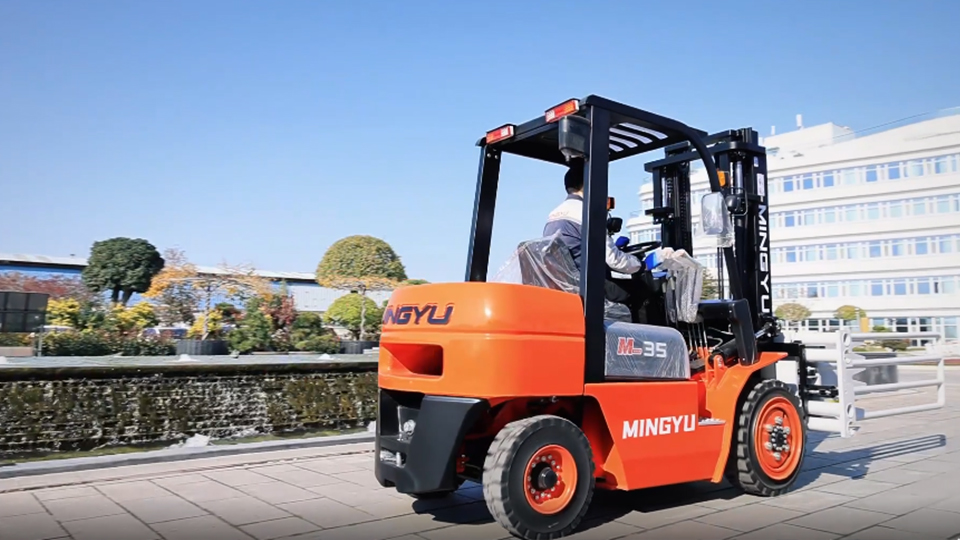
Operational Best Practices for Dual Pedal Systems
Understanding the correct use of dual pedal configurations is critical for safety and equipment longevity:
Inching Pedal Usage:
Use for precise positioning when engaging pallets or rack openings
Maintain partial depression to allow simultaneous braking and hydraulic operation
Avoid "riding" the inching pedal during normal travel to prevent transmission overheating and premature clutch wear
Do not use for hill starts—utilize the service brake and parking brake instead
Service Brake Coordination:
Apply for routine deceleration and emergency stops
Use in conjunction with the inching pedal when complete stops are required during precision operations
Never substitute the inching pedal for the service brake during high-speed travel
Three-Wheel Forklift Considerations:
Exercise heightened caution when turning with elevated loads due to reduced lateral stability
Reduce speed before entering turns to prevent centrifugal force-induced tipping
Be aware of rear-end swing when operating rear-steering configurations
Conclusion
The dual pedal system on most forklifts—comprising a service brake and an inching pedal—does not function as a differential braking mechanism for tighter turning. Instead, the inching pedal provides precision transmission control that enables the slow, deliberate movements necessary for safe operation in narrow aisles. The remarkable turning capabilities of modern narrow aisle forklifts result from rear-wheel steering, three-wheel designs, dual independent drive motors, and electronic differential control—technologies that operate independently of the pedal configuration.
For operators and fleet managers, understanding this distinction is essential. Attempting to use the inching pedal as a steering brake would compromise both safety and equipment integrity. Proper training should emphasize the inching pedal's role in precision load handling while highlighting the engineering systems—steering geometry, wheel configuration, and electronic controls—that truly enable the tight turning radii demanded by modern warehouse density requirements.
As warehouse designs continue trending toward narrower aisles and higher rack storage, the interplay between human control interfaces (like the inching pedal) and automated precision systems (like electronic differential control) will increasingly define material handling efficiency. The inching pedal, despite its humble appearance, remains a critical bridge between operator intent and mechanical execution in these demanding environments.
Name: selena
Mobile:+86-13176910558
Tel:+86-0535-2090977
Whatsapp:8613181602336
Email:vip@mingyuforklift.com
Add:Xiaqiu Town, Laizhou, Yantai City, Shandong Province, China
