
vip@mingyuforklift.com
+86-0535-2090977

Introduction
For operators transitioning from automobiles to forklifts, one of the most puzzling control arrangements is the presence of two brake pedals. Unlike conventional vehicles that operate with a single brake pedal, most internal combustion forklifts feature a dual-pedal configuration: a service brake pedal and an inching brake pedal. This seemingly redundant design serves critical operational functions that address the unique demands of material handling environments. This article examines the engineering principles, hydraulic systems, and operational advantages that necessitate this dual-pedal approach, exploring how the inching pedal transforms forklift maneuverability and load handling precision.
The Dual-Pedal Configuration: An Overview
The standard pedal arrangement in an internal combustion forklift consists of three floor-mounted controls . Positioned on the right is the accelerator pedal, which controls engine rotational speed and travel speed. In the center sits the service brake pedal—the conventional braking mechanism familiar to automotive operators. To the left resides the inching brake pedal, a specialized control unique to forklift operations that serves dual functions: partial braking and transmission disengagement .
This configuration varies by forklift type. Electric sit-down forklifts often feature only two pedals—accelerator and service brake—with a hand-operated parking brake . Internal combustion models, particularly those with hydrostatic or automatic transmissions, typically incorporate the third inching pedal . Understanding the distinction between these pedal functions requires examining the specific operational demands of forklift applications that automotive designs simply do not address.
The Service Brake Pedal: Conventional Deceleration
The service brake pedal functions as the primary braking mechanism, analogous to brake systems in standard automobiles. When depressed, this pedal activates the hydraulic brake system to decelerate or stop the forklift . The system typically employs hydraulically-actuated, self-adjusting drum-and-shoe brakes at the drive wheels, integrated within the transaxle assembly .
Operationally, the service brake pedal serves straightforward deceleration needs. When an operator releases the accelerator and depresses the service brake, hydraulic pressure forces brake shoes against drums, generating friction to reduce travel speed . For complete stops, particularly on ramps or slopes, operators must engage the handbrake in conjunction with the service brake to prevent unintended movement .
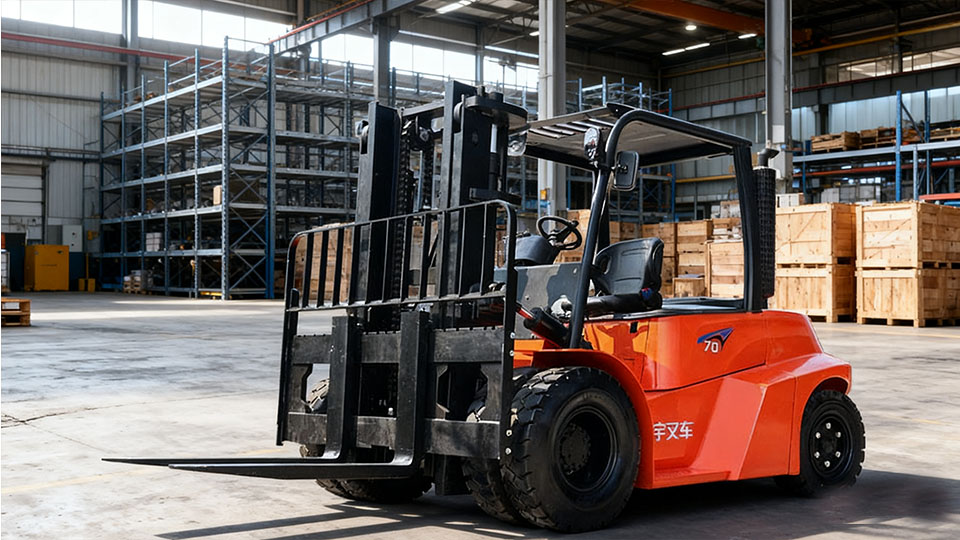
However, relying solely on conventional braking presents limitations in forklift operations. The service brake pedal decelerates the vehicle but maintains transmission engagement—meaning engine power continues transferring to the drive wheels. This characteristic becomes problematic during precision maneuvers requiring simultaneous speed control and hydraulic power for lifting operations.
The Inching Pedal: Precision Control Engineering
The inching pedal represents the critical innovation distinguishing forklift control systems from automotive designs. Despite its name suggesting minimal movement, this pedal serves sophisticated functions essential to material handling efficiency and safety .
Transmission Disengagement Without Neutral Shifting
The primary function of the inching pedal involves disengaging the transmission without requiring the operator to shift into neutral . In conventional operation, an operator needing to pause travel while maintaining engine speed for hydraulic functions would need to shift the directional control lever to neutral—a process requiring hand movement from operational controls, reducing efficiency and increasing cycle times.
The inching pedal eliminates this inefficiency. When depressed, it activates a bypass valve (also termed a "dump" valve) that diverts hydraulic pressure away from the transmission valve body and into the transmission sump . This hydraulic diversion effectively disengages the drive clutches while maintaining engine operation and hydraulic pump engagement. The result allows operators to maintain high engine RPMs for hydraulic lift operations while controlling travel speed independently.
The "Inching" Function: Controlled Creep
The pedal's nomenclature derives from its secondary function: enabling controlled, minimal-speed movement. By partially depressing the inching pedal, operators create controlled clutch slippage that permits "inching" or creeping movements . This graduated control allows precise positioning—critical when aligning forks with pallet openings or maneuvering in confined spaces .
The mechanical implementation involves sophisticated valve control. The first portion of pedal motion regulates transmission control valve pressure, allowing partial clutch engagement that produces limited driving force . Further depression progressively reduces clutch pressure until complete disengagement occurs, at which point the pedal actuates service brakes fully. This graduated response provides operators with intuitive, foot-controlled modulation of both drive and braking functions.
Hydraulic Power Optimization
Material handling operations frequently require simultaneous travel and lift functions. When approaching a storage location, operators must raise loads to rack height while positioning the forklift precisely. The inching pedal facilitates this by allowing engine speed increase—necessary for hydraulic pump output—without corresponding travel speed increase .
Without the inching pedal, operators would face an operational dilemma: increasing engine speed for hydraulic lift power would simultaneously increase travel speed through the engaged transmission, making precise positioning impossible. The inching pedal resolves this by decoupling engine speed from drive engagement, permitting high RPM hydraulic operation while maintaining controlled, slow-speed travel or complete stationary positioning .
Hydraulic System Architecture
The dual-pedal system's functionality depends on sophisticated hydraulic engineering. In forklifts with hydraulic automatic transmissions, the inching pedal connects to an inching valve mounted on the transmission case . This valve, controlled by pedal position via rocker arm assemblies, regulates clutch pack pressure with precision.
Modern systems employ dual-circuit hydraulic designs. Type 2 dual master cylinder systems incorporate hydraulic inching into the left pedal exclusively, with this pedal mechanically actuating the right pedal to provide braking force . The right pedal remains independent, serving braking-only functions in certain transmission configurations. This redundancy ensures braking capability even if the inching circuit experiences failure.
The hydraulic fluid dynamics involved generate significant thermal considerations. When the inching pedal maintains partial clutch engagement, friction generates heat within transmission clutch packs . Improperly adjusted pedals that fail to fully divert hydraulic flow create sustained partial engagement, leading to overheated coolant and transmission systems, burned clutch discs, and potential torque converter failure . These thermal management requirements necessitate precise pedal adjustment and cooling system adequacy.
Operational Advantages in Material Handling
Precision Load Placement
Warehouse efficiency depends on rapid, accurate pallet placement. The inching pedal enables operators to approach storage locations at minimal speed while simultaneously raising forks to precise heights . This simultaneous operation—impossible without transmission disengagement—reduces cycle times and improves placement accuracy.
The pedal's graduated control proves particularly valuable when handling fragile or sensitive materials. By eliminating the lurching associated with transmission engagement/disengagement, operators achieve smoother acceleration profiles that prevent load shifting or damage .
Confined Space Maneuverability
Modern warehouses maximize storage density through narrow aisle configurations. The inching pedal facilitates navigation in these constrained environments by providing precise speed control without requiring constant gear shifting . Operators can creep through tight clearances while maintaining immediate stopping capability through continued pedal depression.
This capability extends to truck loading operations, where forklifts must position loads precisely within trailer dimensions. The inching function allows millimeter-level adjustments while maintaining hydraulic pressure for mast tilting and fork positioning .
Ramp and Slope Operations
The dual-pedal configuration provides specific advantages on inclined surfaces. When stopping on ramps, operators use the service brake rather than the inching pedal to prevent rollback . The service brake maintains vehicle position through mechanical braking force, while the inching pedal's hydraulic disengagement would permit undesired movement on slopes.
For hill starts, proper procedure requires fully depressing the service brake, engaging the transmission, then gradually releasing the brake while accelerating . This sequence prevents the rollback that would occur if the inching pedal—which disengages drive—were used for hill holding.
Variations in Pedal Configurations
Hydrostatic Transmission Systems
Advanced forklifts, particularly Linde's hydrostatic drive models, implement dual-pedal control differently . In these systems, the right pedal controls forward movement while the left controls reverse—both functioning as accelerator pedals rather than brake pedals. Releasing either pedal automatically applies braking through the hydrostatic system's inherent resistance, eliminating the need for a separate service brake pedal for normal operations .
This configuration offers distinct advantages: continuous drive operation enables gentle acceleration and deceleration, quick direction changes, and reduced component wear due to the absence of mechanical clutches and conventional brakes . However, these systems still incorporate inching functionality through modified pedal programming that allows controlled creep speeds independent of engine RPM.
Electric Forklift Simplification
Electric forklifts typically eliminate the inching pedal entirely . These vehicles utilize electronic motor controllers that manage travel speed independently of hydraulic pump operation. The electronic control systems provide inching functionality through software algorithms rather than mechanical hydraulic valves, rendering a dedicated pedal unnecessary. Operators achieve precision control through accelerator modulation, with automatic braking occurring upon pedal release.
Stand-Up Forklift Variations
Stand-up forklifts introduce additional pedal configurations, including deadman pedals and pallet clamp controls . Deadman switches require operator presence detection—typically through a floor-mounted pedal that must remain depressed for operation. When released, these systems immediately disable forklift functions, preventing uncontrolled movement if operators step away.
Maintenance and Adjustment Considerations
The inching pedal's critical functions necessitate precise adjustment and regular maintenance. Improperly adjusted pedals create operational inefficiencies and potential equipment damage .
Adjustment Parameters
Proper inching pedal adjustment ensures complete transmission disengagement at specified pedal travel points. Technicians must verify that the pedal's initial travel disengages the transmission clutch packs before brake application begins. This sequencing ensures that operators can rev engines for hydraulic power without brake drag or transmission load.
Common Failure Modes
Worn inching valves or misadjusted linkages create several operational issues. Incomplete transmission disengagement causes clutch slippage, generating excessive heat and accelerating wear . Conversely, premature brake application during inching pedal travel reduces the available "creep" range, forcing operators to use service brakes for precision positioning—an inefficient and jerky alternative.
Hydraulic system contamination affects inching valve performance. Degraded fluid or particulate contamination causes valve sticking, resulting in unpredictable clutch engagement and potential safety hazards. Regular fluid analysis and filter maintenance prevent these issues .
Safety Implications and Operator Training
The dual-pedal system introduces complexity requiring specific operator training. OSHA-compliant certification programs must address inching pedal operation, emphasizing that this control should not replace standard braking procedures .
Critical safety protocols include:
Prohibition against "riding" the inching pedal: Continuous partial depression generates excessive heat, potentially causing transmission seizure
Proper ramp procedures: Using service brakes rather than inching pedals for hill holding prevents unintended rollback
Clearance awareness: Operators must not use inching pedals when creeping into racking with raised loads, as sudden stops could destabilize elevated materials
Training must also address the distinct "feel" of inching pedal operation. Unlike binary brake pedals, the inching pedal provides graduated response requiring developed operator sensitivity. Novice operators often struggle with smooth inching control, initially creating jerky movements that improve with experience .
Conclusion
The dual-pedal braking system in forklifts represents an elegant engineering solution to the complex operational requirements of material handling. The service brake pedal provides conventional deceleration capabilities, while the inching pedal enables the precise speed control and hydraulic power management essential to efficient warehouse operations. This dual-function design—simultaneously disengaging transmission and controlling creep speed—resolves the fundamental conflict between engine speed requirements for hydraulic lifting and the minimal travel speeds necessary for accurate positioning.
As forklift technology evolves, the fundamental principles behind dual-pedal control persist even as implementation methods change. Hydrostatic transmissions integrate inching functionality into accelerator pedals; electric forklifts achieve similar control through electronic algorithms. Yet the underlying operational need—decoupling engine speed from travel speed for precision load handling—remains constant.
Understanding why forklifts have two brake pedals requires appreciating the unique demands of material handling environments. Unlike automotive applications where braking simply reduces speed, forklift operations demand simultaneous control of multiple systems: travel speed, hydraulic power, and load positioning. The dual-pedal configuration provides this integrated control, transforming what appears as redundancy into essential operational capability. For operators and fleet managers alike, proper utilization and maintenance of these systems ensures both operational efficiency and long-term equipment reliability.
Name: selena
Mobile:+86-13176910558
Tel:+86-0535-2090977
Whatsapp:8613181602336
Email:vip@mingyuforklift.com
Add:Xiaqiu Town, Laizhou, Yantai City, Shandong Province, China
