
vip@mingyuforklift.com
+86-0535-2090977

Introduction
Walk through any warehouse, distribution center, or manufacturing facility, and you'll notice a distinctive feature common to nearly every forklift: the protective cage structure overhead, conspicuously missing a solid roof. This seemingly counterintuitive design choice—protecting operators from falling objects while leaving the top exposed—represents one of the most carefully engineered safety compromises in industrial equipment. The open roof structure of forklift overhead guards is not an oversight but a deliberate, standards-driven solution that balances multiple competing safety requirements. This article explores the engineering principles, regulatory frameworks, and practical considerations that dictate this unique design.
Understanding the Overhead Guard: Definition and Primary Function
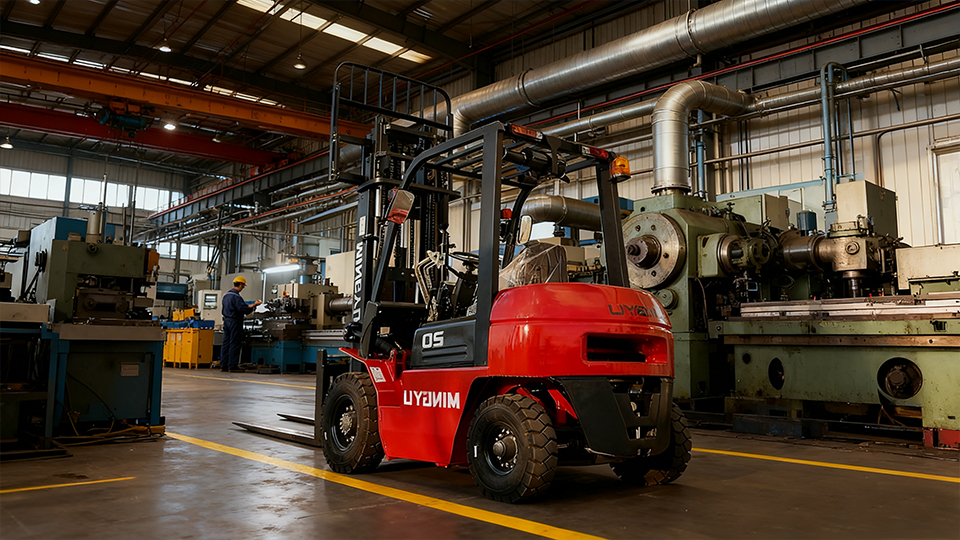
The overhead guard, often colloquially referred to as the "roll cage" or "operator protection structure," is a mandatory safety component installed above the operator compartment on high-lift rider trucks, order pickers, and rough-terrain forklifts. According to OSHA standard 29 CFR 1910.178(e)(1), all such vehicles must be equipped with an overhead guard manufactured in accordance with ANSI B56.1-1969, "Safety Standard for Low and High Lift Trucks," unless operating conditions specifically prohibit their use .
The primary function of the overhead guard is to protect operators from falling objects—specifically small packages, boxes, bagged materials, and debris that may dislodge from elevated racks or loads during placement and retrieval operations . However, crucially, these structures are explicitly not designed to withstand the impact of a full capacity load dropped from maximum lift height . This limitation fundamentally shapes the design philosophy behind the open roof structure.
The Engineering Rationale for Open Roof Design
Load Deflection and Energy Absorption
The most compelling technical reason for the open roof design lies in impact mechanics and energy dissipation. When a falling object strikes an overhead guard, the structure must manage kinetic energy in a way that protects the operator. ANSI testing protocols evaluate overhead guards for "crush or maximum deformation" rather than deflection capability . The designated test involves dropping a specified weight and size of lumber bundle from a defined height, with the guard required to maintain minimum distances between the seat and steering wheel to preserve operator survival space.
A solid roof would behave differently under impact. Rather than allowing controlled deformation and potential deflection of falling objects, a rigid enclosed structure might transfer excessive force to the mounting points or create dangerous ricochet patterns. The open design with structural cross-members allows the guard to absorb energy through controlled deformation—specifically, the leg receiving the maximum impact is engineered to "crush and deflect" the load to one side, away from the operator .
Weight and Center of Gravity Considerations
Forklifts operate under strict stability constraints governed by the "stability triangle" principle. Adding a solid roof would introduce significant weight high above the vehicle's center of gravity, potentially compromising stability during turns, grade operations, and load handling. The open-frame design minimizes this top-heavy effect while providing necessary structural protection.
Visibility Requirements
Operator visibility is paramount for safe forklift operation. OSHA regulations explicitly state that overhead guards "shall not obstruct the operator's view" . A solid roof would create blind spots during critical operations, particularly when placing loads at elevation or navigating narrow aisles. The open structure allows operators to look upward during load placement, ensuring precise positioning while maintaining awareness of overhead hazards.
Regulatory Specifications: The 6-Inch Rule
OSHA standard 29 CFR 1917.43 provides specific dimensional requirements for overhead guard openings: "openings in the top of the guard shall not exceed 6 inches (15.24 cm) in one of the two directions, width or length" . This specification represents a carefully calculated compromise—openings small enough to prevent the smallest unit of handled cargo from falling through, yet large enough to maintain the structural and functional benefits of the open design.
The standard includes an important exception: "Larger openings are permitted if no opening allows the smallest unit of cargo being handled to fall through the guard" . This flexibility acknowledges that different operational contexts—handling bulk materials versus unitized loads—may require adapted protection strategies.
Ventilation and Environmental Factors
Operator Comfort and Heat Management
Forklift operators often work extended shifts in environments that may lack climate control. A solid roof would create a greenhouse effect within the operator compartment, potentially exposing workers to heat stress and reducing concentration. The open design facilitates natural ventilation, allowing hot air to rise and escape while permitting airflow through the operator zone.
This consideration extends to combustion-engine forklifts, where operator exposure to exhaust heat and vibration is already a concern. Enclosing the overhead space would exacerbate these thermal management challenges.
Emergency Egress
In the event of tip-over or collision, the open roof structure provides an additional egress path for operators. While seatbelts and operator restraints are designed to keep workers within the protective zone during overturn events, emergency situations may require rapid exit. A solid roof would complicate extraction procedures and potentially delay emergency response.
Structural Integrity and Maintenance Considerations
Inspection Protocols
Daily pre-operation inspections must include overhead guard assessment for "broken welds, missing bolts, or other damage" . The open-frame design facilitates visual inspection of all structural members, whereas a solid roof would conceal potential fatigue cracks or connection failures until catastrophic failure occurred.
Repair Limitations
Industry standards prohibit welding overhead guards as an acceptable repair method . The open structure allows for easier assessment of damage extent and determination of replacement necessity. When guards are damaged, the entire assembly typically requires replacement rather than repair—a safety protocol that ensures structural integrity isn't compromised by substandard field repairs.
Mounting and Modification Constraints
Additions to overhead guards—such as brackets for inventory control equipment, radios, weather protection, or lighting—must be mounted using clamp brackets or manufacturer-approved methods . The open structure accommodates these accessories without compromising the guard's protective function, whereas a solid roof would limit mounting options and potentially create water infiltration points.
Specialized Variations: When Open Isn't Optional
Folding Overhead Guards
Certain operational environments present height restrictions that conflict with standard overhead guard dimensions. Folding overhead guards address these constraints by allowing the structure to collapse or fold down, enabling access to areas with low overhead clearance . Once clear of restrictions, the guard raises to provide full protection. This adaptation maintains the open-design philosophy while adding operational flexibility.
Enclosed Cab Options
For extreme weather conditions or specialized applications, manufacturers offer fully enclosed cabs with solid roofs. These configurations represent a different safety paradigm—trading the falling-object protection characteristics of standard overhead guards for environmental protection. Such cabs must meet distinct structural requirements and are typically equipped with reinforced framing to compensate for the enclosed design's structural limitations.
The Physics of Falling Object Protection
Understanding why open roofs suffice requires examining the physics of warehouse operations. Most falling object incidents involve:
Small items dislodged during load placement
Packaging materials or debris from elevated racks
Partial load shifts during transport
These hazards typically present as relatively low-mass projectiles. The overhead guard's cross-members provide sufficient surface area to intercept and deflect such objects while allowing larger, more dangerous loads (which the guard isn't designed to stop anyway) to pass through rather than transferring catastrophic impact forces to the operator compartment.
ANSI testing protocols reflect this reality: the specified lumber bundle test load represents realistic falling object scenarios rather than worst-case capacity load drops . The open design acknowledges that protecting against the most common hazards (small falling objects) is achievable, while protection against catastrophic load drops (full capacity loads from maximum height) would require impractical structural mass and compromise other safety factors.
Operational Best Practices
The open roof design necessitates complementary safety measures:
Hard Hat Requirements: When operating in environments with elevated falling object risks, operators should wear hard hats for additional protection .
Load Backrest Extensions: Required when load types present rearward fall hazards, these extensions minimize the possibility of load portions falling backward onto the operator .
Proper Positioning: Operators must keep hands and feet within the forklift's protective envelope to avoid exposure to falling loads .
Clearance Awareness: The open design requires operators to maintain awareness of overhead installations—lights, sprinklers, pipes—that may present strike hazards .
Conclusion
The open roof structure of forklift overhead guards represents a sophisticated engineering solution to multifaceted safety challenges. By balancing falling object protection, visibility requirements, weight distribution, ventilation needs, and emergency egress considerations, the design achieves optimal protection against the most probable hazards while acknowledging the physical limitations of mobile equipment.
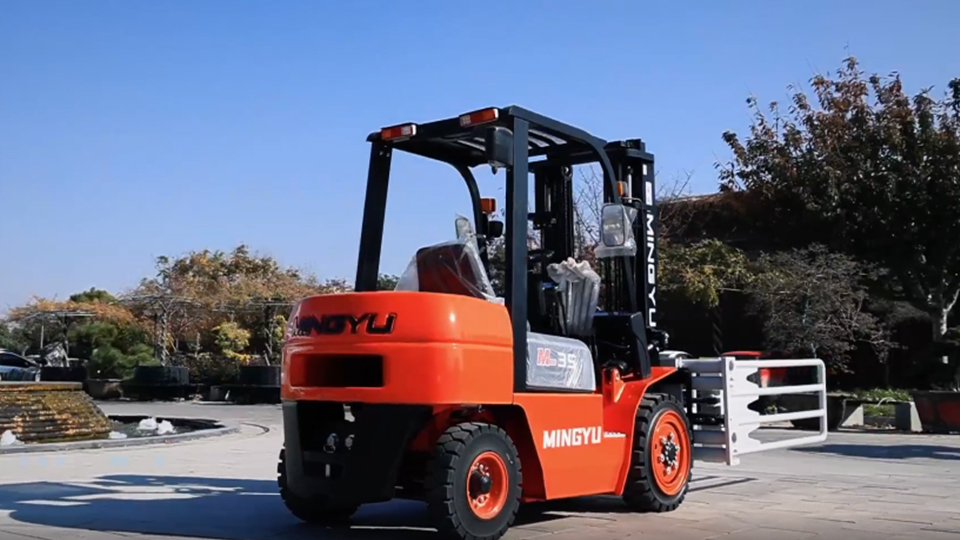
This configuration is not merely a regulatory compliance checkbox but a testament to iterative safety engineering. The ANSI B56.1 standards and OSHA regulations governing overhead guard design reflect decades of incident analysis, material science advancement, and operational feedback. The 6-inch opening limitation, the crush-and-deflect energy management strategy, and the prohibition against full enclosure all serve specific protective functions.
As warehouse operations evolve—with higher rack storage, automated systems, and changing load characteristics—overhead guard design continues to adapt. However, the fundamental open-structure philosophy persists because it addresses an immutable truth of forklift operation: the most effective protection balances multiple risks rather than optimizing for single-hazard scenarios. The gap in the roof isn't a design flaw—it's a carefully calculated safety feature that protects operators while preserving the operational capabilities essential to modern material handling.
Name: selena
Mobile:+86-13176910558
Tel:+86-0535-2090977
Whatsapp:8613181602336
Email:vip@mingyuforklift.com
Add:Xiaqiu Town, Laizhou, Yantai City, Shandong Province, China
