
vip@mingyuforklift.com
+86-0535-2090977

Abstract
Free lift represents one of the most critical yet frequently misunderstood engineering principles in material handling equipment. This technical article provides a comprehensive examination of free lift mechanisms in forklift masts, exploring their hydraulic architecture, operational physics, safety implications, and industrial applications. From the simplex masts with 4-6 inches of limited free lift to sophisticated quad-stage masts achieving full free lift capabilities, we analyze how this design feature enables operation in confined vertical spaces while presenting unique visibility and stability trade-offs. Through detailed exploration of hydraulic cylinder configurations, chain-pulley systems, and mast staging dynamics, this article establishes free lift as a fundamental determinant of forklift functionality in modern warehouse environments.
1. Introduction: Defining Free Lift
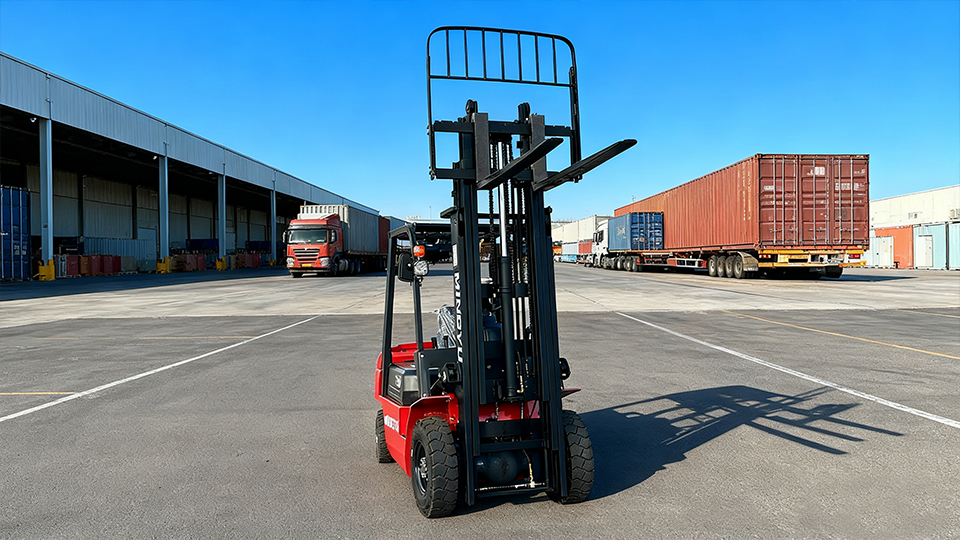
Free lift, in technical terms, refers to the maximum vertical distance that a forklift's forks and carriage assembly can be raised without extending the mast's outer rail sections . This measurement determines the forklift's ability to lift loads in environments with restricted overhead clearance—such as shipping containers, trailers, rail cars, and low-ceiling warehouses—without the mast structure itself increasing in height.
The concept emerges from a fundamental challenge in forklift design: the need to maximize lifting height while minimizing the equipment's collapsed height for maneuverability. Without free lift capability, any elevation of the load requires proportional extension of the entire mast structure, creating operational impossibilities in confined spaces. Free lift mechanisms solve this engineering problem through sophisticated hydraulic and mechanical systems that decouple fork elevation from mast extension during initial lifting phases.
Understanding free lift requires familiarity with several related dimensional specifications:
Overall Height Lowered (OHL): The total height from floor to top of collapsed mast, determining doorway and clearance passage capability
Maximum Fork Height (MFH): The highest elevation reachable by forks with mast fully extended
Free Fork Height (FFH): The specific measurement of vertical lift achievable before mast extension begins
Overall Height Raised (OHR): The total vertical space required when mast achieves full extension
2. The Physics and Engineering of Free Lift Mechanisms
2.1 Hydraulic System Architecture
Free lift functionality depends on specific hydraulic cylinder configurations within the mast assembly. Standard masts without free lift utilize side-mounted lift cylinders that raise inner mast rails directly, with chains providing 2:1 mechanical advantage to the carriage . In this configuration, any cylinder extension immediately produces mast rail elevation.
Free lift masts incorporate a primary center-mounted cylinder (variously termed the free-lift cylinder, primary lift cylinder, or main hoist cylinder) that operates independently from secondary lift mechanisms . This cylinder attaches directly to the carriage assembly, raising forks through its full stroke before engaging the mast's telescoping sections. The hydraulic circuit includes valving that redirects fluid flow: initially to the free-lift cylinder, then to secondary cylinders that extend the mast rails once the primary cylinder reaches full extension.
The mechanical advantage calculations differ between these systems. Free lift cylinders typically operate at 2:1 ratios—two inches of fork elevation per inch of cylinder rod extension—matching standard mast chain systems but achieving this movement without rail extension . This requires precise synchronization between cylinder staging and chain-pulley systems to prevent binding or uneven loading.
2.2 Mast Staging and Telescoping Dynamics
Free lift capability correlates directly with mast staging—the number of nested rail sections comprising the vertical assembly. Each mast type presents distinct free lift characteristics:
Simplex (Single-Stage) Masts: These basic assemblies provide limited free lift of 4-6 inches . The minimal free lift exists primarily to enable load engagement and initial elevation before the single mast channel must extend. Simplex masts find application in outdoor environments without overhead constraints, where their structural simplicity and enhanced visibility outweigh free lift limitations .
Duplex (Two-Stage) Masts: Available in two configurations:
Standard duplex: Side-mounted cylinders provide direct rail lift with minimal free lift (typically 12-24 inches)
Full free lift duplex: Center-mounted primary cylinder enables 50-60 inches of free lift, allowing fork elevation to the top of inner rails before secondary cylinders engage
Triplex (Three-Stage) Masts: The most common configuration in modern warehousing, providing full free lift of 50-60 inches with three nested rail sections enabling maximum fork heights of 4.5-6.5 meters . The outer rails remain stationary during free lift, while middle and inner rails telescope during extended lifting phases.
Quad (Four-Stage) Masts: Designed for specialized high-stacking applications, maintaining equivalent free lift (50-60 inches) to triplex masts but achieving greater maximum fork heights through additional telescoping sections . These masts require careful stability management due to extended load centers at maximum height.
2.3 Chain-Pulley Systems and Mechanical Advantage
The free lift mechanism's mechanical efficiency depends on chain-pulley configurations that multiply hydraulic force. In triplex masts with full free lift:
Primary stage: The free-lift cylinder raises carriage directly via chains fixed to outer rails and engaging pulleys on the cylinder assembly, achieving 2:1 movement ratio
Secondary stage: Upon primary cylinder full extension, hydraulic fluid redirects to secondary cylinders attached to intermediate rails. These cylinders lift middle rails directly while chains pull inner rails and carriage at 4:1 movement ratio
Tertiary stage: Additional chain sets enable the fourth stage in quad masts, maintaining mechanical advantage while extending reach
This cascading mechanical system ensures that operators can lift substantial loads during free lift phases without requiring excessive hydraulic pressure, while maintaining control precision throughout the full vertical range.
3. Operational Applications and Environmental Considerations
3.1 Container and Trailer Operations
Free lift capability proves essential in intermodal freight handling. Standard shipping containers present internal heights of approximately 2.59 meters (8.5 feet) or 2.89 meters (9.5 feet) for high-cube units, with door openings slightly smaller due to structural components. Forklifts operating within these constraints must lift pallets to stacking heights without mast extension contacting container roofs or door headers.
Container specification masts (typically triplex with full free lift) are specifically engineered for this application, featuring collapsed heights below 2.3 meters and free lift capabilities enabling 4.3-meter stacking within containers . The "container mast" designation indicates both free lift functionality and reduced overall lowered height, distinguishing these units from general warehouse equipment.
Rail car operations present similar constraints, with boxcar internal heights typically ranging from 3.0-3.3 meters and door openings limiting vertical clearance. Free lift enables double-stacking of pallets—placing one load atop another—without requiring mast extension that would exceed car dimensions .
3.2 Warehouse and Distribution Center Applications
Modern warehousing increasingly emphasizes vertical space utilization, with racking systems extending 6-12 meters and aisle widths minimized to maximize storage density. Free lift masts enable operation in these environments through:
Low-ceiling maneuvering: Navigation beneath mezzanine floors, conveyor systems, and building infrastructure while maintaining load elevation capability
Doorway passage: Movement between building sections without lowering loads, maintaining operational efficiency
Rack entry: Precise load placement at various heights without mast extension interfering with rack structures
The trade-off involves visibility constraints. Standard masts with side-mounted cylinders provide unobstructed forward view through the mast assembly. Full free lift masts with center-mounted cylinders necessarily position hydraulic mechanisms within the operator's sightline, requiring Free View mast alternatives that use dual side-mounted free-lift cylinders to restore visibility .
3.3 Load Stability and Center of Gravity Dynamics
Free lift operation affects forklift stability through center of gravity management. During free lift phases, the load remains within the collapsed mast envelope, maintaining relatively low center of gravity and favorable stability characteristics. As lifting progresses to mast extension stages, the load center moves upward and potentially forward, reducing load capacity according to forklift stability ratings .
Manufacturers provide residual capacity charts (or load capacity charts) specifying maximum safe loads at various heights and load centers. These charts typically show capacity degradation as mast stages extend, with quad masts presenting the most pronounced reduction due to their extreme reach capabilities . Operators must understand that free lift enables initial elevation but does not override fundamental stability limitations at extended heights.
4. Technical Specifications and Measurement Standards
4.1 Free Lift Quantification
Free lift measurements follow standardized protocols established by the Industrial Truck Standards Development Foundation (ITSDF) and American National Standards Institute (ANSI B56.1). Key specifications include:
Mast Type Free Lift Range Maximum Fork Height Typical Application
Simplex 4-6 inches (100-150mm) 2.0-2.5 meters Outdoor, no height restrictions
Standard Duplex 12-24 inches (300-600mm) 3.0-4.5 meters General warehousing
Full Free Lift Duplex 50-60 inches (1.25-1.5m) 3.0-4.5 meters Trailers, containers
Triplex 50-60 inches (1.25-1.5m) 4.5-6.5 meters High-bay warehousing
Quad 50-60 inches (1.25-1.5m) 6.0-12.0 meters Specialized high stacking
These measurements assume standard fork thicknesses and carriage configurations; actual free lift may vary slightly based on chain tension, fork wear, and hydraulic system condition .
4.2 Visibility and Ergonomic Considerations
The engineering trade-off between free lift capability and operator visibility represents a critical design consideration. Central-mounted free-lift cylinders, while enabling full free lift functionality, occupy visual space within the mast assembly. This obstruction affects:
Load engagement precision: Reduced visibility when positioning forks beneath pallets
Travel safety: Impaired sightlines when moving with elevated loads
High stacking accuracy: Difficulty aligning loads with rack beams at extended heights
Free View mast designs address these limitations by repositioning hydraulic cylinders to the outer rail sides, creating a clear central sight window . However, this configuration may slightly reduce free lift capacity or increase mast width, presenting alternative engineering compromises.
5. Safety Protocols and Operational Best Practices
5.1 Pre-Operational Inspection Requirements
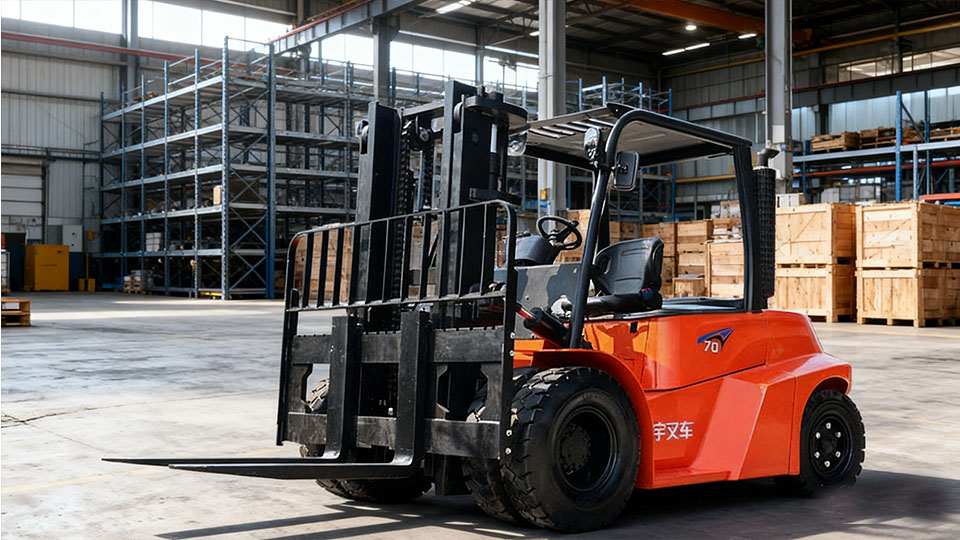
OSHA Standard 1910.178 mandates daily inspection of forklift lifting mechanisms, with specific attention to free lift components . Operators must verify:
Chain condition: No broken links, excessive wear, or improper tension that could affect free lift smoothness
Hydraulic integrity: Absence of leaks in free-lift cylinder seals and hose connections
Synchronization: Smooth transition between free lift and mast extension phases without binding or jerking
Load backrest: Secure attachment preventing load rearward displacement during free lift operations
Failure of free lift mechanisms during operation can result in sudden load drops or uncontrolled mast extension, presenting severe crush and impact hazards .
5.2 Operational Limitations and Prohibitions
Free lift capability does not override fundamental safety limitations. Critical operational prohibitions include:
Free lift alone for travel: Loads elevated solely by free lift (without mast extension) maintain high centers of gravity relative to wheelbase, reducing stability during movement. Operators should minimize travel with free-lifted loads and reduce speeds accordingly.
Exceeding rated capacity: Free lift mechanisms are engineered for specific load weights; exceeding ratings strains hydraulic systems and compromises safety.
Side loading: Free lift cylinders and chains assume vertical loading; horizontal forces from side shifts or uneven loading accelerate wear and potential failure.
6. Technological Evolution and Future Developments
6.1 Electro-Hydraulic Integration
Modern forklifts increasingly incorporate electronic control systems managing free lift operations. Sensors monitor mast position, load weight, and elevation height, automatically adjusting hydraulic flow to optimize free lift transitions and prevent overload conditions. These systems enable active stability control, restricting free lift speed or maximum height based on real-time stability calculations .
6.2 Alternative Lifting Mechanisms
Research into alternative lifting technologies explores options beyond traditional hydraulic free lift systems:
Linear actuators: Electric screw-jack mechanisms offering precise positioning without hydraulic fluid
Pneumatic assist systems: Compressed air supplementation reducing hydraulic system demands
Counterweight-assisted lift: Mechanical advantage systems using adjustable counterbalances
These technologies promise enhanced energy efficiency and reduced maintenance, though hydraulic free lift remains dominant due to its power density and proven reliability.
7. Conclusion
Free lift represents a sophisticated engineering solution to the fundamental challenge of vertical space constraints in material handling. Through hydraulic cylinder staging, chain-pulley mechanical advantage, and telescoping mast architectures, free lift mechanisms enable forklifts to operate in environments—from shipping containers to high-bay warehouses—that would otherwise be inaccessible.
The technical evolution from simplex masts with minimal free lift to sophisticated quad-stage systems with full free lift capability demonstrates the material handling industry's response to changing logistics demands. As warehousing verticalization continues and intermodal freight handling intensifies, free lift technology remains essential infrastructure for global supply chain operations.
Understanding free lift—its mechanical principles, operational applications, safety implications, and design variations—is essential for forklift operators, fleet managers, and facility planners. This knowledge ensures appropriate equipment selection, safe operational practices, and optimal utilization of vertical storage space in increasingly constrained industrial environments.
Name: selena
Mobile:+86-13176910558
Tel:+86-0535-2090977
Whatsapp:8613181602336
Email:vip@mingyuforklift.com
Add:Xiaqiu Town, Laizhou, Yantai City, Shandong Province, China
