
vip@mingyuforklift.com
+86-0535-2090977

Will We Have Forklifts in Star Citizen? A Technical Deep Dive
The Industrial Gameplay Imperative
Star Citizen's development trajectory has consistently pointed toward a fully realized simulation of spacefaring civilization, and industrial gameplay represents one of the most significant frontiers yet to be fully conquered. While players currently engage in mining, cargo hauling, and refining operations, the granular logistics layer—the actual movement of goods within stations, hangars, and planetary facilities—remains conspicuously underdeveloped. This is precisely where industrial vehicles like forklifts enter the conversation, not merely as cosmetic additions but as essential infrastructure for the game's economic simulation.
The question isn't whether forklifts would fit Star Citizen's vision—they absolutely would—but rather how Cloud Imperium Games (CIG) might implement them given the technical constraints of the Star Engine and the design philosophy underpinning the persistent universe. To understand this, we must examine the intersection of vehicle physics, cargo mechanics, player interaction systems, and server meshing architecture.
Current Cargo Handling: The Missing Link
Presently, cargo in Star Citizen exists in several states: physicalized crates that can be manually carried (the infamous "hand tractor" mechanic), vehicle-mounted containers, and abstracted inventory within ships and stations. The manual carrying mechanic, while immersive in concept, proves tedious at scale. Players transporting hundreds of SCU (Standard Cargo Units) find themselves locked in repetitive traversal gameplay that breaks the immersion the game otherwise strives to maintain.
The introduction of the RAFT and Hull series ships demonstrated CIG's commitment to containerized cargo, yet the loading and unloading process remains either automated (via ship systems) or entirely abstracted. There's no intermediate layer where players or NPCs physically manipulate container placement—no moment where cargo transitions from ship storage to station storage through tangible mechanical intervention.
Forklifts would bridge this gap. They would serve as the connective tissue between ship cargo holds and station logistics networks, transforming loading operations from menu-driven abstractions into skill-based physical interactions. This aligns perfectly with Star Citizen's core design tenet: first-person immersion where mechanics matter.
Technical Architecture: Physics and Grid Systems
Implementing functional forklifts in Star Engine presents fascinating technical challenges. The engine's physics grid system, which allows seamless transitions between planetary surfaces, ship interiors, and space environments, would need to accommodate industrial vehicles with specific mechanical behaviors.
The Physics of Lifting
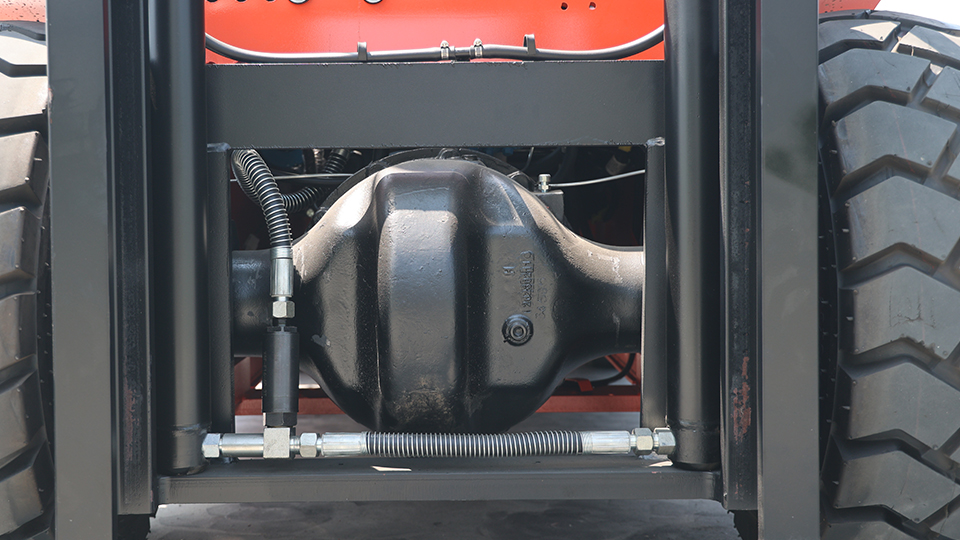
Forklifts operate on principles fundamentally different from wheeled vehicles currently in-game. The telescoping mast mechanism, hydraulic lifting systems, and counterweight physics require specialized simulation. Unlike the Cyclone or Ursa Rover, which operate as rigid bodies with suspension, forklifts introduce articulated mechanics where the vehicle's center of mass shifts dynamically based on load position and height.
Star Engine's physics implementation would need to handle:
Variable center of mass calculations: As forks raise or lower, and as cargo weight changes, the vehicle's stability characteristics must update in real-time. This affects traction, tipping thresholds, and handling on inclined surfaces.
Hydraulic simulation: The lifting mechanism requires pressure-based physics where raising heavy loads depletes "hydraulic energy" (simulated through animation states and force calculations), potentially introducing overheating mechanics or power draw from vehicle batteries.
Fork penetration and gripping: Cargo containers must detect fork insertion depth and grip friction. Too shallow, and the load tips; too much torque during turns, and containers slide off. This necessitates enhanced collision detection beyond simple bounding boxes.
Container Interaction Systems
Star Citizen's cargo containers currently exist as static physics objects with attachment points. Forklift implementation would require dynamic parenting systems where containers transition from "world physics" to "vehicle-attached" states based on fork position and player input.
The technical challenge lies in network synchronization. With server meshing distributing physics calculations across multiple servers, forklift operations must maintain consistency across server boundaries. If a player drives a loaded forklift from one physics grid to another (say, from a station hangar into a ship cargo bay), the handoff must preserve cargo attachment, load stability, and player control without desynchronization artifacts.
CIG's ongoing work on Entity Component System (ECS) architecture provides the foundation for this. ECS enables efficient batching of similar object updates—ideal for scenarios where multiple forklifts operate simultaneously in busy spaceports. Each forklift becomes an entity with position, velocity, load state, and hydraulic status components, processed efficiently by the server mesh.
Gameplay Design: Skill Expression and Economic Impact
Forklifts in Star Citizen wouldn't merely be transportation tools; they'd represent a distinct gameplay loop with skill expression, economic value, and risk-reward calculations.
The Logistics Gameplay Loop
Consider the following scenario: A Hull C arrives at Port Olisar with 460 SCU of refined ore. Currently, this unloads automatically or through abstracted mechanics. With forklift implementation:
Contract generation: The station posts logistics contracts requiring specific cargo movement within timeframes, with penalties for damage or delays.
Vehicle deployment: Players or NPCs retrieve forklifts from station vehicle bays—specialized hangars with charging stations and maintenance facilities.
Physical unloading: Forklift operators navigate to the Hull C's cargo bay, align with container slots, and physically extract containers using fork mechanisms. Precision matters; misalignment damages cargo value.
Transport and stacking: Operators move containers to designated storage areas, potentially stacking them (introducing verticality to cargo management) or transferring them to smaller distribution vehicles.
Maintenance and economics: Forklifts require fuel/charging, repairs from collisions or overloading, and skill progression for operators (faster lifting, better stability, increased capacity).
This loop transforms logistics from waiting gameplay into active, skill-based employment. It creates entry-level gameplay for new players (forklift certification missions) while providing essential services to industrial players.
Risk and Emergent Gameplay
Forklifts introduce new vectors for emergent gameplay and risk:
Piracy and theft: Unattended forklifts with valuable cargo become targets. Do you leave your forklift running while checking manifests, risking hijacking?
Accidents and insurance: Overloaded forklifts tipping in high-traffic areas create liability questions. CIG's planned insurance and legal systems would need to account for industrial vehicle accidents.
Competition and sabotage: Rival logistics companies might "accidentally" damage competitors' cargo or block access to loading zones, creating organic conflict requiring security intervention.
Asset Pipeline and Development Priorities
From a production standpoint, forklift implementation requires significant asset creation and systems integration, raising questions about development priority.
Vehicle Design Variants
Star Citizen's industrial aesthetic demands forklifts that fit the universe's design language—utilitarian, manufacturer-branded, and technologically coherent. Potential variants include:
Argo Astronautics ALV-1: A compact, hydrogen-powered forklift designed for space station operations, featuring magnetic stabilization for zero-gravity cargo handling.
Greycat Industrial GCL-4: A planetary workhorse with ruggedized suspension for rough terrain loading at mining outposts.
Aopoa Xi'an-inspired grav-lifter: Advanced anti-gravity cargo manipulation for high-value, delicate loads, representing alien technology integration.
Each variant requires modeling, texturing, animation rigging for hydraulic systems, and physics tuning—substantial development resources.
Integration with Existing Systems
Forklifts must interface with:
Inventory management: Reading cargo manifests, tracking container contents, updating station storage databases.
Mission system: Generating and completing logistics contracts, tracking performance metrics.
AI navigation: NPC forklift operators need pathfinding through complex station geometries, collision avoidance with players and other vehicles, and priority handling for emergency situations.
Persistence: Cargo positions must save correctly across server restarts; forklifts must remember fuel levels, damage states, and parking locations.
Given CIG's current focus on Squadron 42, server meshing completion, and core gameplay loops (mining, combat, trading), forklift implementation likely falls into the "post-launch expansion" category. However, foundational work on physics grids, cargo systems, and vehicle mechanics proceeds in parallel, potentially accelerating future implementation.
Comparative Analysis: Other Simulation Games
Examining forklift implementation in comparable titles illuminates both possibilities and pitfalls.
Space Engineers
Keen Software House's Space Engineers features functional forklifts and industrial vehicles using voxel-based physics. While mechanically satisfying, the implementation suffers from desynchronization in multiplayer and "janky" collision detection—precisely the issues CIG seeks to avoid with Star Engine's authoritative server architecture.
American Truck Simulator / Euro Truck Simulator 2
SCS Software's approach to logistics emphasizes methodical, realistic vehicle operation. Their forklift DLC demonstrates that players willingly engage with slow, precise vehicle operation when the simulation fidelity justifies it. Star Citizen could adopt similar pacing—forklifts as deliberate, methodical gameplay rather than fast-paced action.
Elite Dangerous: Odyssey
Frontier's attempt at on-foot gameplay included basic logistics elements but failed to integrate them meaningfully with the core ship-based experience. This highlights the importance of seamless transition—forklifts must feel like natural extensions of cargo gameplay, not isolated minigames.
The Server Meshing Factor
Server meshing, CIG's solution to scaling the persistent universe, fundamentally enables forklift gameplay. Traditional MMO architectures struggle with high-density physics simulations in concentrated areas (imagine fifty players operating forklifts simultaneously in a major spaceport). Server meshing distributes these calculations, allowing:
Localized physics servers: Dedicated processing for busy hangar areas where multiple forklifts operate simultaneously.
Dynamic server allocation: As industrial activity increases in specific locations, additional server resources spin up to maintain simulation fidelity.
Seamless handoffs: Forklifts moving between station sections transition between physics servers without gameplay interruption.
Without server meshing, forklift implementation would be limited to low-population instances, undermining the economic viability of logistics gameplay. Its completion removes this barrier.
Conclusion: Inevitability, Not Improbability
Will we have forklifts in Star Citizen? The technical foundations are being laid. The design justification is compelling. The gameplay potential is substantial. Yet the implementation timeline remains uncertain, contingent on core technology completion and resource allocation.
What seems certain is that industrial vehicles represent the next frontier for Star Citizen's physicalized simulation. As the game matures beyond combat and exploration toward economic depth, the granular logistics layer becomes essential. Forklifts, cargo loaders, and industrial drones will transition from community wishlist items to development priorities.
When they arrive, they won't be simple transportation—they'll be the physical manifestation of Star Citizen's economic simulation, the moment where abstract cargo manifests become tangible boxes moved by skilled operators. They'll create employment for new players, depth for industrialists, and emergent stories of heists, accidents, and logistical triumphs.
The question isn't if, but when—and whether the implementation honors the ambition that defines Star Citizen's development philosophy. Based on CIG's track record with complex vehicle systems and the technical groundwork currently underway, the future of space logistics looks mechanized, physicalized, and deeply immersive. The forklifts are coming; the only uncertainty is which patch will bring the first beep of a reversing alarm to the hangars of the 'verse.
Name: selena
Mobile:+86-13176910558
Tel:+86-0535-2090977
Whatsapp:8613181602336
Email:vip@mingyuforklift.com
Add:Xiaqiu Town, Laizhou, Yantai City, Shandong Province, China