
vip@mingyuforklift.com
+86-0535-2090977

Executive Summary
Forklift stability is governed by fundamental physical principles that, when violated through improper loading practices, create catastrophic failure modes. Improper loading—encompassing overloading, uneven weight distribution, incorrect load positioning, and dynamic load mismanagement—represents the primary contributing factor in approximately 42% of all forklift tip-over incidents . This technical analysis examines the biomechanical relationships between load characteristics and forklift stability, quantifies the safety degradation resulting from specific loading violations, and establishes evidence-based protocols for risk mitigation in material handling operations.
The Physics of Forklift Stability
The Stability Triangle Concept
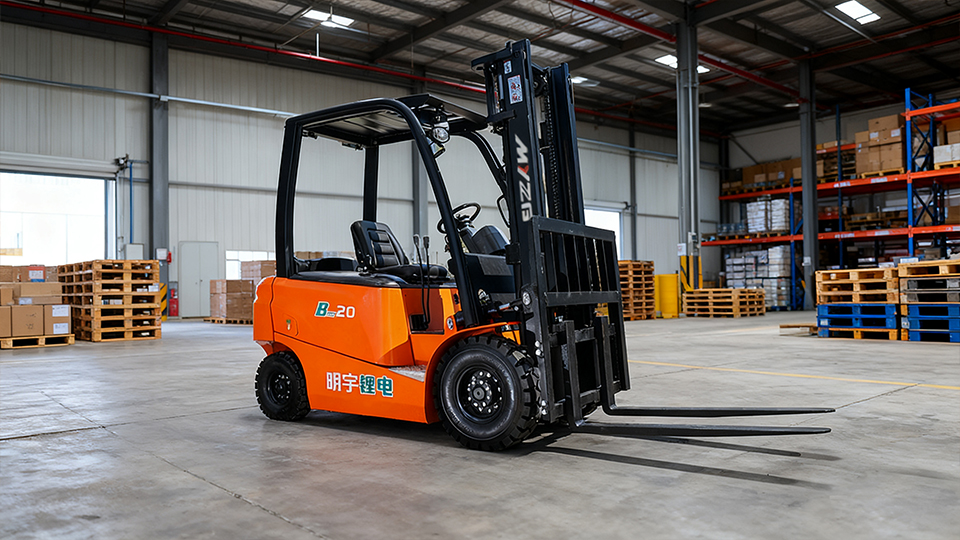
Forklift stability is defined by a three-point suspension system forming what industry professionals term the "stability triangle." Two points of this triangle rest at the front axle ends (the drive wheels), while the third point is located at the pivot pin in the center of the rear steer axle . The combined center of gravity of the forklift and its load must remain within the boundaries of this triangle to prevent tip-over.
When a forklift operates without a load, its center of gravity is positioned within the stability triangle, typically located beneath the operator's seat in sit-down models . The introduction of a load shifts the combined center of gravity forward toward the front axle (the fulcrum point) and upward toward the apex of the stability triangle . This shift is mathematically predictable but operationally hazardous when loading parameters exceed design specifications.
Load Center Dynamics
The load center is defined as the horizontal distance from the vertical face of the forks to the center of gravity of the load. Standard North American forklifts are rated assuming a 24-inch load center, which corresponds to a standard 48-inch square pallet with evenly distributed weight . When load centers extend beyond this specification—whether through longer loads, uneven weight distribution, or improper fork positioning—the effective lifting capacity decreases according to the formula: Actual Capacity = (Rated Load Center / Actual Load Center) × Rated Capacity .
For example, a forklift rated for 5,000 pounds at a 24-inch load center experiences capacity reduction to approximately 3,333 pounds when handling a load with a 36-inch center of gravity. Operators unaware of this relationship routinely overload equipment while believing they operate within rated limits.
Overloading: The Primary Stability Violation
Mechanical Consequences
Overloading generates immediate mechanical stresses that compromise multiple safety systems. When load weight exceeds rated capacity, the combined center of gravity shifts forward beyond the front axle, causing the rear steer wheels to lose contact with the ground . This wheel lift eliminates steering control, rendering the operator unable to correct trajectory or prevent collision.
Hydraulic systems experience proportional stress increases. Overloaded lifts place excessive pressure on hydraulic cylinders, hoses, and seals, accelerating wear and increasing catastrophic failure probability. The structural integrity of the mast, carriage, and fork assembly undergoes similar degradation; repeated overloading initiates metal fatigue that may result in sudden component failure during subsequent operations .
Statistical Significance
OSHA data indicates that tip-overs account for the largest percentage of forklift accidents at 42%, with overloading representing a primary causal factor . Approximately 24% of all industrial truck accidents involve overturning or tipping, with over 25% of fatal tip-over accidents involving victims crushed between the forklift and a surface . These statistics underscore that overloading is not merely an operational inefficiency but a life-critical safety violation.
Uneven Load Distribution: The Hidden Hazard
Lateral Instability Mechanisms
While overloading is visually obvious, uneven load distribution creates insidious stability risks that operators may fail to recognize. When weight is concentrated on one fork or shifted to either side of the centerline, the combined center of gravity moves laterally toward the stability triangle's edge . This lateral shift dramatically reduces the margin of safety for turns, slopes, or dynamic maneuvers.
The consequences manifest primarily as sideways (lateral) tip-overs. When a forklift turns, centrifugal force generates additional lateral weight transfer. If the load is already unevenly distributed, the combined effect of pre-existing lateral center-of-gravity offset and dynamic turning forces can shift the center of gravity outside the stability triangle . This mechanism explains why approximately 11% of fatal forklift accidents involve being crushed between two forklift vehicles—operators losing control due to lateral instability often collide with nearby equipment or structures .
Longitudinal Instability from Load Positioning
Load positioning along the fork length creates longitudinal stability risks. Loads placed too far forward on the forks extend the load center beyond rated specifications, effectively overloading the forklift even when total weight remains within rated capacity . This forward positioning generates a lever arm that amplifies the destabilizing moment.
Conversely, loads positioned too far rearward—while theoretically more stable—create operational hazards by reducing ground clearance and potentially contacting the mast or load backrest during elevation. The optimal load position places the center of gravity as close to the carriage as possible while maintaining full fork insertion and adequate clearance .
Dynamic Loading Effects
Acceleration and Deceleration Forces
Static load calculations assume stationary or constant-velocity operation. Dynamic forces generated during acceleration, braking, and direction changes fundamentally alter stability calculations. Rapid acceleration shifts the center of gravity rearward, potentially causing rearward tip-over (longitudinal instability) . Sudden braking generates forward momentum that, when combined with elevated load heights, can shift the center of gravity beyond the stability triangle's forward boundary .
The relationship between speed and stability is exponential. Kinetic energy increases with the square of velocity, meaning that doubling travel speed quadruples the destabilizing forces available to disrupt equilibrium. This mathematical reality explains why excessive speed contributes so significantly to tip-over incidents—approximately 8% of forklift fatalities involve loads falling on operators or bystanders, often resulting from sudden stops that shift unsecured loads .
Grade and Slope Interactions
Operating on slopes introduces geometric complexity to stability calculations. When a forklift is positioned on an incline, the entire stability triangle tilts relative to the horizontal plane . This tilting reduces the effective stability margin in the downhill direction while apparently increasing it uphill.
Improper loading exacerbates grade-related instability. When ascending a slope with a load, the combined center of gravity shifts both forward (due to the load) and downhill (due to the grade), potentially exceeding the stability triangle's forward boundary . When descending, the load's weight generates accelerating forces that braking must overcome, with improper load positioning amplifying these effects.
OSHA guidelines mandate that loads always be carried uphill—meaning when ascending, the load faces uphill; when descending, the forklift travels in reverse with the load still facing uphill . This positioning keeps the combined center of gravity within the stability triangle despite grade effects.
Height-Related Stability Degradation
Elevated Load Dynamics
As loads are elevated, the combined center of gravity moves upward toward the stability triangle's apex, effectively reducing the triangle's base and stability margin . At maximum lift heights, the center of gravity may approach the triangle's geometric center, leaving minimal margin for dynamic disturbances.
Traveling with elevated loads is consequently prohibited by safety regulations, yet remains a common operational violation. The practice combines the inherent instability of elevated centers of gravity with dynamic forces from travel, creating predictable tip-over risks . Safety protocols mandate that loads be carried no more than 4-6 inches above ground level during transport .
Mast Tilt Considerations
Mast tilt angle directly influences load center positioning. Forward tilt moves the load center away from the forklift, reducing capacity and stability . Rearward tilt moves the center of gravity toward the forklift, increasing stability but potentially creating load retention issues if excessive.
Improper loading compounds mast tilt risks. An already forward-shifted load center combined with forward mast tilt can immediately exceed stability limits. Operators must understand that mast movement when fully extended translates to magnified load center movement—a small tilt adjustment at height creates significant center-of-gravity displacement .
Attachment-Induced Loading Complications
Capacity Reduction Mechanics
Attachments fundamentally alter forklift loading dynamics. Side shifters, fork positioners, clamps, and rotators add weight to the carriage and extend the load center forward through their physical thickness—termed "lost load" . A side shifter weighing 400 pounds mounted 18 inches forward of the carriage face effectively reduces available capacity for actual loads while shifting the empty forklift's center of gravity forward.
OSHA regulations require updated data plates reflecting attachment-specific capacity ratings, yet many operations fail to maintain current documentation . Using standard capacity plates with attachments creates systematic overloading, as operators reference incorrect limits unaware of attachment-induced reductions.
Operational Complexity
Attachments introduce operational variables that increase improper loading probability. Clamp attachments require pressure adjustments based on load characteristics; insufficient pressure allows load slippage, while excessive pressure damages goods and alters weight distribution. Rotating attachments shift centers of gravity dynamically during operation, requiring continuous stability awareness.
Environmental Interactions with Improper Loading
Surface Condition Effects
Improper loading transforms minor surface irregularities into major hazards. A properly loaded forklift may traverse small potholes or expansion joints without incident; the same surface discontinuity with an overloaded or unevenly loaded forklift provides sufficient disturbance to shift the center of gravity outside the stability triangle .
Wet or contaminated surfaces reduce friction coefficients, preventing corrective steering inputs from generating expected vehicle response. When combined with improper loading, reduced traction eliminates the operator's ability to recover from developing instability.
Pedestrian and Traffic Conflicts
Improper loading affects visibility and control in ways that increase collision risks with pedestrians—who account for approximately 67% of forklift-related hospitalizations . Elevated or forward-shifted loads obstruct forward visibility, forcing reverse travel that compromises situational awareness. Loss of steering control from overloading prevents collision avoidance maneuvers when pedestrians enter the operational zone.
Regulatory and Liability Implications
OSHA Compliance Requirements
OSHA standard 29 CFR 1910.178 mandates that forklift operators be trained in load capacity, stability principles, and safe loading practices . Operation with improper loads constitutes a violation of this standard, exposing employers to penalties ranging from $15,625 to $156,259 per violation depending on severity and willfulness .
Data plate accuracy is legally enforced; operation with missing, illegible, or incorrect capacity plates is a per se violation . Employers must ensure that capacity documentation reflects actual equipment configuration, including any attachments or modifications that affect loading parameters.
Civil Liability Considerations
Improper loading incidents generate significant civil liability beyond regulatory penalties. Workers' compensation claims for forklift-related injuries average substantially higher than general workplace injuries due to severity. Third-party liability arises when improperly loaded forklifts injure visitors, contractors, or bystanders. Product liability theories may implicate manufacturers when accidents result from inadequate capacity documentation or stability warnings.
Prevention and Risk Mitigation
Engineering Controls
Load weighing systems integrated into forklift hydraulics provide real-time feedback when approaching capacity limits. Stability monitoring systems using accelerometers and tilt sensors can alert operators to developing instability before tip-over occurs. Blue spotlights, pedestrian warning systems, and proximity sensors address the visibility and traffic conflicts exacerbated by improper loading.
Administrative Controls
Mandatory pre-operation inspections must verify load capacity plate accuracy and attachment specifications . Load calculation protocols should require documentation of load weight and center of gravity before lifting non-standard items. Supervisory oversight of loading operations ensures compliance with established procedures.
Training Imperatives
OSHA estimates that 70% of forklift accidents can be prevented with quality training . Effective training must extend beyond classroom instruction to hands-on demonstration of stability principles. Practical exercises showing the effects of load position on stability—using ballasted demonstration loads and stability tilt tables—create lasting operator understanding.
Refresher training must emphasize that load capacity ratings assume ideal conditions; real-world factors including dynamic forces, surface conditions, and attachment effects require operational margins below rated limits .
Conclusion
Improper loading affects forklift stability through well-defined physical mechanisms that convert manageable operational parameters into catastrophic failure modes. The stability triangle concept provides a framework for understanding these relationships, but operational discipline is required to maintain centers of gravity within safe boundaries. Overloading, uneven distribution, incorrect positioning, and dynamic load mismanagement each contribute to the 42% of forklift accidents involving tip-over—accidents that result in fatalities, severe injuries, and substantial property damage.
Effective safety management requires multi-layered controls: engineering solutions that monitor and alert, administrative procedures that verify and document, and training programs that instill deep understanding of stability principles. Organizations that master the technical aspects of proper loading will achieve both operational efficiency and safety performance, while those that tolerate improper loading practices accept predictable and preventable risks.
Name: selena
Mobile:+86-13176910558
Tel:+86-0535-2090977
Whatsapp:8613181602336
Email:vip@mingyuforklift.com
Add:Xiaqiu Town, Laizhou, Yantai City, Shandong Province, China
